• Fri frakt över 249 kr
  • •
  • Snabba leveranser
  • •
  • Billiga böcker
Kundservice

Du är på sajten för privatpersoner.

Företag, bibliotek eller offentlig verksamhet?

Du handlar på classic.bokus.com, där alla dina funktioner finns intakta.
Till classic.bokus.com
Bokus logotyp. Gå till startsidan.
  • Erbjudanden
  • Nyheter
  • Student
  • Topplistor
  • Barn & ungdom
  • Bokus Play
  • E-böcker
  • Pocketböcker
  • Spel & pussel

10% rabatt på allt med kod: NYSTART10 →

Sidfot

Mina sidor

    Hjälp

    • Kundservice
    • Vanliga frågor och svar
    • Frakt och leverans
    • Retur vid ångerrätt
    • Reklamera vara
    • Betalning
    • Köpvillkor
    • Allmänna villkor
    • Information om webbplatsens tillgänglighet

    Om Bokus

    • Om oss
    • Pressrum
    • För studenter
    • För företag
    • För bibliotek och offentlig verksamhet
    • För leverantörer
    • Hållbarhet

    Populärt

    • Aktuella erbjudanden
    • Presentkort
    • Studentlitteratur
    • Nya böcker
    • Topplistor
    • Signerade böcker
    • Engelska böcker

    Inspiration

    • Boktips
    • BookTok
    • Populära bokserier
    • Barnbokskaraktärer
    • Populära författare
    Logotyp för Bokus
    Följ oss på Facebook (extern länk)Följ oss på Instagram (extern länk)Följ oss på YouTube (extern länk)Följ oss på TikTok (extern länk)
    bokus @ CookiesAnpassa cookiesIntegritetspolicyKöpvillkor
    Till Citymail hemsida (extern länk)Till Budbee hemsida (extern länk)Till Postnord hemsida (extern länk)Till Schenker hemsida (extern länk)Till Early Bird hemsida (extern länk)Till Walleys hemsida (extern länk)
    1. Språk och ordböcker
    2. Språkvetenskap och lingvistik

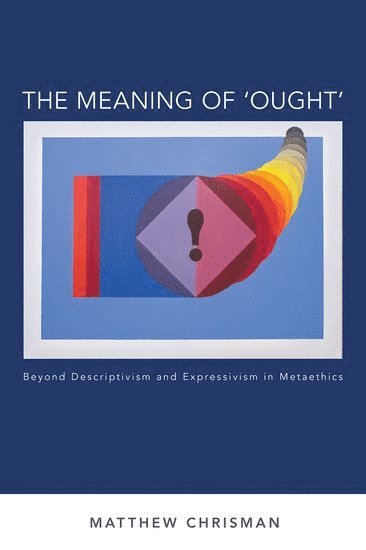
    The Meaning of 'Ought'

    Beyond Descriptivism and Expressivism in Metaethics

    AvMatthew Chrisman

    Inbunden, Engelska, 2015

    Del i serien Oxford Moral Theory

    1 648 kr

    Beställningsvara. Skickas inom 5-8 vardagar. Fri frakt över 249 kr.

    Beskrivning

    The word 'ought' is one of the core normative terms, but it is also a modal word. In this book Matthew Chrisman develops a careful account of the semantics of 'ought' as a modal operator, and uses this to motivate a novel inferentialist account of why ought-sentences have the meaning that they have. This is a metanormative account that agrees with traditional descriptivist theories in metaethics that specifying the truth-conditions of normative sentences is a central part of the explanation of their meaning. But Chrisman argues that this leaves important metasemantic questions about what it is in virtue of which ought-sentences have the meanings that they have unanswered. His appeal to inferentialism aims to provide a viable anti-descriptivist but also anti-expressivist answer to these questions.

    Produktinformation

    • Utgivningsdatum:2015-11-05
    • Mått:155 x 236 x 22 mm
    • Vikt:499 g
    • Format:Inbunden
    • Språk:Engelska
    • Serie:Oxford Moral Theory
    • Antal sidor:280
    • Förlag:OUP USA
    • ISBN:9780199363001

    Utforska kategorier

    • Språkvetenskap och lingvistik inom Språk och ordböcker
    • Filosofiska discipliner inom Filosofi och religion

    Mer om författaren

    Matthew Chrisman is a Reader in Philosophy at the University of Edinburgh. He came to Edinburgh after earning his PhD and MA at the University of North Carolina at Chapel Hill and his BA at Rice University. His research is focused on ethical theory, the philosophy of language, and epistemology. He has published widely in these areas, including articles in the Journal of Philosophy, the Australasian Journal of Philosophy, Oxford Studies in Metaethics, Philosophy and Phenomenological Research, Philosophers' Imprint and Philosophical Studies.

    Recensioner i media

    Matthew Chrisman has developed an innovative, sophisticated, and plausible set of views about the meaning of 'ought.' This book is a major contribution in metaethics ... The book is deep and contains many extraordinarily valuable resources. It ought to receive wide attention from metaethicists and other philosophers interested in normativity.

    Innehållsförteckning

    • 1. Introduction ; 1.1. The Ubiquity of 'Ought' ; 1.2. Some Initial Theoretical Cartography ; 1.3. Metanormative Theorizing and the Philosophy of Language ; 1.4. Compositional Semantics, Some Basics ; 1.5. The Word 'Ought' ; 1.6. Plan ; 2. 'Ought's, Obligations, Reasons, and Values ; 2.1. Introduction ; 2.2. Formal Framework and Toy Analysis of 'Ought' ; 2.3. An Initial Ambiguity View ; 2.4. Analyzing 'Ought' in Terms of Reasons ; 2.5. Analyzing 'Ought' in Terms of Values ; 2.6. Conclusion ; 3. A Possible Worlds Semantics for 'Ought' ; 3.1. Introduction ; 3.2. From Modal Logic to Deontic Necessity and Possibility ; 3.3. From Deontic Necessity to a Simple Possible Worlds Semantics for 'Ought' ; 3.4. Some Reasons to Complicate the Analysis ; 3.5. Kratzer's Improvements ; 3.6. Application of Kratzer's Framework to 'Ought' ; 3.7. The Weakness of 'Ought' Compared to 'Must' ; 3.8. Conclusion ; 4. Problems with Possible Worlds ; 4.1. Introduction ; 4.2. The Challenge of Dilemmas ; 4.3. The Challenge of 'Ought-to-Do' ; 4.4. Conclusion ; 5. A New Semantic Rule for 'Ought' ; 5.1. Introduction ; 5.2. Is 'Ought' Polysemous between Agentive and Non-Agentive Readings? ; 5.3. Imperatival Content ; 5.4. A New Semantic Rule for 'Ought' ; 5.5. Conclusion ; 6. Metanormative Debate Renewed ; 6.1. Introduction ; 6.2. Truth Conditions as Ways Reality Could Be ; 6.3. Truth Conditions as What One Ought to Think ; 6.4. Truth Conditions as Positions in a Space of Implications ; 6.5. Conclusion ; 7. Conclusion ; 7.1. Introduction ; 7.2. Should the Metalanguage of Metanormative Theory be Nonnormative? ; 7.3. What about Other Normative and Evaluative Words and Concepts? ; 7.4. Moral Psychology ; 7.5. The Epistemology of Normativity ; 7.6. Conclusion ; Appendix of Proposed Rules ; Bibliography