• Fri frakt över 249 kr
  • •
  • Snabba leveranser
  • •
  • Billiga böcker
Kundservice

Du är på sajten för privatpersoner.

Företag, bibliotek eller offentlig verksamhet?

Du handlar på classic.bokus.com, där alla dina funktioner finns intakta.
Till classic.bokus.com
Bokus logotyp. Gå till startsidan.
  • Erbjudanden
  • Nyheter
  • Student
  • Topplistor
  • Barn & ungdom
  • Bokus Play
  • E-böcker
  • Pocketböcker
  • Spel & pussel

10% rabatt på allt med kod: NYSTART10 →

Sidfot

Mina sidor

    Hjälp

    • Kundservice
    • Vanliga frågor och svar
    • Frakt och leverans
    • Retur vid ångerrätt
    • Reklamera vara
    • Betalning
    • Köpvillkor
    • Allmänna villkor
    • Information om webbplatsens tillgänglighet

    Om Bokus

    • Om oss
    • Pressrum
    • För studenter
    • För företag
    • För bibliotek och offentlig verksamhet
    • För leverantörer
    • Hållbarhet

    Populärt

    • Aktuella erbjudanden
    • Presentkort
    • Studentlitteratur
    • Nya böcker
    • Topplistor
    • Signerade böcker
    • Engelska böcker

    Inspiration

    • Boktips
    • BookTok
    • Populära bokserier
    • Barnbokskaraktärer
    • Populära författare
    Logotyp för Bokus
    Följ oss på Facebook (extern länk)Följ oss på Instagram (extern länk)Följ oss på YouTube (extern länk)Följ oss på TikTok (extern länk)
    bokus @ CookiesAnpassa cookiesIntegritetspolicyKöpvillkor
    Till Citymail hemsida (extern länk)Till Budbee hemsida (extern länk)Till Postnord hemsida (extern länk)Till Schenker hemsida (extern länk)Till Early Bird hemsida (extern länk)Till Walleys hemsida (extern länk)
    1. Historia och arkeologi
    2. Historia
    3. Europas historia

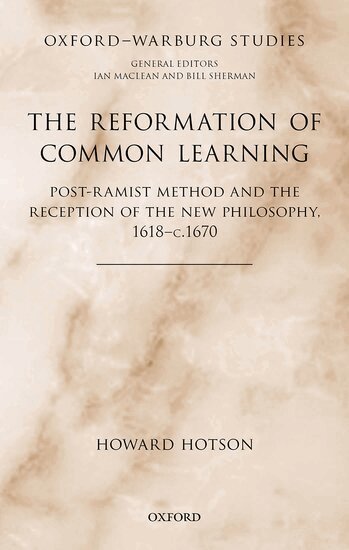
    The Reformation of Common Learning

    Post-Ramist Method and the Reception of the New Philosophy, 1618 - 1670

    AvHoward Hotson

    Inbunden, Engelska, 2020

    Del i serien Oxford-Warburg Studies

    2 454 kr

    Beställningsvara. Skickas inom 3-6 vardagar. Fri frakt över 249 kr.

    Beskrivning

    Ramism was the most innovative and disruptive educational reform movement to sweep through the international Protestant world in the latter sixteenth and early seventeenth centuries. During the 1620s, the Thirty Years' War destroyed the network of central European academies and universities which had generated most of this innovation. Students and teachers, fleeing the conflict in all directions, transplanted that tradition into many different geographical and cultural contexts in which it bore are wide variety of interrelated fruit. Within the Dutch Republic, post-Ramist method played a crucial role in the rapid assimilation of Cartesianism into a network of thriving young academies and universities. From England to east-central Europe, the tradition was no less important in accelerating the reception of Baconianism. In the easternmost outpost of the Reformed world in Transylvania, the displaced tradition generated a final flourishing of philosophical innovation which exercised a formative influence on the young Leibniz. The failure of all of these efforts to assemble the fruits of this tradition into an encyclopaedic synthesis marks a major watershed in Western intellectual history. The Reformation of Common Learning brings together all of these aspects of the tradition in a manner which roots them in deeper historical developments and relates a series of far-flung and poorly understood developments together in new ways.

    Produktinformation

    • Utgivningsdatum:2020-12-24
    • Mått:145 x 225 x 28 mm
    • Vikt:722 g
    • Format:Inbunden
    • Språk:Engelska
    • Serie:Oxford-Warburg Studies
    • Antal sidor:500
    • Förlag:OUP OXFORD
    • ISBN:9780199553389

    Utforska kategorier

    • Europas historia inom Historia och arkeologi
    • Filosofiska discipliner inom Filosofi och religion

    Mer om författaren

    Howard Hotson is Professor of Early Modern Intellectual History at the University of Oxford and a Fellow and Tutor at St Anne's College. This book illustrates the convergence of several of his main areas of interest, including the gradually expanding reform movements of the post-Reformation period, the intellectual geography of the Thirty Years' War, and prospects for rewriting aspects of intellectual history from the bottom up with the assistance of large pools of digitally assembled and analysed data.

    Recensioner i media

    The significance of Descartes's reliance on mechanical analogies seems to go unremarked.

    Innehållsförteckning

    • 1: Status quo ante bellum: Reformed Germany as Protestant Europe's Pedagogical Laboratory Part I: The Thirty Years War and the Dutch Golden Age: Post-Ramist method and early 'Cartesianism', 1620-1670 2: Preamble: Philosophy during Leiden's first golden age, 1575-1618 3: Transformation: Ramism, artisanal learning, and the mechanical philosophy, 1618-1639 4: Transplantation: a transfer of pedagogical leadership, 1618-1660 5: Reception and Dissemination: German Reformed roots of 'Dutch Cartesianism', 1640-1670 Part II: The Reformed diaspora and the Hartlib circle: Post-Ramist method and mid-century 'Baconianism', 1630-1670 6: Dissemination: The Reformed diaspora and the Hartlib circle 7: Form and Function: Post-Ramist Roots of Comenian Pansophia 8: Sources and Methods: Post-Ramist Pedagogy and Baconian Natural Philosophy Part III: Post-Ramist encyclopaedism in post-war Europe: Leibniz and the end of an era, 1630-1716 9: Reception: the fortuna of the Encyclopaedia 10: Emendation: the pursuit of a new encyclopaedia, 1630-1716 11: Failure and transformation: the encyclopaedia turned inside out 12: Summary, conclusions, and prospects