Inbunden, Engelska, 2011
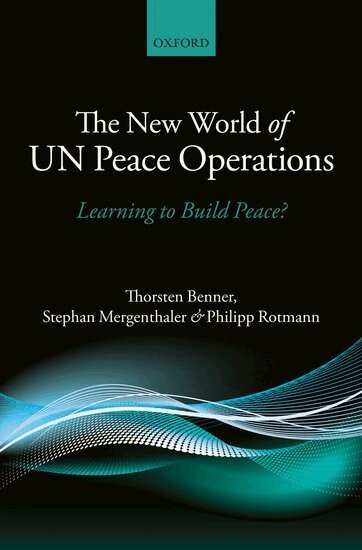
The New World of UN Peace Operations
Learning to Build Peace?
Av Thorsten Benner, Stephan Mergenthaler, Philipp Rotmann
2417 kr
Beställningsvara. Skickas inom 5-8 vardagar. Fri frakt över 249 kr.
Beskrivning
Produktinformation
- Utgivningsdatum: 2011-06-09
- Mått: 160 x 238 x 21 mm
- Vikt: 565 g
- Format: Inbunden
- Språk: Engelska
- Antal sidor: 262
- Förlag: OUP OXFORD
- ISBN: 9780199594887
Utforska kategorier
Mer om författaren
Thorsten Benner's areas of expertise include international organizations (focusing on the United Nations), global security governance, EU foreign policy and EU-US relations in an emerging multipolar world as well as global energy and the public-private interface in global governance. Prior to co-founding the Global Public Policy Institute in 2003 (of which he is Associate Director) he worked with the German Council on Foreign Relations (DGAP), Berlin; the UN Development Program (UNDP), New York; and the Global Public Policy Project, Washington D.C. His commentary has appeared in DIE ZEIT, the International Herald Tribune, the L.A. Times,Handelsblatt, the Süddeutsche Zeitung, Financial Times Deutschland and the Neue Zürcher Zeitung, among others. He teaches in the Executive Master of Public Management (EMPM) and Master of Public Policy (MPP) programs at the Hertie School of Governance.Philipp Rotmann's research interests include global security governance and conflict management, in particular the interface of military force, policing and the rule of law in peace operations and counterinsurgency. He is a Fellow with the Global Public Policy Institute, Berlin, and serves until May 2011 as a Senior Strategy Analyst with the Office of the Senior Civilian Representative at ISAF Regional Command North in Mazar-e-Sharif, Afghanistan. In 2009, Philipp was briefly assigned to the German Federal Foreign Office at its Special Task Force on Afghanistan and Pakistan. Before joining GPPi as a Research Associate in 2005, he worked for the Organization for Security and Cooperation in Europe (OSCE) in Bosnia-Herzegovina. His commentary has been featured on the BBC, in the Financial Times Deutschland and in the International Herald Tribune, among others. He holds an MPA from the Harvard Kennedy School of Government.Stephan Mergenthaler's research interests comprise global security governance, EU foreign policy and EU-China relations. He is a fellow with GPPi and a project manager with the World Economic Forum. Prior to joining GPPi in 2007 Stephan Mergenthaler worked with the International Institute for Strategies Studies, London. He also gained experience with the American Enterprise Institute in Washington DC, the South Asia Human Rights Documentation Center in New Delhi, the German and French Ministries for Foreign Affairs in Berlin and Paris, and the German Mission to the UN, New York. His commentary has appeared in the International Herald Tribune, DIE ZEIT online, Spiegel online and EU Observer, among others. He holds an M.A. and M.Sc. from Sciences Po Paris and the London School of Economics.
Recensioner i media
This book is a useful snapshot of the policy-making process in the largest and most complex of international organisations. Catherine Baker, London School of Economics A longstanding wisdom is that "UN" and "learning" should never be used in the same sentence. The New World of UN Peace Operations give us evidence for why some wisdoms have the mark of truth. It also gives us reason for hope. This sober, hard-headed, deeply researched exploration of the education of UN peace operations reveals: why the UN's culture makes learning so difficult; why the failure of states to support reforms and innovation is a big reason for that difficulty; and how the UN is, at times, able to overcome its own limitations and constraints imposed by states to improve its operations. This is the rare volume that contributes both to policy and scholarly debates. Practitioners should take seriously the volume's lessons learned. Scholars will appreciate the rigorous treatment of organizational learning. Michael Barnett, University Professor, George Washington University. After the cold war, the United Nations attempted to ratchet up UN peacekeeping into a military more robust instrument, often with deleterious consequences for all involved. This study traces how the UN learned from those failures: to use, not abuse, peacekeeping, turning it into a core component of more comprehensive peace operations in battered societies, in order to protect civilians and help build sustainable institutions. It is the best book on UN peace operations in a very long time. John G. Ruggie, , Berthold Beitz Professor in Human Rights and International Affairs, Harvard University This innovative work provides up-to-date and in-depth analysis for one of the most pressing questions of the UN community: how to better build peace? The authors deserve great credit for widening the scope well beyond classical peacekeeping-and to have produced a thorough study rich with empirical data that makes it valuable both for reading and reference. Peter Wittig, German Ambassador to the United Nations (and Chair of the UN Peacebuilding Commission 2010-2011) The fruit of many years of research this book is a truly impressive piece of scholarship, and the peacekeeping community should count itself lucky to have such constructively critical friends. Gordon Peake, International Peacekeeping
Betyg & recensioner
0 recensioner
Inga recensioner tillgängliga.