• Fri frakt över 249 kr
  • •
  • Snabba leveranser
  • •
  • Billiga böcker
Kundservice

Du är på sajten för privatpersoner.

Företag, bibliotek eller offentlig verksamhet?

Du handlar på classic.bokus.com, där alla dina funktioner finns intakta.
Till classic.bokus.com
Bokus logotyp. Gå till startsidan.
  • Erbjudanden
  • Nyheter
  • Student
  • Topplistor
  • Barn & ungdom
  • Bokus Play
  • E-böcker
  • Pocketböcker
  • Spel & pussel

10% rabatt på allt med kod: NYSTART10 →

Sidfot

Mina sidor

    Hjälp

    • Kundservice
    • Vanliga frågor och svar
    • Frakt och leverans
    • Retur vid ångerrätt
    • Reklamera vara
    • Betalning
    • Köpvillkor
    • Allmänna villkor
    • Information om webbplatsens tillgänglighet

    Om Bokus

    • Om oss
    • Pressrum
    • För studenter
    • För företag
    • För bibliotek och offentlig verksamhet
    • För leverantörer
    • Hållbarhet

    Populärt

    • Aktuella erbjudanden
    • Presentkort
    • Studentlitteratur
    • Nya böcker
    • Topplistor
    • Signerade böcker
    • Engelska böcker

    Inspiration

    • Boktips
    • BookTok
    • Populära bokserier
    • Barnbokskaraktärer
    • Populära författare
    Logotyp för Bokus
    Följ oss på Facebook (extern länk)Följ oss på Instagram (extern länk)Följ oss på YouTube (extern länk)Följ oss på TikTok (extern länk)
    bokus @ CookiesAnpassa cookiesIntegritetspolicyKöpvillkor
    Till Citymail hemsida (extern länk)Till Budbee hemsida (extern länk)Till Postnord hemsida (extern länk)Till Schenker hemsida (extern länk)Till Early Bird hemsida (extern länk)Till Walleys hemsida (extern länk)
    1. Juridik
    2. Internationell rätt
    3. Internationell rätt: transport och handel

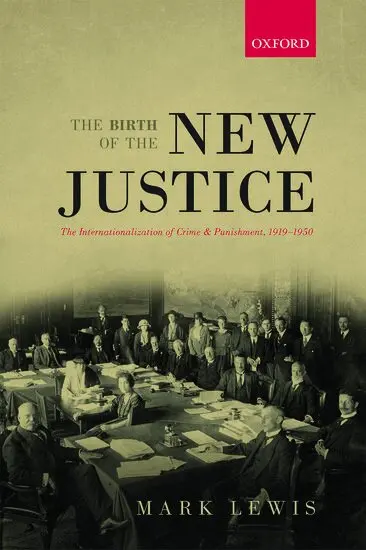
    The Birth of the New Justice

    The Internationalization of Crime and Punishment, 1919-1950

    AvMark Lewis

    Inbunden, Engelska, 2014

    Del i serien Oxford Studies in Modern European History

    2 586 kr

    Beställningsvara. Skickas inom 5-8 vardagar. Fri frakt över 249 kr.

    Fler format och utgåvor

    Häftad

    591 kr

    Beskrivning

    The Birth of the New Justice is a history of the attempts to instate ad hoc and permanent international criminal courts and new international criminal laws from the end of World War I to the beginning of the Cold War. The purpose of these courts was to repress aggressive war, war crimes, terrorism, and genocide.Rather than arguing that these legal projects were attempts by state governments to project a "liberal legalism" and create an international state system that limited sovereignty, Mark Lewis shows that European jurists in a variety of transnational organizations derived their motives from a range of ideological motives - liberal, conservative, utopian, humanitarian, nationalist, and particularist. European jurists at the Paris Peace Conference in 1919 created a controversial new philosophy of prosecution and punishment, and during the following decades, jurists in different organizations, including the International Law Association, International Association for Criminal Law, the World Jewish Congress, and the International Committee of the Red Cross, transformed the ideas of the legitimacy of post-war trials and the concept of international crime to deal with myriad social and political problems. The concept of an international criminal court was never static, and the idea that national tribunals would form an integral part of an international system to enforce new laws was frequently advanced as a pragmatic-and politically convenient-solution.The Birth of the New Justice shows that legal organizations were not merely interested in ensuring that the guilty were punished or that international peace was assured. They hoped to instil particular moral values, represent the interests of certain social groups, and even pursue national agendas. At the same time, their projects to define new types of crimes and ensure that old ones were truly punished also sprang from hopes that a new international political and moral order would check the power of the sovereign nation-state. When jurists had to scale back their projects, it was not only because state governments opposed them; it was also because they lacked political connections, did not build public support for their ideas, or decided that compromises were better than nothing.

    Produktinformation

    • Utgivningsdatum:2014-02-13
    • Mått:162 x 240 x 30 mm
    • Vikt:694 g
    • Format:Inbunden
    • Språk:Engelska
    • Serie:Oxford Studies in Modern European History
    • Antal sidor:360
    • Förlag:OUP OXFORD
    • ISBN:9780199660285
    • Utmärkelser:Winner of the 2015 Bronisław Geremek Prize; Winner of the Fraenkel Prize in Contemporary History 2013.

    Utforska kategorier

    • Internationell rätt: transport och handel inom Juridik
    • Folkrätt inom Juridik
    • Internationella relationer inom Samhälle och politik

    Mer om författaren

    Mark Lewis is the co-author of Himmler's Jewish Tailor: The Story of Holocaust Survivor Jacob Frank, the oral history of a Polish Jew who was the head of a clothing factory at the SS-run labor camp on Lipowa Street in Lublin, Poland. Lewis received a Ph.D. in European history from the University of California, Los Angeles, and is an assistant professor of European history at the College of Staten Island, City University of New York.

    Recensioner i media

    These chapters are small monographs, most of which are extremely well researched on the basis of archival sources and bring many new insights. Yet their sum does not create a history of international criminal law, but a detailed critical commentary on many of these histories of international criminal law. It is the great merit of this book that it carefully traces the discontinuities, the fissures and inner contradictions, and not least of all the political contingencies, which characterize the development of international criminal law. And nevertheless, as Lewis makes clear, the particular fragments remain in memory, surfacing again as reference points and not disappearing from history. In this sense, it is an immensely stimulating work worth reading.

    Innehållsförteckning

    • Introduction ; 1. Nineteenth Century Precursors of an International Criminal Legal System ; 2. The Birth of the New Justice at the Paris Peace Conference ; 3. Crimes against Humanity and Crimes of Denationalization: The Victory of Political Expediency over Justice ; 4. Blueprints for International Criminal Courts in the 1920s ; 5. International Terrorism in the 1920s and 1930s: The Response of European States through the League of Nations and the Attempt to Create an International Criminal Court ; 6. The Search for a Victim-Centered New Justice, 1942-1946: The World Jewish Congress and Institute of Jewish Affairs ; 7. The Genocide Convention: The Gutting of Preventative Measures, 1946-1948 ; 8. Revising the Geneva Conventions, 1946-1949: Synthesizing the Old and New Justice ; Epilogue: Bleak Prospects in the 1950s and the Contemporary Period