• Fri frakt över 249 kr
  • •
  • Snabba leveranser
  • •
  • Billiga böcker
Kundservice

Du är på sajten för privatpersoner.

Företag, bibliotek eller offentlig verksamhet?

Du handlar på classic.bokus.com, där alla dina funktioner finns intakta.
Till classic.bokus.com
Bokus logotyp. Gå till startsidan.
  • Erbjudanden
  • Nyheter
  • Student
  • Topplistor
  • Barn & ungdom
  • Bokus Play
  • E-böcker
  • Pocketböcker
  • Spel & pussel

10% studentrabatt med kod TERM26

Sidfot

Mina sidor

    Hjälp

    • Kundservice
    • Vanliga frågor och svar
    • Frakt och leverans
    • Retur vid ångerrätt
    • Reklamera vara
    • Betalning
    • Köpvillkor
    • Allmänna villkor
    • Information om webbplatsens tillgänglighet

    Om Bokus

    • Om oss
    • Pressrum
    • För studenter
    • För företag
    • För bibliotek och offentlig verksamhet
    • För leverantörer
    • Hållbarhet

    Populärt

    • Aktuella erbjudanden
    • Presentkort
    • Studentlitteratur
    • Nya böcker
    • Topplistor
    • Signerade böcker
    • Engelska böcker

    Inspiration

    • Boktips
    • BookTok
    • Populära bokserier
    • Barnbokskaraktärer
    • Populära författare
    Logotyp för Bokus
    Följ oss på Facebook (extern länk)Följ oss på Instagram (extern länk)Följ oss på YouTube (extern länk)Följ oss på TikTok (extern länk)
    bokus @ CookiesAnpassa cookiesIntegritetspolicyKöpvillkor
    Till Citymail hemsida (extern länk)Till Budbee hemsida (extern länk)Till Postnord hemsida (extern länk)Till Schenker hemsida (extern länk)Till Early Bird hemsida (extern länk)Till Walleys hemsida (extern länk)
    1. Samhälle och politik
    2. Politik och statsskick
    3. Politiska partier

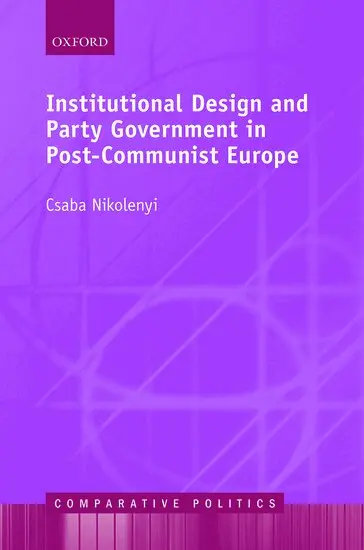
    Institutional Design and Party Government in Post-Communist Europe

    AvCsaba Nikolenyi

    Inbunden, Engelska, 2014

    Del i serien Comparative Politics

    1 834 kr

    Beställningsvara. Skickas inom 5-8 vardagar. Fri frakt över 249 kr.

    Fler format och utgåvor

    E-bok

    1 107 kr

    Beskrivning

    This books examines the institutional foundations of coalition government in the ten post-communist democracies of Eastern and Central Europe for the 1990-2010 period: Bulgaria, the Czech Republic, Estonia, Hungary, Latvia, Lithuania, Poland, Romania, Slovakia, and Slovenia. Its central argument is that differences in the arrangement of political institutions systematically explain variations in patterns of multi-party government across these states. The book starts with the premise that electoral systems and constitutional provisions about the powers, the structure, and the relationship between parliament and the presidency determine the degree to which political power is dispersed or concentrated in the political system. On the basis of these institutional features, three groups of states are distinguished with regard to their degree of power concentration; the substantive chapters of the book demonstrate how these institutional combinations and differences shape three specific facets of party government which capture the main stages of the lifecycle of coalitions governments: the formation of electoral coalitions, government formation and government duration. Specifically, three comparative chapters assess the impact of institutional power concentration on the size of electoral coalitions; the likelihood that political parties form a minority government; and the number of days that a government lasts in office. The main finding of the book is that power concentration matters: political parties in those democracies where institutions are designed to concentrate political power tend to form large electoral coalitions, they tend to form majority rather than undersized governments, and they build more durable cabinets. In addition, the book contains a detailed case study of government formation in Hungary and a previously unstudied comparison of indirect presidential elections in four states: the Czech Republic, Estonia, Hungary and Latvia. Comparative Politics is a series for students, teachers, and researchers of political science that deals with contemporary government and politics. Global in scope, books in the series are characterised by a stress on comparative analysis and strong methodological rigour. The series is published in association with the European Consortium for Political Research. For more information visit: www.ecprnet.eu.

    Produktinformation

    • Utgivningsdatum:2014-10-30
    • Mått:163 x 236 x 20 mm
    • Vikt:510 g
    • Format:Inbunden
    • Språk:Engelska
    • Serie:Comparative Politics
    • Antal sidor:230
    • Förlag:OUP OXFORD
    • ISBN:9780199675302

    Utforska kategorier

    • Politiska partier inom Samhälle och politik
    • Statsvetenskap och politisk teori inom Samhälle och politik

    Mer om författaren

    Csaba Nikolenyi received his PhD from The University of British Columbia in 2000 and joined the Department of Political Science at Concordia University the same year. His research focuses on comparative electoral and party politics. In 2010, he published a singe-authored book on Minority Governments in India; he has also published extensively in leading national and international comparative politics journals such as Party Politics, West European Politics, Political Studies, Journal of Communist and Post-Communist Studies, Canadian Journal of Political Science, the Japanese Journal of Political Science, and Europe-Asia Studies. He has received a number of research grants from the Social Sciences and Humanities Research Council of Canada. From 2006 to 2011 he served as English Co-Editor of the Canadian Journal of Political Science, the flagship publication of the profession in Canada.

    Recensioner i media

    ... the book provides a worthwhile contribution to the study of party politics in Central and Eastern Europe as well as to the literature on coalition government and the effects of political institutions more generally

    Innehållsförteckning

    • 1. Introduction ; 2. Post-Communist Institutional Design: Electoral Systems, Parliaments and Presidents ; 3. Political Institutions and Electoral Coalitions ; 4. The Electoral Origins of Hungarian Governments, 1990-2002 ; 5. The Institutional Sources of Minority Governments ; 6. The Institutional Sources of Cabinet Duration ; 7. Dividing the Executive? Party Coalitions and Indirect Presidential Elections ; 8. Conclusion ; Appendix A: The Development of Post-Communist Electoral Systems ; Appendix B: Government Formation Rules in Post-Communist Democracies ; Appendix C: Electoral Coalitions in Post-Communist Democracies ; Appendix D: Government Coalitions in Post-Communist Democracies ; Bibliography