• Fri frakt över 249 kr
  • •
  • Snabba leveranser
  • •
  • Billiga böcker
Kundservice

Du är på sajten för privatpersoner.

Företag, bibliotek eller offentlig verksamhet?

Du handlar på classic.bokus.com, där alla dina funktioner finns intakta.
Till classic.bokus.com
Bokus logotyp. Gå till startsidan.
  • Erbjudanden
  • Nyheter
  • Student
  • Topplistor
  • Barn & ungdom
  • Bokus Play
  • E-böcker
  • Pocketböcker
  • Spel & pussel

10% rabatt på allt med kod: NYSTART10 →

Sidfot

Mina sidor

    Hjälp

    • Kundservice
    • Vanliga frågor och svar
    • Frakt och leverans
    • Retur vid ångerrätt
    • Reklamera vara
    • Betalning
    • Köpvillkor
    • Allmänna villkor
    • Information om webbplatsens tillgänglighet

    Om Bokus

    • Om oss
    • Pressrum
    • För studenter
    • För företag
    • För bibliotek och offentlig verksamhet
    • För leverantörer
    • Hållbarhet

    Populärt

    • Aktuella erbjudanden
    • Presentkort
    • Studentlitteratur
    • Nya böcker
    • Topplistor
    • Signerade böcker
    • Engelska böcker

    Inspiration

    • Boktips
    • BookTok
    • Populära bokserier
    • Barnbokskaraktärer
    • Populära författare
    Logotyp för Bokus
    Följ oss på Facebook (extern länk)Följ oss på Instagram (extern länk)Följ oss på YouTube (extern länk)Följ oss på TikTok (extern länk)
    bokus @ CookiesAnpassa cookiesIntegritetspolicyKöpvillkor
    Till Citymail hemsida (extern länk)Till Budbee hemsida (extern länk)Till Postnord hemsida (extern länk)Till Schenker hemsida (extern länk)Till Early Bird hemsida (extern länk)Till Walleys hemsida (extern länk)
    1. Ekonomi och Ledarskap
    2. Nationalekonomi
    3. Internationell ekonomi

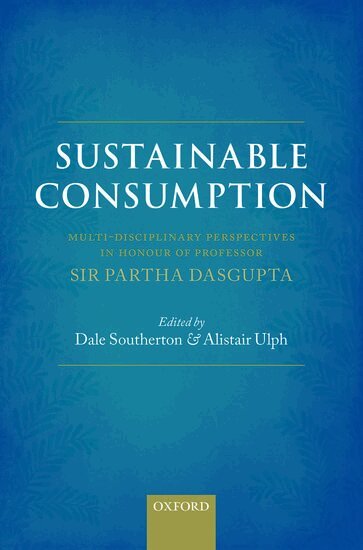
    Sustainable Consumption

    Multi-disciplinary Perspectives In Honour of Professor Sir Partha Dasgupta

    AvAlistair Ulph,Dale Southerton

    Inbunden, Engelska, 2014

    1 698 kr

    Beställningsvara. Skickas inom 7-10 vardagar. Fri frakt över 249 kr.

    Beskrivning

    If global society is to address the many environmental and other sustainability challenges that confront us in the twenty-first century, such as climate change and water resources, it will be necessary to make significant changes in our patterns of consumption, production, and distribution. There is a growing realization that while changes in production and distribution are formidable, the proposed solutions may not succeed unless it is possible to persuade individuals and households to change their patterns of consumption to make them more sustainable. However there are significant differences in how key disciplines such as psychology, neuroscience, economics, politics, sociology, anthropology, and history conceptualise consumption, empirically test their theoretical predictions, and use these to inform policy-makers across the private, public and third sectors on how to make consumption more sustainable. This book contains chapters from world-leading experts in these different disciplines that seek to explain the perspectives on sustainable consumption of their disciplines, suggest how these might be further enriched by taking on board some of the findings from other disciplines, and consider what this implies for new policies to address the key sustainability challenges outlined above. The book is dedicated to Professor Sir Partha Dasgupta, one of the world's leading economists who has worked across a range of topics, including environmental and resource economics and development economics, and throughout his career has sought to incorporate into his economic thinking ideas from a range of other disciplines.

    Produktinformation

    • Utgivningsdatum:2014-08-14
    • Mått:168 x 235 x 29 mm
    • Vikt:702 g
    • Format:Inbunden
    • Språk:Engelska
    • Antal sidor:366
    • Förlag:OUP OXFORD
    • ISBN:9780199679355

    Utforska kategorier

    • Internationell ekonomi inom Ekonomi och Ledarskap
    • Miljöekonomi inom Ekonomi och Ledarskap

    Mer om författaren

    Alistair Ulph is Professorial Research Fellow of the Sustainable Consumption Institute and formerly Director of the Sustainable Consumption Institute, The University of Manchester, where he was also Vice-President and Dean of Humanities (2004-2010). His research interests are mainly in the field of environmental and resource economics, recently focussing on international aspects of environmental and trade policies, though he has also published in labour economics, industrial economics, and public economics. Over his career he has published eight books, including Trade and the Environment, Selected Essays of Alistair Ulph (Edward Elgar, 1999) and over 100 refereed papers. In 2000 he was elected Fellow of the Royal Society of Arts and President of European Association of Environmental and Resource Economists.Dale Southerton is Professor of Sociology and Director of the Sustainable Consumption Institute at The University of Manchester, and Director of the Sustainable Practices Research Group (funded by the ESRC, Defra, and the Scottish Government). His principal areas of research interest are consumption, sustainability, theories of practice and social change, innovation and material culture, time-use, and everyday life. He has published extensively in these fields, is the author of Communities of Consumption: Place, Geographical Mobility and Identification (VDM Verlag, 2009), editor of the Encyclopedia of Consumer Culture (Sage, 2011) and co-editor (with Alan Warde) of The Habits of Consumption (Helsinki: Open Access Book Series of the Helsinki Collegium of Advanced Studies, 2012) and (with H. Chappells and B. Van Vliet) Sustainable consumption: the implications of changing infrastructures of provision (London: Edward Elgar, 2004).

    Innehållsförteckning

    • 1. Introduction ; PART ONE: EXTENSIONS OF THE SIMPLE ECONOMISTS' MODEL OF CONSUMPTION ; 2. Sustainability and the Determinants of Personal Consumption ; 3. The Value to the Environmental Movement of the New Literature on the Economics of Happiness ; 4. Consumption, Stability, and Sustainability in Socio-Economic Systems ; 5. How Should Benefits and Costs Be Discounted in an Intergenerational Context ; PART TWO: CHALLENGING THE ASSUMPTION THAT INDIVIDUAL CONSUMERS ALWAYS ACT RATIONALLY ; 6. The Hungry Brain ; 7. Consuming at the Wrong Rate: Lessons from the Harvard Game ; 8. The Psychology of Sustainable Consumption ; 9. Behavioural Economics in Water Management: An Overview of Behavioural Economics Applications to Residential Water Demand ; 10. The Politics of Nudge: Dilemmas in Implementing Policies for Sustainable Consumption ; PART THREE: LOOKING BEYOND THE INDIVIDUAL CONSUMER: SOCIO-CULTURAL EXPLANATIONS OF CONSUMPTION ; 11. Past and Present: Historical Perspectives on Inequality and Collective Provision in Modern Consumption ; 12. Sociology, Consumption, and Habit ; 13. The Body in Consumption: Perspectives from India ; 14. Consumer Cultures: Past, Present, and Future