• Fri frakt över 249 kr
  • •
  • Snabba leveranser
  • •
  • Billiga böcker
Kundservice

Du är på sajten för privatpersoner.

Företag, bibliotek eller offentlig verksamhet?

Du handlar på classic.bokus.com, där alla dina funktioner finns intakta.
Till classic.bokus.com
Bokus logotyp. Gå till startsidan.
  • Erbjudanden
  • Nyheter
  • Student
  • Topplistor
  • Barn & ungdom
  • Bokus Play
  • E-böcker
  • Pocketböcker
  • Spel & pussel

10% studentrabatt med kod TERM26

Sidfot

Mina sidor

    Hjälp

    • Kundservice
    • Vanliga frågor och svar
    • Frakt och leverans
    • Retur vid ångerrätt
    • Reklamera vara
    • Betalning
    • Köpvillkor
    • Allmänna villkor
    • Information om webbplatsens tillgänglighet

    Om Bokus

    • Om oss
    • Pressrum
    • För studenter
    • För företag
    • För bibliotek och offentlig verksamhet
    • För leverantörer
    • Hållbarhet

    Populärt

    • Aktuella erbjudanden
    • Presentkort
    • Studentlitteratur
    • Nya böcker
    • Topplistor
    • Signerade böcker
    • Engelska böcker

    Inspiration

    • Boktips
    • BookTok
    • Populära bokserier
    • Barnbokskaraktärer
    • Populära författare
    Logotyp för Bokus
    Följ oss på Facebook (extern länk)Följ oss på Instagram (extern länk)Följ oss på YouTube (extern länk)Följ oss på TikTok (extern länk)
    bokus @ CookiesAnpassa cookiesIntegritetspolicyKöpvillkor
    Till Citymail hemsida (extern länk)Till Budbee hemsida (extern länk)Till Postnord hemsida (extern länk)Till Schenker hemsida (extern länk)Till Early Bird hemsida (extern länk)Till Walleys hemsida (extern länk)
    1. Ekonomi och Ledarskap
    2. Nationalekonomi
    3. Mikroekonomi

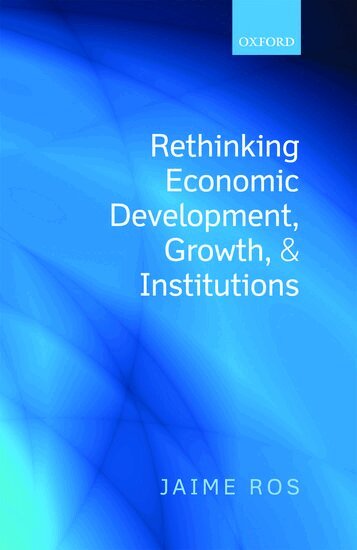
    Rethinking Economic Development, Growth, and Institutions

    AvJaime Ros

    Inbunden, Engelska, 2013

    1 824 kr

    Beställningsvara. Skickas inom 7-10 vardagar. Fri frakt över 249 kr.

    Fler format och utgåvor

    E-bok

    650 kr

    Häftad

    860 kr

    Beskrivning

    Why are some countries richer than others? Why do some economies grow so much faster than others do? Do economies tend to converge to similar levels of per capita income? Or is catching up simply impossible? If modern technology has shown the potential to raise living standards to first-world levels, why is it that the vast majority of the world's population lives in poverty in underdeveloped countries? These questions have been at the heart of development economics since its inception several decades ago and are now at the center of the research agenda of the modern economics of growth. This book reviews the answers to these questions in the contemporary fields of growth theory and comparative development. It is a sequel to Development Theory and the Economics of Growth published in 2000 with the aim to vindicate the theoretical insights and accumulated empirical knowledge of classical development economics and to integrate them into the mainstream of modern growth economics. The growth and development fields have expanded in the last twelve years in welcome directions that aim to deepen our understanding of the fundamental determinants of comparative development. This new book evaluates these new directions, including developments in endogenous growth theory and economic geography as well as the rise and challenge of the new institutional economics, in the light of the earlier, classical contributions to development theory.

    Produktinformation

    • Utgivningsdatum:2013-10-03
    • Mått:162 x 237 x 35 mm
    • Vikt:860 g
    • Format:Inbunden
    • Språk:Engelska
    • Antal sidor:470
    • Förlag:OUP OXFORD
    • ISBN:9780199684809

    Utforska kategorier

    • Mikroekonomi inom Ekonomi och Ledarskap
    • Internationell ekonomi inom Ekonomi och Ledarskap

    Innehållsförteckning

    • Introduction ; 1. Some Stylized Facts of Economic Development ; PART I. NEOCLASSICAL AND ENDOGENOUS GROWTH MODELS ; 2. Basic Neoclassical and Endogenous Growth Models ; 3. Endogenous Savings and International Capital Mobility in the Neoclassical Model ; 4. Human Capital in Neoclassical and Endogenous Growth Models ; 5. Industrial Differentiation and Creative Destruction in New Growth Theory ; PART II. CLASSICAL DEVELOPMENT THEORY ; 6. The Lewis Model and the Labor Surplus Economy ; 7. Increasing Returns, External Economies, and Multiple Equilibria ; 8. Internal Economies, Imperfect Competition, and Pecuniary Externalities ; 9. Openness and the Big Push: Criticisms and Extensions of Classical Development Theory ; PART III. AGGREGATE DEMAND AND GROWTH ; 10. Effective Demand and Factor Accumulation ; 11. Demand-Driven Technical Change, the Real Exchange Rate, and Growth ; 12. Kalecki's Dual Economy Model and Structuralist Growth Models ; 13. Debt Traps and Growth Collapses ; PART IV. DEEP DETERMINANTS OF COMPARATIVE DEVELOPMENT ; 14. Trade and Development ; 15. Developmental Effects of Natural Resource Abundance ; 16. Inequality and Middle Income Traps ; 17. Institutions and Development ; 18. Geography, Colonialism, and Underdevelopment ; 19. Successes and Failures in Economic Development: The Keys to the Kingdom