• Fri frakt över 249 kr
  • •
  • Snabba leveranser
  • •
  • Billiga böcker
Kundservice

Du är på sajten för privatpersoner.

Företag, bibliotek eller offentlig verksamhet?

Du handlar på classic.bokus.com, där alla dina funktioner finns intakta.
Till classic.bokus.com
Bokus logotyp. Gå till startsidan.
  • Erbjudanden
  • Nyheter
  • Student
  • Topplistor
  • Barn & ungdom
  • Bokus Play
  • E-böcker
  • Pocketböcker
  • Spel & pussel

10% rabatt på allt med kod NYSTART10 →

Sidfot

Mina sidor

    Hjälp

    • Kundservice
    • Vanliga frågor och svar
    • Frakt och leverans
    • Retur vid ångerrätt
    • Reklamera vara
    • Betalning
    • Köpvillkor
    • Allmänna villkor
    • Information om webbplatsens tillgänglighet

    Om Bokus

    • Om oss
    • Pressrum
    • För studenter
    • För företag
    • För bibliotek och offentlig verksamhet
    • För leverantörer
    • Hållbarhet

    Populärt

    • Aktuella erbjudanden
    • Presentkort
    • Studentlitteratur
    • Nya böcker
    • Topplistor
    • Signerade böcker
    • Engelska böcker

    Inspiration

    • Boktips
    • BookTok
    • Populära bokserier
    • Barnbokskaraktärer
    • Populära författare
    Logotyp för Bokus
    Följ oss på Facebook (extern länk)Följ oss på Instagram (extern länk)Följ oss på YouTube (extern länk)Följ oss på TikTok (extern länk)
    bokus @ CookiesAnpassa cookiesIntegritetspolicyKöpvillkor
    Till Citymail hemsida (extern länk)Till Budbee hemsida (extern länk)Till Postnord hemsida (extern länk)Till Schenker hemsida (extern länk)Till Early Bird hemsida (extern länk)Till Walleys hemsida (extern länk)
    1. Ekonomi och Ledarskap
    2. Nationalekonomi

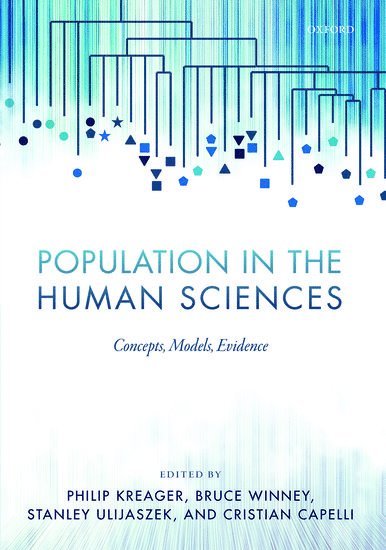
    Population in the Human Sciences

    Concepts, Models, Evidence

    AvPhilip Kreager,Philip Kreager

    Inbunden, Engelska, 2015

    1 491 kr

    Beställningsvara. Skickas inom 7-10 vardagar. Fri frakt över 249 kr.

    Beskrivning

    The Human Sciences address problems in nature and society that often require coordinated approaches of several scientific disciplines and scholarly research, embracing the social and biological sciences, and history. When we wish, for example, to understand how some sub-populations and not others come to be vulnerable, why a disease spreads in one part of a population and not another, or which gene variants are transmitted across generations, then a remarkable range of disciplinary perspectives need to be brought together, from the study of institutional structures, cultural boundaries, and social networks down to the micro-biology of cellular pathways, and gene expression. The need to explain and address differential impacts of pressing contemporary issues like AIDS, ageing, social and economic inequalities, and environmental change, are well-known cases in point. Population concepts, models, and evidence lie at the core of approaches to all of these problems, if only because accurate differentiation and identification of groups, their structures, constituents, and relations between sub-populations, are necessary to specify their nature and extent. The study of population thus draws both on statistical methodologies of demography and population genetics and sustained observation of the ways in which populations and sub-populations are formed, maintained, or broken up in nature, in the laboratory, and in society. In an era in which research needs to operate on multiple levels, population thinking thus provides a common ground for communication and critical thought across disciplines.Population in the Human Sciences addresses the need for review and assessment of the framework of interdisciplinary population studies. Limitations to prevailing postwar paradigms like the Evolutionary Synthesis and Demographic Transition were becoming evident by the 1970s. Subsequent decades have witnessed an immense expansion of population modelling and related empirical inquiry, with new genetic developments that have reshaped evolutionary, population, and developmental biology. The rise of anthropological and historical demography, and social network analysis, are playing major roles in rethinking modern and earlier population history. More recently, the emergence of sub-disciplines like biodemography and evolutionary anthropology, and growing links between evolutionary and developmental biology, indicate a growing convergence of biological and social approaches to population.

    Produktinformation

    • Utgivningsdatum:2015-03-05
    • Mått:182 x 253 x 40 mm
    • Vikt:1 254 g
    • Format:Inbunden
    • Språk:Engelska
    • Antal sidor:628
    • Förlag:OUP OXFORD
    • ISBN:9780199688203

    Utforska kategorier

    • Nationalekonomi inom Ekonomi och Ledarskap
    • Sociologi inom Samhälle och politik
    • Geografi inom Naturvetenskap och teknik

    Mer om författaren

    Philip Kreager is an anthropological demographer and historian of population thought and analysis. He is Senior Research Fellow in Human Sciences, Somerville College; Director, Fertility and Reproductive Studies Group, School of Anthropology; Lecturer and Tutor in Population, Institute of Human Sciences; and Senior Research Fellow, Institute of Population Ageing, Oxford University. He currently co-directs an exploratory anthropological and demographic study of problems of malaria treatment in the eastern archipelago of Indonesia. During 1999-2007 he directed Ageing in Indonesia, a multi-site longitudinal study of ageing in three Indonesian Communities, supported by the Welcome Trust. This work has led to continuing collaboration with the University of Indonesia, where he is Honorary Professor. Dr Kreager has a primary interest in the history of population thought, particularly as a common ground of theory and analysis linking the biological and social sciences.

    Recensioner i media

    Ultimately, philosophically inclined readers and historians of science may get the most out of this book, as it offers a panoramic view of the of human sciences.

    Innehållsförteckning

    • PART I. POPULATION IN THE HUMAN SCIENCES: AN INTRODUCTION ; PART II. WHAT IS A POPULATION? ; PART III. RETHINKING INTRA- AND INTER-POPULATION DYNAMICS ; PART IV. MECHANISMS OF LOCAL LEVEL VARIATION AND CHANGE OF STATE ; PART V. CONSTRUCTING POPULATIONS IN THE LONG TERM ; PART VI. IDENTIFYING SUB-POPULATIONS FOR DISEASE TREATMENT AND CONTROL