• Fri frakt över 249 kr
  • •
  • Snabba leveranser
  • •
  • Billiga böcker
Kundservice

Du är på sajten för privatpersoner.

Företag, bibliotek eller offentlig verksamhet?

Du handlar på classic.bokus.com, där alla dina funktioner finns intakta.
Till classic.bokus.com
Bokus logotyp. Gå till startsidan.
  • Erbjudanden
  • Nyheter
  • Student
  • Topplistor
  • Barn & ungdom
  • Bokus Play
  • E-böcker
  • Pocketböcker
  • Spel & pussel

Må bättre, för mindre! Upp till 50% rabatt på hälsoböcker

Sidfot

Mina sidor

    Hjälp

    • Kundservice
    • Vanliga frågor och svar
    • Frakt och leverans
    • Retur vid ångerrätt
    • Reklamera vara
    • Betalning
    • Köpvillkor
    • Allmänna villkor
    • Information om webbplatsens tillgänglighet

    Om Bokus

    • Om oss
    • Pressrum
    • För studenter
    • För företag
    • För bibliotek och offentlig verksamhet
    • För leverantörer
    • Hållbarhet

    Populärt

    • Aktuella erbjudanden
    • Presentkort
    • Studentlitteratur
    • Nya böcker
    • Topplistor
    • Signerade böcker
    • Engelska böcker

    Inspiration

    • Boktips
    • BookTok
    • Populära bokserier
    • Barnbokskaraktärer
    • Populära författare
    Logotyp för Bokus
    Följ oss på Facebook (extern länk)Följ oss på Instagram (extern länk)Följ oss på YouTube (extern länk)Följ oss på TikTok (extern länk)
    bokus @ CookiesAnpassa cookiesIntegritetspolicyKöpvillkor
    Till Citymail hemsida (extern länk)Till Budbee hemsida (extern länk)Till Postnord hemsida (extern länk)Till Schenker hemsida (extern länk)Till Early Bird hemsida (extern länk)Till Walleys hemsida (extern länk)
    1. Juridik
    2. Särskilda rättsområden
    3. Rättsordning

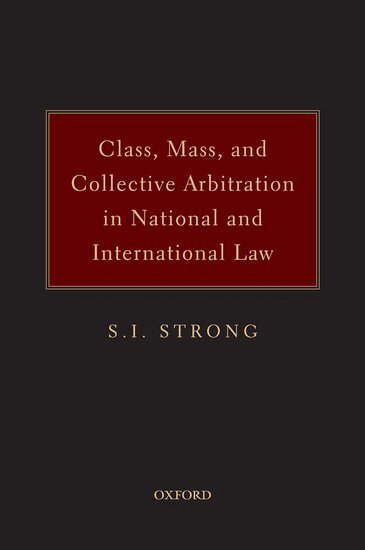
    Class, Mass, and Collective Arbitration in National and International Law

    AvS.I. Strong

    Inbunden, Engelska, 2013

    4 025 kr

    Beställningsvara. Skickas inom 5-8 vardagar. Fri frakt över 249 kr.

    Fler format och utgåvor

    E-bok

    1 722 kr

    Beskrivning

    Class arbitration first developed in the United States in the 1980s as a means of providing large numbers of individuals with the opportunity to assert their claims at the same time and in the same proceeding. Large-scale arbitration has since spread beyond U.S. borders, with collective arbitration being seen in Europe and mass arbitration being used in the international investment regime. Class, Mass and Collective Arbitration in National and International Law considers all three forms of arbitration as a matter of domestic and international law, providing arbitrators, advocates and scholars with the tools they need to evaluate these sorts of procedural mechanisms. The book covers the best-known decisions in the field - Stolt-Nielsen S.A. v. Animal Feeds International Corp. and AT&T Mobility LLC v. Concepcion from the U.S. Supreme Court and Abaclat v. Argentine Republic from the world of investment arbitration - as well as specialized rules promulgated by the American Arbitration Association, JAMS and the German Institution of Arbitration (DIS). The text introduces dozens of previously undiscussed judicial opinions and covers issues ranging from contractual (or treaty) silence and waiver to regulatory concerns and matters of enforcement. The book discusses the entire timeline of class, mass and collective arbitration, ranging from the devices' historical origins through the present and into the future. Lawyers in a wide variety of jurisdictions will benefit from the material contained in this text, which is the first full-length monograph to address large-scale arbitration as a matter of national and international law.

    Produktinformation

    • Utgivningsdatum:2013-11-07
    • Mått:236 x 163 x 25 mm
    • Vikt:734 g
    • Format:Inbunden
    • Språk:Engelska
    • Antal sidor:432
    • Förlag:OUP USA
    • ISBN:9780199772520

    Utforska kategorier

    • Rättsordning inom Juridik
    • Internationell rätt: transport och handel inom Juridik

    Mer om författaren

    S.I. Strong is Associate Professor of Law at the University of Missouri School of Law. She is a leading authority on class, mass and collective arbitration, having published over twenty-five articles on large-scale and multiparty procedures in Europe and the Americas in addition to numerous other books and articles on international dispute resolution and comparative law.Professor Strong has extensive experience as a dual-qualified practitioner (U.S.-England), having acted as Counsel at Baker & McKenzie after working in the New York and London offices of Weil, Gotshal & Manges. Professor Strong has taught at Georgetown Law Center in Washington, D.C. as well as the University of Cambridge and the University of Oxford in the United Kingdom. Professor Strong has provided expert assistance to state agencies in various jurisdictions and is the author of International Commercial Arbitration: A Guide for U.S. Judges (2012).

    Recensioner i media

    Strong accomplishes her aim in a thoughtful, lucid, and commendably concise way ... There is no doubt that her taxonomy of the forms of large-scale arbitrations (representative and aggregative arbitration) will continue to inform the debate on the appropriate characterization of multiparty investment arbitration. Abaclat has already relied upon her classification to understand whether mass claims are representative or aggregative in nature; future potential mass claims such as Adamakopolous v Cyprus (initiated by 676 claimants) will continue to gain from her insight.

    Innehållsförteckning

    • Chapter 1 Introduction ; I. Introduction ; II. A Brief History of Large-Scale Arbitration ; III. Uses of Class, Mass and Collective Arbitration ; Chapter 2 Rules and Procedures ; I. Introduction ; II. Initiation of Class, Mass or Collective Arbitrations ; III. Procedures ; Chapter 3 Is Large-Scale Arbitration Really Arbitration? ; I. Introduction ; II. The Question Arises - Stolt-Nielsen S.A. v. AnimalFeeds International Corp. ; III. Distinguishing Class, Mass and Collective Arbitration From Other Multiparty Proceedings ; IV. Class, Mass and Collective Proceedings and the Nature of Arbitration ; V. Do Class, Mass or Collective Arbitration Change The Nature Of Arbitration? ; VI. Forward-Looking Concerns ; Chapter 4 Interpreting the Arbitration Agreement ; I. Introduction ; II. Interpretation of Arbitration Agreements in Cases Involving Class, Mass and Collective Claims ; III. Interpreting Agreements That Are Silent or Ambiguous Regarding Class, Mass or Collective Treatment ; IV. Waivers of Class, Mass or Collective Treatment ; Chapter 5 Regulatory Elements of Class, Mass and Collective Arbitration ; I. Introduction ; II. Large-Scale Litigation as a Form of Regulation ; III. Regulatory Arbitration ; IV. Regulatory Arbitration in Context ; Chapter 6 The Future of Class, Mass and Collective Arbitration ; I. Introduction ; II. Relative Benefits of Class, Mass and Collective Proceedings ; III. New Forms of Class, Mass and Collective Arbitration ; IV. Creating an Enforceable Arbitration Agreement for Class, Mass or Collective Disputes ; Chapter 7 Enforcement of Class, Mass and Collective Awards ; I. Introduction ; II. Issues Regarding International Enforcement of Large-Scale Arbitral Awards ; III. Issues Regarding National Enforcement of Large-Scale Arbitral Awards ; IV. Conclusion ; Appendix ; Spanish Statute on Collective Consumer Arbitration