• Fri frakt över 249 kr
  • •
  • Snabba leveranser
  • •
  • Billiga böcker
Kundservice

Du är på sajten för privatpersoner.

Företag, bibliotek eller offentlig verksamhet?

Du handlar på classic.bokus.com, där alla dina funktioner finns intakta.
Till classic.bokus.com
Bokus logotyp. Gå till startsidan.
  • Erbjudanden
  • Nyheter
  • Student
  • Topplistor
  • Barn & ungdom
  • Bokus Play
  • E-böcker
  • Pocketböcker
  • Spel & pussel

10% rabatt på allt med kod NYSTART10 →

Sidfot

Mina sidor

    Hjälp

    • Kundservice
    • Vanliga frågor och svar
    • Frakt och leverans
    • Retur vid ångerrätt
    • Reklamera vara
    • Betalning
    • Köpvillkor
    • Allmänna villkor
    • Information om webbplatsens tillgänglighet

    Om Bokus

    • Om oss
    • Pressrum
    • För studenter
    • För företag
    • För bibliotek och offentlig verksamhet
    • För leverantörer
    • Hållbarhet

    Populärt

    • Aktuella erbjudanden
    • Presentkort
    • Studentlitteratur
    • Nya böcker
    • Topplistor
    • Signerade böcker
    • Engelska böcker

    Inspiration

    • Boktips
    • BookTok
    • Populära bokserier
    • Barnbokskaraktärer
    • Populära författare
    Logotyp för Bokus
    Följ oss på Facebook (extern länk)Följ oss på Instagram (extern länk)Följ oss på YouTube (extern länk)Följ oss på TikTok (extern länk)
    bokus @ CookiesAnpassa cookiesIntegritetspolicyKöpvillkor
    Till Citymail hemsida (extern länk)Till Budbee hemsida (extern länk)Till Postnord hemsida (extern länk)Till Schenker hemsida (extern länk)Till Early Bird hemsida (extern länk)Till Walleys hemsida (extern länk)
    1. Samhälle och politik
    2. Sociologi och antropologi

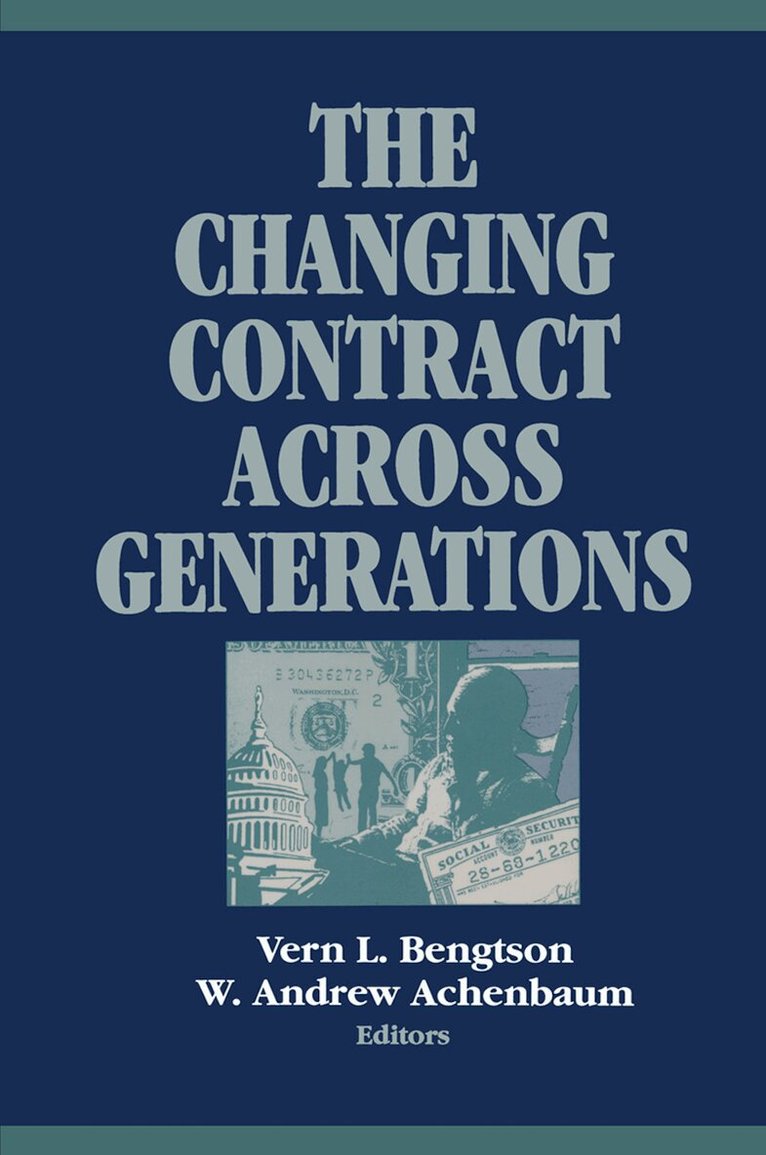
    Changing Contract across Generations

    AvVern L. Bengtson,W. Andrew Achenbaum

    Inbunden, Engelska, 1993

    Del i serien Social Institutions and Social Change Series

    1 764 kr

    Beställningsvara. Skickas inom 10-15 vardagar. Fri frakt över 249 kr.

    Beskrivning

    Generational conflict has attracted considerable attention in the media and within academic circles during the past decade. At the center of this collection of papers analyzing various facets of that conflict lie complex issues of generational equity - issues that will remain important for the framing of public policy during the 1990s, What do the young and the middle-aged owe the elderly? In discharging that debt, to what extent are they able to provide for their own old age in a climate of changing notions of welfare? What light do the longer perspectives of history shed on these issues? What role do kinship, gender, and economic status play?The papers commissioned by Bengtson and Achenbaum are intended to give greater analytic rigor to current debates. The volume is interdisciplinary not only by theoretical intent but by the practical imperatives of gerontology. More than a dozen sociologists, economists, historians, demographers, and policy analysts discuss the meanings and ambiguities that are inherent in terms such as "generation," "equity," "compact," "contract," and "conflict," in order to assess how relations between the age groups seem to vary from one sociohistorical context to the next.This distinguished group of contributors raises comparative issues throughout, assessing variations in generational ties by gender, race, class, and geographic location. Several project the extent to which recent changes in the political economy, public philosophy, and demographic structure of most "modern" societies presage greater conflicts, or greater consensus, in family members' relationships and social ties.

    Produktinformation

    • Utgivningsdatum:1993-12-31
    • Mått:152 x 229 x 26 mm
    • Vikt:453 g
    • Format:Inbunden
    • Språk:Engelska
    • Serie:Social Institutions and Social Change Series
    • Antal sidor:330
    • Förlag:Taylor & Francis Inc
    • ISBN:9780202304595

    Utforska kategorier

    • Sociologi och antropologi inom Samhälle och politik
    • Sociala grupper och identitet inom Samhälle och politik

    Mer om författaren

    Vern L. Bengtson is AARP/University Professor of Gerontology and Sociology at the University of Southern California, and Past President of the Gerontological Society of America. His publications include The Social Psychology of Aging; Youth, Generations, and Social Change; Grandparenthood; The Measurement of Intergenerational Relations; Emergent Theories of Aging, and The Course of Later Life. W. Andrew Achenbaum is professor of history at the University of Michigan, Ann Arbor, and is Deputy Director of its Institute of Gerontology. His research focuses on the history of the elderly in the United States. He currently is completing a book on the history of gerontology. Among his numerous publications are Images of Old Age in America; :1790 to the Present and Social Security: Visions and Revisions.

    Innehållsförteckning

    • Preface Foreword PART I Conceptual and Contextual Issues in the Current Generational Debate 1 Is the Contract Across Generations Changing? Effects of Population Aging on Obligations and Expectations Across Age Groups 2 Generational Relations in Historical Context PART II Social Contexts of the Generational Contract 3 An Historical Perspective on Support for Schooling by Different Age Cohorts 4 Economic Status of the Young and Old in the Working-Age Population, 1964 and 1987 5 Of Deeds and Contracts: Filial Piety Perceived in Contemporary Shanghai PART III Age Cohorts in Conflict? 6 When the Contract Fails: Care for the Elderly in Nonindustrial Cultures 7 Conflict over Intergenerational Equity: Rhetoric and Reality in a Comparative Context 8 Intergenerational Relations and Welfare Restructuring: The Social Construction of an Intergenerational Problem PART IV Family Issues Across Generations 9 Connections: Kin and Cohort 10 Intergenerational Relations: Gender, Norms, and Behavior PART V The Politics and Polity of Age Groups and Generations 11 A Lifetime of Privilege? Aging and Generations at Century's End 12 Interest Group Politics: Generational Changes in the Politics of Aging 13 Setting the Agenda for Research on Cohorts and Generations: Theoretical, Political, and Policy Implications