• Fri frakt över 249 kr
  • •
  • Snabba leveranser
  • •
  • Billiga böcker
Kundservice

Du är på sajten för privatpersoner.

Företag, bibliotek eller offentlig verksamhet?

Du handlar på classic.bokus.com, där alla dina funktioner finns intakta.
Till classic.bokus.com
Bokus logotyp. Gå till startsidan.
  • Erbjudanden
  • Nyheter
  • Student
  • Topplistor
  • Barn & ungdom
  • Bokus Play
  • E-böcker
  • Pocketböcker
  • Spel & pussel

10% rabatt på allt med kod NYSTART10 →

Sidfot

Mina sidor

    Hjälp

    • Kundservice
    • Vanliga frågor och svar
    • Frakt och leverans
    • Retur vid ångerrätt
    • Reklamera vara
    • Betalning
    • Köpvillkor
    • Allmänna villkor
    • Information om webbplatsens tillgänglighet

    Om Bokus

    • Om oss
    • Pressrum
    • För studenter
    • För företag
    • För bibliotek och offentlig verksamhet
    • För leverantörer
    • Hållbarhet

    Populärt

    • Aktuella erbjudanden
    • Presentkort
    • Studentlitteratur
    • Nya böcker
    • Topplistor
    • Signerade böcker
    • Engelska böcker

    Inspiration

    • Boktips
    • BookTok
    • Populära bokserier
    • Barnbokskaraktärer
    • Populära författare
    Logotyp för Bokus
    Följ oss på Facebook (extern länk)Följ oss på Instagram (extern länk)Följ oss på YouTube (extern länk)Följ oss på TikTok (extern länk)
    bokus @ CookiesAnpassa cookiesIntegritetspolicyKöpvillkor
    Till Citymail hemsida (extern länk)Till Budbee hemsida (extern länk)Till Postnord hemsida (extern länk)Till Schenker hemsida (extern länk)Till Early Bird hemsida (extern länk)Till Walleys hemsida (extern länk)
    1. Ekonomi och Ledarskap
    2. Nationalekonomi

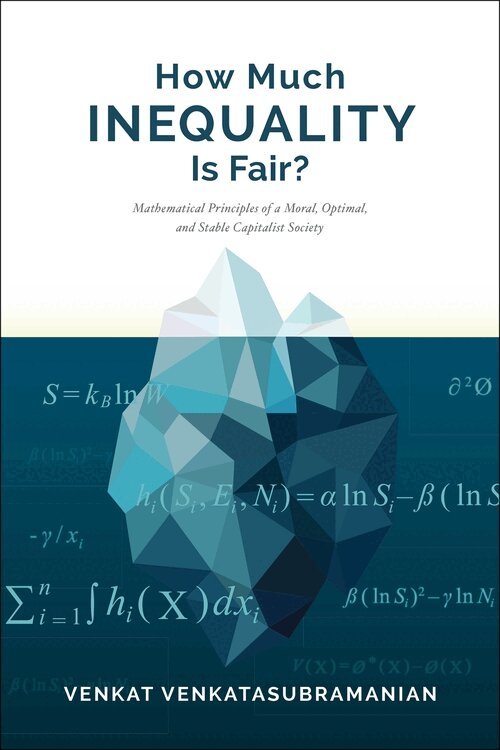
    How Much Inequality Is Fair?

    Mathematical Principles of a Moral, Optimal, and Stable Capitalist Society

    AvVenkat Venkatasubramanian

    Häftad, Engelska, 2019

    251 kr

    Beställningsvara. Skickas inom 5-8 vardagar. Fri frakt över 249 kr.

    Fler format och utgåvor

    Inbunden

    985 kr

    Beskrivning

    Many in the United States feel that the nation’s current level of economic inequality is unfair and that capitalism is not working for 90% of the population. Yet some inequality is inevitable. The question is: What level of inequality is fair? Mainstream economics has offered little guidance on fairness and the ideal distribution of income. Political philosophy, meanwhile, has much to say about fairness yet relies on qualitative theories that cannot be verified by empirical data. To address inequality, we need to know what the goal is—and for this, we need a quantitative, testable theory of fairness for free-market capitalism.How Much Inequality Is Fair? synthesizes concepts from economics, political philosophy, game theory, information theory, statistical mechanics, and systems engineering into a mathematical framework for a fair free-market society. The key to this framework is the insight that maximizing fairness means maximizing entropy, which makes it possible to determine the fairest possible level of pay inequality. The framework therefore provides a moral justification for capitalism in mathematical terms. Venkat Venkatasubramanian also compares his theory’s predictions to actual inequality data from various countries—showing, for instance, that Scandinavia has near-ideal fairness, while the United States is markedly unfair—and discusses the theory’s implications for tax policy, social programs, and executive compensation.

    Produktinformation

    • Utgivningsdatum:2019-06-25
    • Mått:152 x 229 x 16 mm
    • Vikt:406 g
    • Format:Häftad
    • Språk:Engelska
    • Antal sidor:304
    • Förlag:Columbia University Press
    • ISBN:9780231180733

    Utforska kategorier

    • Nationalekonomi inom Ekonomi och Ledarskap
    • Matematisk statistik inom Naturvetenskap och teknik
    • Makroekonomi inom Ekonomi och Ledarskap

    Mer om författaren

    Venkat Venkatasubramanian is Samuel Ruben–Peter G. Viele Professor of Engineering at Columbia University.

    Recensioner i media

    Venkat Venkatasubramanian’s unusual argument, which draws on both mathematical and philosophical principles to propose a model of a fair society, is itself worthy of remark. Whether or not you agree with it, it is clearly and fairly presented. It’s one of the best books of its kind.

    Innehållsförteckning

    • List of TablesList of FiguresPreface1. Extreme Inequality in Income and Wealth2. Foundational Principles of a Fair Capitalist Society3. Distributive Justice in a Hybrid Utopia4. Statistical Thermodynamics and Equilibrium Distribution5. Fairness in Income Distribution6. Global Trends in Income Inequality: Theory Versus Reality7. What Is Fair Pay for Executives?8. Final Synthesis and Future DirectionsNotesBibliographyIndex