• Fri frakt över 249 kr
  • •
  • Snabba leveranser
  • •
  • Billiga böcker
Kundservice

Du är på sajten för privatpersoner.

Företag, bibliotek eller offentlig verksamhet?

Du handlar på classic.bokus.com, där alla dina funktioner finns intakta.
Till classic.bokus.com
Bokus logotyp. Gå till startsidan.
  • Erbjudanden
  • Nyheter
  • Student
  • Topplistor
  • Barn & ungdom
  • Bokus Play
  • E-böcker
  • Pocketböcker
  • Spel & pussel

10% rabatt på allt med kod: NYSTART10 →

Sidfot

Mina sidor

    Hjälp

    • Kundservice
    • Vanliga frågor och svar
    • Frakt och leverans
    • Retur vid ångerrätt
    • Reklamera vara
    • Betalning
    • Köpvillkor
    • Allmänna villkor
    • Information om webbplatsens tillgänglighet

    Om Bokus

    • Om oss
    • Pressrum
    • För studenter
    • För företag
    • För bibliotek och offentlig verksamhet
    • För leverantörer
    • Hållbarhet

    Populärt

    • Aktuella erbjudanden
    • Presentkort
    • Studentlitteratur
    • Nya böcker
    • Topplistor
    • Signerade böcker
    • Engelska böcker

    Inspiration

    • Boktips
    • BookTok
    • Populära bokserier
    • Barnbokskaraktärer
    • Populära författare
    Logotyp för Bokus
    Följ oss på Facebook (extern länk)Följ oss på Instagram (extern länk)Följ oss på YouTube (extern länk)Följ oss på TikTok (extern länk)
    bokus @ CookiesAnpassa cookiesIntegritetspolicyKöpvillkor
    Till Citymail hemsida (extern länk)Till Budbee hemsida (extern länk)Till Postnord hemsida (extern länk)Till Schenker hemsida (extern länk)Till Early Bird hemsida (extern länk)Till Walleys hemsida (extern länk)
    1. Historia och arkeologi
    2. Historia
    3. Historia: särskilda händelser och ämnen
    4. Slaveri

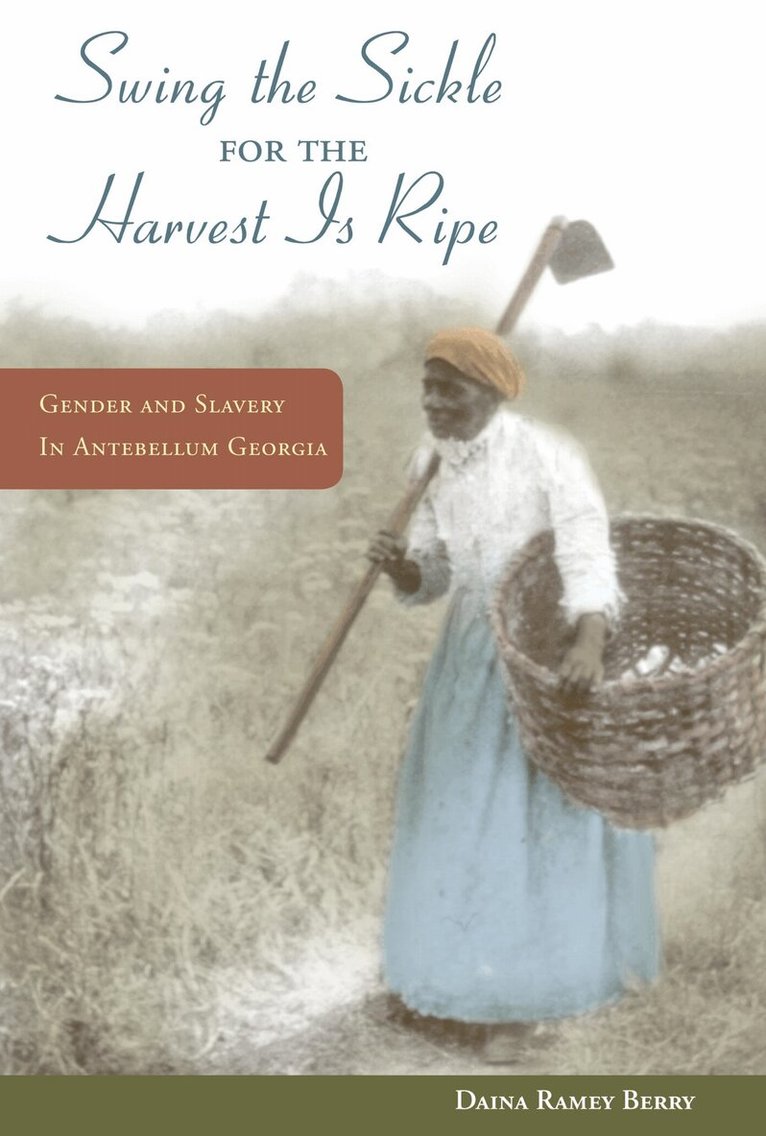
    "Swing the Sickle for the Harvest Is Ripe"

    Gender and Slavery in Antebellum Georgia

    AvDaina Ramey Berry

    Häftad, Engelska, 2010

    Del i serien Women, Gender, and Sexuality in American History

    304 kr

    Beställningsvara. Skickas inom 5-8 vardagar. Fri frakt över 249 kr.

    Beskrivning

    Examining how labor and economy shaped the family life of bondwomen and bondmen in the antebellum South "Swing the Sickle for the Harvest Is Ripe" compares the work, family, and economic experiences of enslaved women and men in upcountry and lowland Georgia during the nineteenth century. Mining planters' daybooks, plantation records, and a wealth of other sources, Daina Ramey Berry shows how slaves' experiences on large plantations, which were essentially self-contained, closed communities, contrasted with those on small plantations, where planters' interests in sharing their workforce allowed slaves more open, fluid communications. By inviting readers into slaves' internal lives through her detailed examination of domestic violence, separation and sale, and forced breeding, Berry also reveals important new ways of understanding what it meant to be a female or male slave, as well as how public and private aspects of slave life influenced each other on the plantation.A volume in the series Women in American History, edited by Anne Firor Scott, Susan Armitage, Susan K. Cahn, and Deborah Gray White

    Produktinformation

    • Utgivningsdatum:2010-06-28
    • Mått:152 x 229 x 23 mm
    • Vikt:399 g
    • Format:Häftad
    • Språk:Engelska
    • Serie:Women, Gender, and Sexuality in American History
    • Antal sidor:256
    • Förlag:University of Illinois Press
    • ISBN:9780252077586

    Utforska kategorier

    • Slaveri inom Historia och arkeologi
    • Amerikas historia inom Historia och arkeologi
    • Genusvetenskap inom Samhälle och politik

    Mer om författaren

    Daina Ramey Berry is an associate professor of history at Michigan State University.

    Recensioner i media

    "'Swing the Sickle' demonstrates how far gender has come as a category of historical analysis in slave studies. It displays refinement, nuance, and balance . . . it brings together gender, work, family, and economy in an easily accessible, readable account useful to slave scholars and students of Georgia slavery in particular."--Georgia Historical Quarterly "Reconstructing the practices of slavery from plantation records, memoirs, and newspapers and the encounter with those practices through folk songs and ex-slave testimonies, Berry succeeds in capturing commonalities and differences in slavery in white-majority communities and African American-majority communities. . . . [An] important contribution to historiography. Recommended."--Choice "[Berry's] approach reveals new ways of looking at slavery. . . . Berry also raises questions about the relationship between southern and northern ideologies of labor and emerging definitions of what constituted work and skill in the nineteenth-century United States."--Journal of Southern History "Berry's book contributes to our understanding about how slaveholders attempted to control slave labor and what men and women did to shape family lives within the confines of enslavement."--American Historical Review "Berry's study is filled with rich, personal stories that, together with its brevity, make it an engaging book for use in undergraduate instruction. Berry has provided us with a useful overview of the significance of gender in shaping the experiences of enslaved laborers in antebellum Georgia."--Journal of the Early Republic "A well-researched and written book, readers interested in the history of African Americans, women, labor, slavery, and Georgia will find this book useful."--Civil War Book Review "Berry's book adds a great deal to our understanding of the variety and complexity of slave life and makes a valuable contribution to scholarship both about Georgia and the antebellum South as a whole."--Journal of Interdisciplinary History "Berry's fresh approach to studying slavery in Georgia includes new discussions of gender exploitation, family, and worker's skills. 'Swing the Sickle for the Harvest Is Ripe' makes a tremendous contribution to the field, as it makes important connections between labor, skill and gender, forced breeding, and the informal economy."--Deborah Gray White, author of Ar'n't I a Woman?: Female Slaves in the Antebellum South and Too Heavy a Load: Black Women in Defense of Themselves, 1894-1994"An appeal of this book is that it compares communities in upcountry and lowcountry Georgia to provide a gendered analysis of the family, labor, and economy of enslaved women and men during the antebellum period. Berry's distinctive focus will be useful for scholars and students in the fields of African American history, women's studies, gender studies, family history, and U.S. history before 1876."--Wilma King, author of The Essence of Liberty: Free Black Women during the Slave Era

    Innehållsförteckning

    • Preface   ixAcknowledgments   xiIntroduction   11. "I Had to Work Hard, Plow, and Go and Split Wood Jus' Like a Man": Skill, Gender, and Productivity in Agricultural Settings   132. "Dey S'lected Me Out to Be a Housegirl": The Privileges and Pain of Nonagricultural Labor   353. "There Sho' Was a Sight of Us": Enslaved Family and Community Rituals   524. "O, I Never Has Forgot Dat Last Dinner wit My Folks": Enslaved Family and Community Realities   765. "For the Current Year": The Informal Economy and Slave Hiring   104Epilogue: The Aftermath of Slavery   129Appendix A   135Appendix B   138