• Fri frakt över 249 kr
  • •
  • Snabba leveranser
  • •
  • Billiga böcker
Kundservice

Du är på sajten för privatpersoner.

Företag, bibliotek eller offentlig verksamhet?

Du handlar på classic.bokus.com, där alla dina funktioner finns intakta.
Till classic.bokus.com
Bokus logotyp. Gå till startsidan.
  • Erbjudanden
  • Nyheter
  • Student
  • Topplistor
  • Barn & ungdom
  • Bokus Play
  • E-böcker
  • Pocketböcker
  • Spel & pussel

10% rabatt på allt med kod: NYSTART10 →

Sidfot

Mina sidor

    Hjälp

    • Kundservice
    • Vanliga frågor och svar
    • Frakt och leverans
    • Retur vid ångerrätt
    • Reklamera vara
    • Betalning
    • Köpvillkor
    • Allmänna villkor
    • Information om webbplatsens tillgänglighet

    Om Bokus

    • Om oss
    • Pressrum
    • För studenter
    • För företag
    • För bibliotek och offentlig verksamhet
    • För leverantörer
    • Hållbarhet

    Populärt

    • Aktuella erbjudanden
    • Presentkort
    • Studentlitteratur
    • Nya böcker
    • Topplistor
    • Signerade böcker
    • Engelska böcker

    Inspiration

    • Boktips
    • BookTok
    • Populära bokserier
    • Barnbokskaraktärer
    • Populära författare
    Logotyp för Bokus
    Följ oss på Facebook (extern länk)Följ oss på Instagram (extern länk)Följ oss på YouTube (extern länk)Följ oss på TikTok (extern länk)
    bokus @ CookiesAnpassa cookiesIntegritetspolicyKöpvillkor
    Till Citymail hemsida (extern länk)Till Budbee hemsida (extern länk)Till Postnord hemsida (extern länk)Till Schenker hemsida (extern länk)Till Early Bird hemsida (extern länk)Till Walleys hemsida (extern länk)
    1. Ekonomi och Ledarskap
    2. Industrier och branscher
    3. Arbetsmarknaden

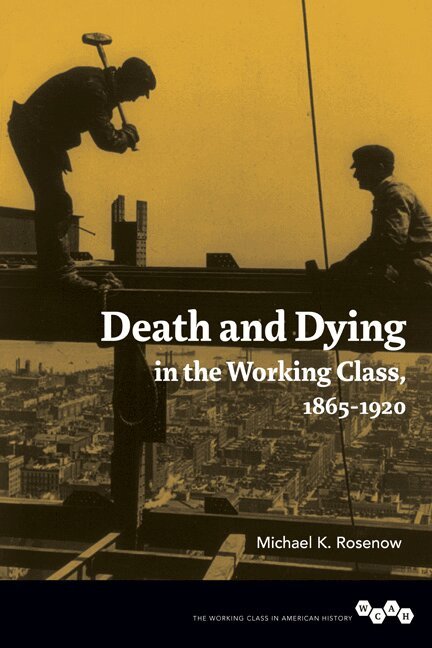
    Death and Dying in the Working Class, 1865-1920

    AvMichael K. Rosenow

    Häftad, Engelska, 2015

    Del i serien Working Class in American History

    332 kr

    Beställningsvara. Skickas inom 5-8 vardagar. Fri frakt över 249 kr.

    Fler format och utgåvor

    Inbunden

    1 247 kr

    E-bok

    550 kr

    Beskrivning

    Michael K. Rosenow investigates working people's beliefs, rituals of dying, and the politics of death by honing in on three overarching questions: How did workers, their families, and their communities experience death? Did various identities of class, race, gender, and religion coalesce to form distinct cultures of death for working people? And how did people's attitudes toward death reflect notions of who mattered in U.S. society?  Drawing from an eclectic array of sources ranging from Andrew Carnegie to grave markers in Chicago's potter's field, Rosenow portrays the complex political, social, and cultural relationships that fueled the United States' industrial ascent. The result is an undertaking that adds emotional depth to existing history while challenging our understanding of modes of cultural transmission.

    Produktinformation

    • Utgivningsdatum:2015-03-31
    • Mått:152 x 229 x 36 mm
    • Vikt:399 g
    • Format:Häftad
    • Språk:Engelska
    • Serie:Working Class in American History
    • Antal sidor:248
    • Förlag:University of Illinois Press
    • ISBN:9780252080715
    • Utmärkelser:Winner of <DIV>Herbert G. Gutman Award, Labor and Working-Class History Association (LAWCHA), 2009.</DIV> 2009

    Utforska kategorier

    • Arbetsmarknaden inom Ekonomi och Ledarskap
    • Sociologi inom Samhälle och politik
    • Amerikas historia inom Historia och arkeologi

    Mer om författaren

    Michael K. Rosenow is an assistant professor at the University of Central Arkansas.

    Recensioner i media

    Herbert G. Gutman Award, Labor and Working-Class History Association (LAWCHA), 2009."Through portraits of industrial accidents, political funerals, and burial rituals, this compelling reinterpretation of working-class culture and the making of labor solidarity highlights how bodies in their gendered, class, and ethnic valences matter--in death as well as life."--Eileen Boris, Hull Professor of Feminist Studies, University of California, Santa Barbara "A tantalizing and well-researched glimpse into the rituals of death for workers whose lives held little value outside their own communities in industrializing America."--Annals of Iowa "Rosenow is to be congratulated on his mastery of diverse literatures and his rigorous argument. Death and Dying in the Working Class, 1865-1920 demonstrates that wageworker's rituals--and the industrial violence that engendered them--were foundational to the formation of working-class identities and organizations."--American Historical Review "In his thoughtfully conceived and clearly developed study, Michael K. Rosenow shows that in death as in life, American workers existed on anything but a level playing field."--The Journal of American History "For scholars seeking insight into the formation of class identity among the industrial workforce and an intellectually creative use of methodologies to examine the links between religion, ethnicity, and class, Rosenow's study provides an evocative study of social transformation as well as introducing a rich field for further research."--H-Net "This award-winning book (it won the Herbert G. Gutman Prize from the Labor and Working Class History Association) helps us understand the complex ways the working class has responded to death on the job and expands our notions of American ways of caring for—and about—the dead."--Journal of Social History "Rosenow's book offers rich insight into how the working class of the early twentieth century approached death within their historical and situational context."--Working USA "Engaging, thoughtful, and very readable . . . It adds to our knowledge of how Americans responded to the changes brought by industrialization in the second half of the nineteenth century."--Robert V. Wells, author of Life Flows On in Endless Song: Folk Songs and American History"Rosenow usefully extends a now-rich literature on American memorial practices to the northern industrial working classes from the Civil War to World War I. . . . This pioneering study deserves wide attention."--Leon Fink, author of Sweatshops at Sea: Merchant Seamen in the World's First Globalized Industry, from 1812 to the Present