• Fri frakt över 249 kr
  • •
  • Snabba leveranser
  • •
  • Billiga böcker
Kundservice

Du är på sajten för privatpersoner.

Företag, bibliotek eller offentlig verksamhet?

Du handlar på classic.bokus.com, där alla dina funktioner finns intakta.
Till classic.bokus.com
Bokus logotyp. Gå till startsidan.
  • Erbjudanden
  • Nyheter
  • Student
  • Topplistor
  • Barn & ungdom
  • Bokus Play
  • E-böcker
  • Pocketböcker
  • Spel & pussel

10% rabatt på allt med kod: NYSTART10 →

Sidfot

Mina sidor

    Hjälp

    • Kundservice
    • Vanliga frågor och svar
    • Frakt och leverans
    • Retur vid ångerrätt
    • Reklamera vara
    • Betalning
    • Köpvillkor
    • Allmänna villkor
    • Information om webbplatsens tillgänglighet

    Om Bokus

    • Om oss
    • Pressrum
    • För studenter
    • För företag
    • För bibliotek och offentlig verksamhet
    • För leverantörer
    • Hållbarhet

    Populärt

    • Aktuella erbjudanden
    • Presentkort
    • Studentlitteratur
    • Nya böcker
    • Topplistor
    • Signerade böcker
    • Engelska böcker

    Inspiration

    • Boktips
    • BookTok
    • Populära bokserier
    • Barnbokskaraktärer
    • Populära författare
    Logotyp för Bokus
    Följ oss på Facebook (extern länk)Följ oss på Instagram (extern länk)Följ oss på YouTube (extern länk)Följ oss på TikTok (extern länk)
    bokus @ CookiesAnpassa cookiesIntegritetspolicyKöpvillkor
    Till Citymail hemsida (extern länk)Till Budbee hemsida (extern länk)Till Postnord hemsida (extern länk)Till Schenker hemsida (extern länk)Till Early Bird hemsida (extern länk)Till Walleys hemsida (extern länk)
    1. Kultur
    2. Scenkonst och film
    3. Film

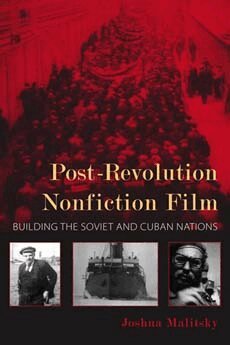
    Post-Revolution Nonfiction Film

    Building the Soviet and Cuban Nations

    AvJoshua Malitsky

    Inbunden, Engelska, 2013

    Del i serien New Directions in National Cinemas

    937 kr

    Beställningsvara. Skickas inom 5-8 vardagar. Fri frakt över 249 kr.

    Fler format och utgåvor

    Häftad

    312 kr

    Beskrivning

    In the charged atmosphere of post-revolution, artistic and political forces often join in the effort to reimagine a new national space for a liberated people. Joshua Malitsky examines nonfiction film and nation building to better understand documentary film as a tool used by the state to create powerful historical and political narratives. Drawing on newsreels and documentaries produced in the aftermath of the Russian revolution of 1917 and the Cuban revolution of 1959, Malitsky demonstrates the ability of nonfiction film to help shape the new citizen and unify, edify, and modernize society as a whole. Post-Revolution Nonfiction Film not only presents a critical historical view of the politics, rhetoric, and aesthetics shaping post-revolution Soviet and Cuban culture but also provides a framework for understanding the larger political and cultural implications of documentary and nonfiction film.

    Produktinformation

    • Utgivningsdatum:2013-03-20
    • Mått:152 x 229 x 22 mm
    • Vikt:590 g
    • Format:Inbunden
    • Språk:Engelska
    • Serie:New Directions in National Cinemas
    • Antal sidor:290
    • Förlag:Indiana University Press
    • ISBN:9780253007643

    Utforska kategorier

    • Film inom Kultur

    Mer om författaren

    Joshua Malitsky is Associate Professor in the Department of Communication and Culture at Indiana University Bloomington.

    Recensioner i media

    "[M]alitsky's book is an extremely valuable contribution to both film theory and film history and should become required reading for students of film with a focus on documentary.October 2014"—Russian Review"A book that analyzes Soviet cinema side-by-side with Cuban film is welcome, even though the two countries are represented here in parallel. . . . Highly recommended."—Choice"A splendid and highly readable book which imbues a suggestive comparison of cinema in the early years of the Soviet and Cuban revolutions with fresh insights."—Michael Chanan, author of Cuban Cinema"Joshua Malitsky here mines a rich seam. By closely comparing Vertov and Alvarez he uncovers 'post-revolutionary nonfiction film' as a discernible entity with commonalities shared across time and cultures. The extensive—indeed vast—archive of newsreels from both filmmakers is well worth the thorough attention he gives it, suggesting a context for their better-known documentaries. And his situating of Esfir Shub's compilations as not so much an alternative to Vertov but rather a wholesale replacement approach to agitprop is also compelling. All in all, Malitsky offers a crucial corrective to much received thinking on 20th century radical film."—Brian Winston, University of Lincoln, UK

    Innehållsförteckning

    • Acknowledgments1. Introduction: Revolutionary Rupture and National StabilityPart 12. Kino-Nedelia, Early Documentary, and the Performance of a New Collective, 1917-19213. A Cinema Looking For People: The Individual and the Collective in Immediate Post-Revolutionary Cuban Nonfiction FilmPart 24. The Dialectics of Thought and Vision in the Films of Dziga Vertov, 1922-19275. (Non)Alignments and the New Revolutionary ManPart 36. Esfir Shub, Factography, and the New Documentary Historiography7. The Object of Revolutionary History: Santiago Álvarez' Commemorative Newsreels and Chronicle Documentaries, 1972-1974NotesFilmographyBibliographyIndex