• Fri frakt över 249 kr
  • •
  • Snabba leveranser
  • •
  • Billiga böcker
Kundservice

Du är på sajten för privatpersoner.

Företag, bibliotek eller offentlig verksamhet?

Du handlar på classic.bokus.com, där alla dina funktioner finns intakta.
Till classic.bokus.com
Bokus logotyp. Gå till startsidan.
  • Erbjudanden
  • Nyheter
  • Student
  • Topplistor
  • Barn & ungdom
  • Bokus Play
  • E-böcker
  • Pocketböcker
  • Spel & pussel

10% rabatt på allt med kod NYSTART10 →

Sidfot

Mina sidor

    Hjälp

    • Kundservice
    • Vanliga frågor och svar
    • Frakt och leverans
    • Retur vid ångerrätt
    • Reklamera vara
    • Betalning
    • Köpvillkor
    • Allmänna villkor
    • Information om webbplatsens tillgänglighet

    Om Bokus

    • Om oss
    • Pressrum
    • För studenter
    • För företag
    • För bibliotek och offentlig verksamhet
    • För leverantörer
    • Hållbarhet

    Populärt

    • Aktuella erbjudanden
    • Presentkort
    • Studentlitteratur
    • Nya böcker
    • Topplistor
    • Signerade böcker
    • Engelska böcker

    Inspiration

    • Boktips
    • BookTok
    • Populära bokserier
    • Barnbokskaraktärer
    • Populära författare
    Logotyp för Bokus
    Följ oss på Facebook (extern länk)Följ oss på Instagram (extern länk)Följ oss på YouTube (extern länk)Följ oss på TikTok (extern länk)
    bokus @ CookiesAnpassa cookiesIntegritetspolicyKöpvillkor
    Till Citymail hemsida (extern länk)Till Budbee hemsida (extern länk)Till Postnord hemsida (extern länk)Till Schenker hemsida (extern länk)Till Early Bird hemsida (extern länk)Till Walleys hemsida (extern länk)
    1. Psykologi och pedagogik
    2. Pedagogik
    3. Undervisning i specifika ämnen

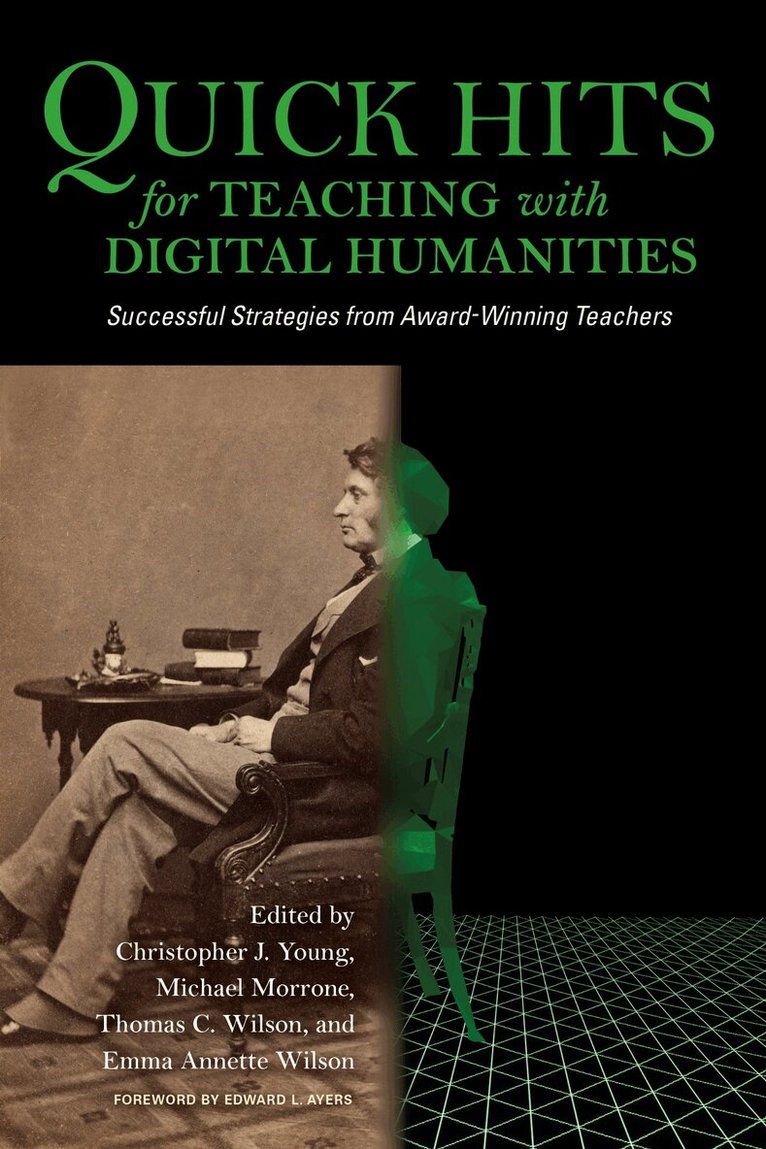
    Quick Hits for Teaching with Digital Humanities

    Successful Strategies from Award-Winning Teachers

    AvChristopher J. Young,Michael C. Morrone

    Häftad, Engelska, 2020

    Del i serien Indiana University Press (IPS)

    260 kr

    Beställningsvara. Skickas inom 5-8 vardagar. Fri frakt över 249 kr.

    Beskrivning

    Quick Hits for Teaching with Digital Humanities: Successful Strategies from Award-Winning Teachers is an edited collection of 24 articles that aims to introduce faculty, administrators, and staff to ways in which digital techniques from the arts, humanities, and social sciences can be incorporated in the classroom. These techniques can enhance learning and professional development experiences for undergraduate and graduate students and faculty alike. This essential handbook illustrates the breadth of digital humanities across the disciplines with rich examples that bring best practices to life. Anyone who teaches at an institution of higher learning will find entry into new digital paradigms. As the authors share simple and complex ways to introduce digital humanities into the classroom, they expand understandings of what constitutes these current technologies for learning.

    Produktinformation

    • Utgivningsdatum:2020-10-06
    • Mått:152 x 229 x 17 mm
    • Vikt:408 g
    • Format:Häftad
    • Språk:Engelska
    • Serie:Indiana University Press (IPS)
    • Antal sidor:302
    • Förlag:Indiana University Press
    • Medarbetare:EdwardL. Ayers
    • ISBN:9780253050212

    Utforska kategorier

    • Undervisning i specifika ämnen inom Psykologi och pedagogik

    Mer om författaren

    The Faculty Academy on Excellence in Teaching (FACET) was established as an Indiana University Presidential Initiative in 1989 to promote and sustain teaching excellence. Today, FACET involves over 600 full-time faculty members, nominated and selected through an annual campus and statewide peer review process. Michael C. Morrone is Director of the Faculty Academy on Excellence in Teaching (FACET) and is a senior lecturer in the Kelley School of Business at Indiana University Bloomington. Thomas C. Wilson is Professor and Associate Dean for Research and Technology at the University of Alabama Libraries. Emma Annette Wilson is Assistant Professor of English at Southern Methodist University. Christopher J. Young is Assistant Vice Chancellor for Academic Affairs, Director for the Center for Innovation and Scholarship in Teaching and Learning, and Professor of History at Indiana University Northwest.

    Recensioner i media

    "At this moment when all of us, suddenly, have become teachers in the digital space, this volume provides the kinds of hands on, practical advice educators need to navigate the complexities of teaching in the digital humanities. Ten years ago, half of the topics covered in these essays wouldn't even be topics of discussion, but today are part of our regular teaching practices. None of us will ever master all aspects of DH teaching, but taken together, the essays in this volume come close."—Mills Kelly, Executive Director of Roy Rosenzweig Center for History and New Media and Professor of History, George Mason University"I'm not sure I can". "I'm not sure my students can."I don't think I'd know where to begin"I don't really see the point, to be honest". Decades after the emergence of digital humanities, the field can still seem daunting to outsiders and integration to teaching projects remains uneven. That's where this book comes in, presenting a variety of ambitious yet accessible, real-life projects to inspire and embolden. A stepping stone to a new dimension."—Géraldine Castel, Lecturer in English LEA (Applied Foreign Languages), Grenoble Alpes University"Featuring a wide variety of examples from educators from across higher-ed, this Quick Hits volume is as useful to educators looking to develop digital humanities classes as it is to more advanced practitioners interested in integrating the latest tools and approaches. By highlighting field-tested methods in digital humanities teaching, the essays collected here will greatly enrich scholars' ability to enhance their curricular interventions, both conceptually and methodologically."—Marisa Parham, University of Maryland, Director of irLhumanities

    Innehållsförteckning

    • Edward L. Ayers / ForewordMichael Morrone / FACET Director's WelcomeChristopher J. Young, Michael Morrone, Emma Annette Wilson, and Thomas C. Wilson / IntroductionI. Overview of Ways to Teach with Digital Humanities1. Elizabeth Matelski / Social Network Analysis: Visualizing the Salem Witch Trials2. Camden Burd / Close Reading and Coding with the Seward Family Digital Archive: Digital-Documentary Editing in the Undergraduate History Classroom 3. Robert Voss / Teaching with Digital Humanities: Engaging your Audience4. Mary Alexander, Connie Janiga-Perkins, and Emma Annette Wilson / Teaching Text Encoding In The Madre María de San José (México 1656-1719) Digital Project5. Adam Clulow, Bernard Z. Keo, and Samuel Horewood / Teaching with Trials: Using Digital Humanities to Flip the Humanities Classroom6. Brian Kokensparger / Corpus Visualization: High-Level Student Engagement on a Zero Budget7. Lisa McFall / Metadata in the Classroom: Fostering an Understanding of the Value of Metadata in Digital Humanities8. Mary Angelec Cooksey / Teaching the Philosophy of Computing Using the Raspberry Pi9. Robert Voss / Teaching Digital Humanities with Timeline.js 10. Katherine Wills and Robin D. Fritz / Authentic Instruction through Blogging: Increasing Student Engagement with Digital HumanitiesII. Supporting Teaching and Learning11. Armanda Lewis / Capacity Building for DH Pedagogy Supports: An Ecological Approach 12. James Roussain and Silvia Vong / From Researcher to Curator: Reimagining Undergraduate Primary Source Research with Omeka13. Hélène Huet and Laurie N. Taylor / Teaching Together for the Digital Humanities Graduate Certificate14. Serenity Sutherland / Graduate Training in the Digital Archive15. David Ainsworth / Digital Humanities and Undergraduate Research for Undergraduates16. Kirsta Stapelfeldt, Christine Berkowitz, Chad Crichton, Anne Milne, Alejandro Paz, Natalie Rothman and Anya Tafliovich / Pay it Forward: Collaboration and DH Capacity Building at the University of Toronto Scarborough17. Scot A. French / VisualEyesThis: Using Interactive Visualization Tools to Engage Students in Historical Research and Digital Humanities R&D 3. Mapping and Augmented Realities18. Clifford B. Anderson and Joy H. Calico / The Digital Flâneur: Mapping Twentieth-Century Berlin19. Stephen Buttes / Digital Maps as Content and Pedagogy: Alternative Cartographic Practices in the Humanities Classroom20. Jacqueline H. Fewkes / Fieldtrips and Classrooms in Second Life: A Few Realities of Teaching in a Virtual Environment21. Sofiya Asher and Theresa Quill / Narrative Maps for World Language Learning22. Julia M.Gossard / Digitally Mapping Space and Time in History General Education Surveys: Google Maps & TimelineJS23. Molly Taylor-Poleskey / Charting Urban Change with Digital Mapping Tools24. Justin B. Makemson / Shifting Frames of Interpretation: Place-Based Technologies and Virtual Augmentation in Art Education25. Lisa Siefker Bailey / Using Podcasts to Teach Short StoriesIV. Public Scholarship and Community Engagement 26. J. Michael Francis, Hannah Tweet, and Rachel L. Sanderson / Building La Florida: Rethinking Colonial Florida History in the Digital Age27. Zach Coble and Rebecca Amato / (Dis)Placed Urban Histories: Combining Digital Humanities Pedagogy and Community Engagement28. Rhonda J. Marker / Digital Exhibitions: Engaging in Public Scholarship with Primary Source Materials29. Samantha J. Boardman / Oral History In The Digital Age: The Krueger-Scott Collection30 Carmen Walker / The Infusion of Digital Humanities in an Introductory Political Science Course at an HBCU: Lessons Learned31. Juilee Decker / No More 'Dusty Archive' Kitten Deaths: Discoverability, Incidental Learning, and Digital Humanities32. Mary R. Anderson and William M. Myers / Global Engagement and Digital Technology33. Patricia Turner / Using Digital Humanities to Re-Imagine College Writing and Promote Integrated and Applied Learning34. Shawn Martin and Carey Beam /Early Indiana Presidents: Incorporating Digital Humanities, Public History, and Community Engagement35. Evan Roberts/ Measuring the ANZACs: Exploring the Lives of World War I Soldiers in a Citizen Science Project36. Lauren S. Cardon/ Global Foodways: Digital Humanities and Experiential LearningList of ContributorsIndex