• Fri frakt över 249 kr
  • •
  • Snabba leveranser
  • •
  • Billiga böcker
Kundservice

Du är på sajten för privatpersoner.

Företag, bibliotek eller offentlig verksamhet?

Du handlar på classic.bokus.com, där alla dina funktioner finns intakta.
Till classic.bokus.com
Bokus logotyp. Gå till startsidan.
  • Erbjudanden
  • Nyheter
  • Student
  • Topplistor
  • Barn & ungdom
  • Bokus Play
  • E-böcker
  • Pocketböcker
  • Spel & pussel

10% rabatt på allt med kod: NYSTART10 →

Sidfot

Mina sidor

    Hjälp

    • Kundservice
    • Vanliga frågor och svar
    • Frakt och leverans
    • Retur vid ångerrätt
    • Reklamera vara
    • Betalning
    • Köpvillkor
    • Allmänna villkor
    • Information om webbplatsens tillgänglighet

    Om Bokus

    • Om oss
    • Pressrum
    • För studenter
    • För företag
    • För bibliotek och offentlig verksamhet
    • För leverantörer
    • Hållbarhet

    Populärt

    • Aktuella erbjudanden
    • Presentkort
    • Studentlitteratur
    • Nya böcker
    • Topplistor
    • Signerade böcker
    • Engelska böcker

    Inspiration

    • Boktips
    • BookTok
    • Populära bokserier
    • Barnbokskaraktärer
    • Populära författare
    Logotyp för Bokus
    Följ oss på Facebook (extern länk)Följ oss på Instagram (extern länk)Följ oss på YouTube (extern länk)Följ oss på TikTok (extern länk)
    bokus @ CookiesAnpassa cookiesIntegritetspolicyKöpvillkor
    Till Citymail hemsida (extern länk)Till Budbee hemsida (extern länk)Till Postnord hemsida (extern länk)Till Schenker hemsida (extern länk)Till Early Bird hemsida (extern länk)Till Walleys hemsida (extern länk)
    1. Historia och arkeologi
    2. Historia
    3. Europas historia

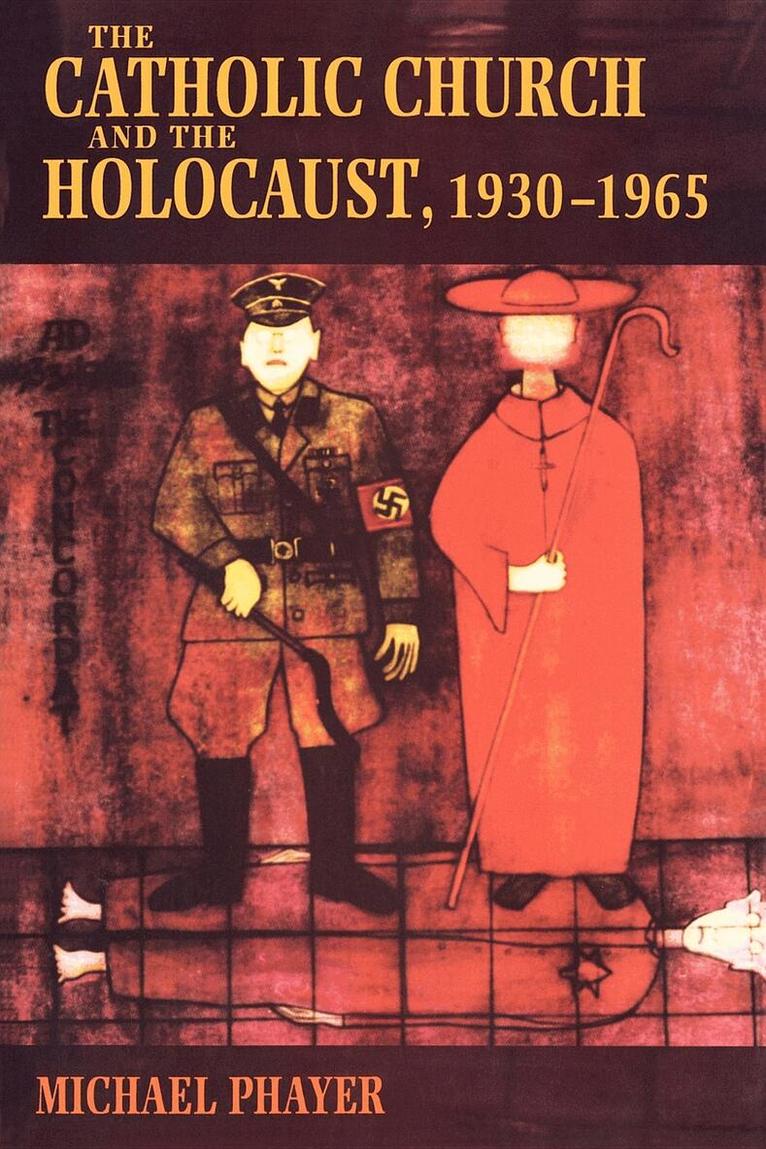
    Catholic Church and the Holocaust, 1930-1965

    AvMichael Phayer

    Häftad, Engelska, 2001

    Del i serien Indiana University Press (IPS)

    307 kr

    Beställningsvara. Skickas inom 10-15 vardagar. Fri frakt över 249 kr.

    Beskrivning

    "Phayer offers exactly what was needed. . . . A fair and even-tempered account of a volatile subject." —Kirkus Reviews"An important addition to the literature of the Holocaust." —Publishers Weekly"Very valuable . . . a fine and judicious book." —István Deák, The New York Review of Books"Phayer has written a singularly important book on the role of the Catholic Church in both the Holocaust and its aftermath, up to and including Vatican II. Diligently researched and documented, judicious in its conclusions, comprehensive in its scope, compassionate and humane in its outlook, this book is an indispensable resource." —Richard L. Rubenstein"Phayer's study of [the Catholic Church] as an actor in the tumultuous history of the [20th century] will serve as a model for other historians." —Donald J. Dietrich, Boston CollegePhayer's book, particularly strong on German source material, is at pains to list Pius's strong points his piety, his loathing of Hitler, the instances of personal warmth, the occasions when he criticized Nazism. Phayer examines not only Pius's actions but those of other leading Catholics, and his study extends beyond the end of World War II to follow the evolution of official Catholic thinking during the rebuilding of Germany, the cold war, and the gradual theological reforms that led to Vatican II. This enables Phayer to show how the church completely reversed its position relative to the Jews, but it also gives him a more thorough reading of Pius XII's overall record. It is a damning and convincing verdict that emerges." —Commonweal

    Produktinformation

    • Utgivningsdatum:2001-05-22
    • Mått:156 x 235 x 23 mm
    • Vikt:567 g
    • Format:Häftad
    • Språk:Engelska
    • Serie:Indiana University Press (IPS)
    • Antal sidor:328
    • Förlag:Indiana University Press
    • ISBN:9780253214713
    • Utmärkelser:Short-listed for National Jewish Book Award (Holocaust) 2000

    Utforska kategorier

    • Europas historia inom Historia och arkeologi
    • Andra världskriget inom Historia och arkeologi
    • Allmän historia och världshistoria inom Historia och arkeologi

    Mer om författaren

    Michael Phayer is Professor of History at Marquette University. His two most recent books, Protestant Catholic Women in Nazi Germany and (with Eva Fleischner) Cries in the Night: Women Who Challenged the Holocaust, dealextensively with Catholic-Jewish relations before and during the Shoah.

    Recensioner i media

    "This title has been reviewed jointly with Hitler, the war, and the pope, by Ronald Rychlak. John Cornwell's controversial book, Hitler's Pope (CH, Jun'00), serves as the backdrop for these disparate approaches to the question of papal complicity in the Holocaust. Cornwell's condemnation of Pope Pius XII (Eugenio Pacelli) as Hitler's pawn and as an antisemite follows Rolf Hochhuth's 1964 play The Deputy, which condemned the silence of the pope. Both Phayer (history, Marquette Univ.) and Rychlak (Univ. of Mississippi School of Law) criticize Cornwell's attack on the papacy; Phayer crafts a carefully nuanced argument that recognizes the moral ambiguity of any response—including the pope's—to the horror of the Holocaust. Rychlak, an apologist for the Roman Catholic Church, seeks to defend the reputation of Pope Pius XII. Rychlak's publisher, Our Sunday Visitor, is a Catholic press that pledges (on its Web site (http://www.osv.com)) to support the teachings of the Church as proclaimed by the Holy Father. These partisan interests obscure what may have been interesting details about the activity of Pius XII during WW II. The question is whether the failure to act, speak, and object can be interpreted as acts of complicity. Rychlak argues that had Pius XII objected more strenuously, Hitler would have retaliated with even more violence. But could it have gotten any worse inside the gates of the hell of Auschwitz? By highlighting the suffering of German Catholic priests and bishops without giving adequate attention to the particularity of Jewish suffering, Rychlak seems insensitive to the horror suffered by the Jews during the Holocaust. Phayer acknowledges that Pius XII could not have halted the Holocaust, but that he could have done far more—for example, by disseminating information about the genocide, which the Vatican is known to have had. Phayer speculates that while Pius XII could have been more active, the pope's fixation on diplomatic solutions and his obsession with the threat of communism made him inflexible. Phayer insists that the failures and deficiencies of Pius XII's leadership ought not lead to a simplistic condemnation. He looks carefully at the record of the pope as well as those of bishops, the church, and individual Catholics, and concludes that the record is mixed and complex. This reviewer recommends Phayer's text as the appropriate choice for all libraries having an interest in issues relating to the Holocaust. General readers and undergraduates."—P. K. Steinfeld, Buena Vista University , 2001may CHOICE."Phayer insists that the failures and deficiencies of Pius XII's leadership ought not lead to a simplistic condemnation. He looks carefully at the record of the pope as well as those of bishops, the church, and individual Catholics, and concludes that the record is mixed and complex. This reviewer recommends Phayer's text as the appropriate choice for all libraries having an interest in issues relating to the Holocaust. May 2001"—Choice"After a thorough examination of recently-released archival materialMichael Phayer presents much new information and many carefully-considered original interpretations. His book constitutes essential reading for Holocaust specialists and students alike."—Susan Zuccotti, Author, Under His Very Windows: The Vatican and the Holocaust in Italy"Peter HayesTheodore Z. Weiss Professor of Holocaust StudiesNorthwestern University"—"All the more powerfully because of its measured tone and deliberate reasoning, this book demonstrates how Pius XII's anticommunism warped his moral judgment during the 1940s. As a result, he behaved more like Metternich or the CEO of a self—interested corporation than the Vicar of Christ on earth. In wel"—researched, fearless, and devastating fashion, Michael Phayer has illuminated a long, sad record of delusion and

    Innehållsförteckning

    • ContentsIntroduction1. Catholic Attitudes Toward Jews Before the Holocaust2. Genocide before the Holocaust: Poland, 19393. Genocide before the Holocaust: Croatia, 19414. The Holocaust and the Priorities of Pope Pius XII5. In the Eye of the Storm: German Bishops and the Holocaust6. European Bishops and the Holocaust7. Catholic Rescue Efforts during the Holocaust8. Answering for the Holocaust: The United States Confronts Germany9. The Holocaust and the Priorities of Pope Pius XII during the Cold War10. Catholics and Jews after the Holocaust11. The Holocaust Recalled, Antisemitism Renounced: The Second Vatican Council12. EpilogueNotesReferencesIndex