• Fri frakt över 249 kr
  • •
  • Snabba leveranser
  • •
  • Billiga böcker
Kundservice

Du är på sajten för privatpersoner.

Företag, bibliotek eller offentlig verksamhet?

Du handlar på classic.bokus.com, där alla dina funktioner finns intakta.
Till classic.bokus.com
Bokus logotyp. Gå till startsidan.
  • Erbjudanden
  • Nyheter
  • Student
  • Topplistor
  • Barn & ungdom
  • Bokus Play
  • E-böcker
  • Pocketböcker
  • Spel & pussel

10% rabatt på allt med kod: NYSTART10 →

Sidfot

Mina sidor

    Hjälp

    • Kundservice
    • Vanliga frågor och svar
    • Frakt och leverans
    • Retur vid ångerrätt
    • Reklamera vara
    • Betalning
    • Köpvillkor
    • Allmänna villkor
    • Information om webbplatsens tillgänglighet

    Om Bokus

    • Om oss
    • Pressrum
    • För studenter
    • För företag
    • För bibliotek och offentlig verksamhet
    • För leverantörer
    • Hållbarhet

    Populärt

    • Aktuella erbjudanden
    • Presentkort
    • Studentlitteratur
    • Nya böcker
    • Topplistor
    • Signerade böcker
    • Engelska böcker

    Inspiration

    • Boktips
    • BookTok
    • Populära bokserier
    • Barnbokskaraktärer
    • Populära författare
    Logotyp för Bokus
    Följ oss på Facebook (extern länk)Följ oss på Instagram (extern länk)Följ oss på YouTube (extern länk)Följ oss på TikTok (extern länk)
    bokus @ CookiesAnpassa cookiesIntegritetspolicyKöpvillkor
    Till Citymail hemsida (extern länk)Till Budbee hemsida (extern länk)Till Postnord hemsida (extern länk)Till Schenker hemsida (extern länk)Till Early Bird hemsida (extern länk)Till Walleys hemsida (extern länk)
    1. Samhälle och politik
    2. Samhälle och kultur
    3. Sociala grupper och identitet
    4. Genusvetenskap

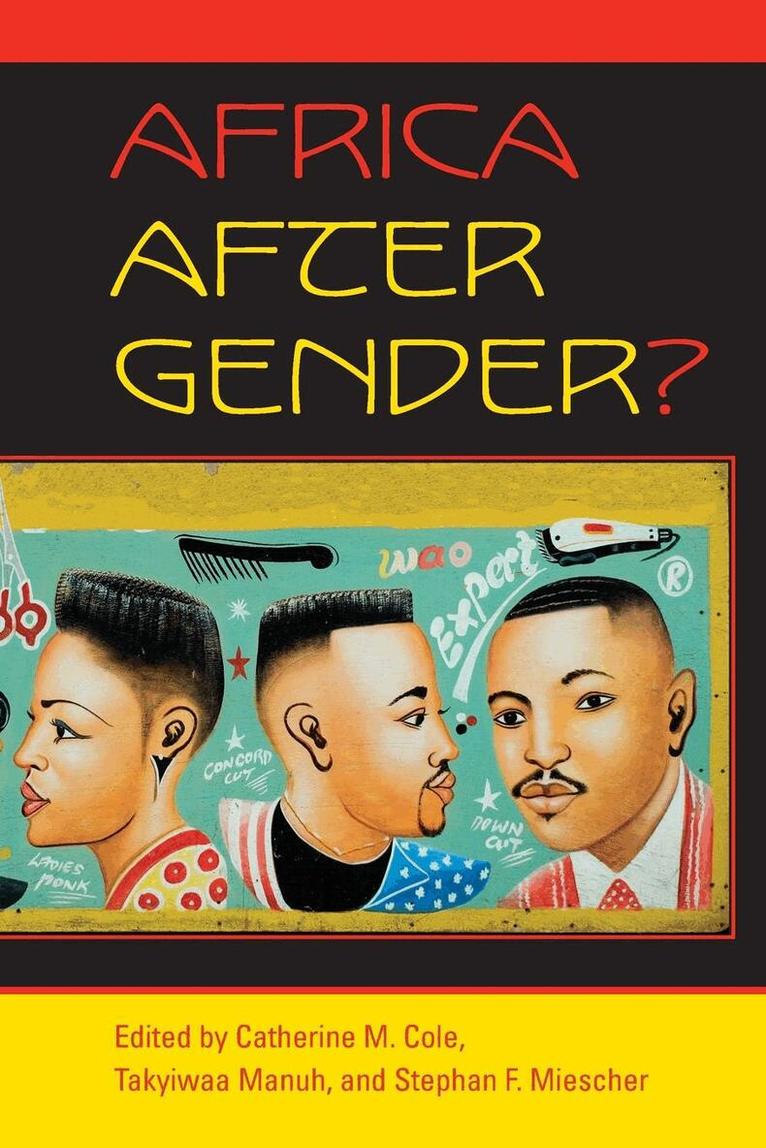
    Africa After Gender?

    AvCatherine M. Cole,Takyiwaa Manuh

    Häftad, Engelska, 2007

    Del i serien Indiana University Press (IPS)

    271 kr

    Beställningsvara. Skickas inom 10-15 vardagar. Fri frakt över 249 kr.

    Beskrivning

    Gender is one of the most productive, dynamic, and vibrant areas of Africanist research today. But what is the meaning of gender in an African context? Why does gender usually connote women? Why has gender taken hold in Africa when feminism hasn't? Is gender yet another Western construct that has been applied to Africa however ill-suited and riddled with assumptions? Africa After Gender? looks at Africa now that gender has come into play to consider how the continent, its people, and the term itself have changed. Leading Africanist historians, anthropologists, literary critics, and political scientists move past simple dichotomies, entrenched debates, and polarizing identity politics to present an evolving discourse of gender. They show gender as an applied rather than theoretical tool and discuss themes such as the performance of sexuality, lesbianism, women's political mobilization, the work of gendered NGOs, and the role of masculinity in a gendered world. For activists, students, and scholars, this book reveals a rich and cross-disciplinary view of the status of gender in Africa today.Contributors are Hussaina J. Abdullah, Nwando Achebe, Susan Andrade, Eileen Boris, Catherine M. Cole, Paulla A. Ebron, Eileen Julien, Lisa A. Lindsay, Adrienne MacIain, Takyiwaa Manuh, Stephan F. Miescher, Helen Mugambi, Gay Seidman, Sylvia Tamale, Bridget Teboh, Lynn M. Thomas, and Nana Wilson-Tagoe.

    Produktinformation

    • Utgivningsdatum:2007-02-07
    • Mått:156 x 235 x 22 mm
    • Vikt:499 g
    • Format:Häftad
    • Språk:Engelska
    • Serie:Indiana University Press (IPS)
    • Antal sidor:344
    • Förlag:Indiana University Press
    • ISBN:9780253218773

    Utforska kategorier

    • Genusvetenskap inom Samhälle och politik

    Mer om författaren

    Catherine M. Cole is Associate Professor of Dramatic Art and Associate Director of the Interdisciplinary Humanities Center at the University of California, Santa Barbara. She is author of Ghana's Concert Party Theatre (IUP, 2001).Takyiwaa Manuh is Professor of African Studies at the University of Ghana, Legon, and serves as Director of the Institute of African Studies.Stephan F. Miescher is Associate Professor of History at the University of California, Santa Barbara. He is author of Making Men in Ghana (IUP, 2005).

    Recensioner i media

    ". . . this book is an important contribution to the location of knowledge production and the study of gender in Africa. The multi- and transdisciplinary essays emphasize in various pragmatic ways how local custodians immeasurably enrich collaborative scholarly research. Other essays offer fresh approaches to gender and gender performance while situating such enactments within a transcontinental global framework with the clear aim of promoting less antagonistic North-South dialogue and groundbreaking studies of women's and gender issues in Africa.39.4 Winter 2008"—JULIANA MAKUCHI NFAH-ABBENYI, NORTH CAROLINA STATE UNIVERSITY"[This] is a truly remarkable and important book . . . . This text offer[s] a fresh and challenging analysis on African gender issues. . . . This book is very accessible and engaging . . . . It should have widespread appeal to Africanists from all subfields, as well as scholars of women and gender studies. Africa after Gender? makes a significant contribution to African studies and illuminates the changing discourse of gender within African contexts.June 2010"—Jacqueline-Bethel T. Mougoue, Purdue University

    Innehållsförteckning

    • ContentsAcknowledgmentsIntroduction: When Was Gender?Stephan F. Miescher, Takyiwaa Manuh, and Catherine M. ColePart 1. Volatile Genders and New African Women1. Out of the Closet: Unveiling Sexuality Discourses in UgandaSylvia TamalePostscript compiled by Bianca A. Murillo2. Institutional Dilemmas: Representation versus Mobilization in the South African Gender CommissionGay W. Seidman3. Gendered Reproduction: Placing Schoolgirl Pregnancies in African HistoryLynn M. Thomas4. Dialoging WomenNwando Achebe and Bridget TebohPart 2. Activism and Public Space5. Rioting Women and Writing Women: Gender, Class, and the Public Sphere in AfricaSusan Z. Andrade6. Let Us Be United in Purpose: Variations on Gender Relations in the Yorùbá Popular TheatreAdrienne MacIain7. Doing Gender Work in GhanaTakyiwaa Manuh8. Women as Emergent Actors: A Survey of New Women's Organizations in Nigeria since the 1990sHussaina J. AbdullahPart 3. Gender Enactments, Gendered Perceptions9. Constituting Subjects through Performative ActsPaulla A. Ebron10. Gender After Africa!Eileen Boris11. When a Man Loves a Woman: Gender and National Identity in Wole Soyinkas's Death and the King's Horseman and Mariama Bâ's Scarlet SongEileen Julien12. Representing Culture and Identity: African Women Writers and National CulturesNana Wilson-TagoePart 4. Masculinity, Misogyny, and Seniority13. Working with Gender: The Emergence of the "Male Breadwinner" in Colonial Southwestern NigeriaLisa A. Lindsay14. Becoming an Opanyin: Elders, Gender, and Masculinities in Ghana since the Nineteenth CenturyStephan F. Miescher15. "Give Her a Slap to Warm Her Up": Post-Gender Theory and Ghana's Popular CultureCatherine M. Cole16. The "Post-Gender" Question in African StudiesHelen Nabasuta MugambiThe Production of Gendered Knowledge in the Digital AgeResources for Further ReadingList of ContributorsIndex