• Fri frakt över 249 kr
  • •
  • Snabba leveranser
  • •
  • Billiga böcker
Kundservice

Du är på sajten för privatpersoner.

Företag, bibliotek eller offentlig verksamhet?

Du handlar på classic.bokus.com, där alla dina funktioner finns intakta.
Till classic.bokus.com
Bokus logotyp. Gå till startsidan.
  • Erbjudanden
  • Nyheter
  • Student
  • Topplistor
  • Barn & ungdom
  • Bokus Play
  • E-böcker
  • Pocketböcker
  • Spel & pussel

10% rabatt på allt med kod: NYSTART10 →

Sidfot

Mina sidor

    Hjälp

    • Kundservice
    • Vanliga frågor och svar
    • Frakt och leverans
    • Retur vid ångerrätt
    • Reklamera vara
    • Betalning
    • Köpvillkor
    • Allmänna villkor
    • Information om webbplatsens tillgänglighet

    Om Bokus

    • Om oss
    • Pressrum
    • För studenter
    • För företag
    • För bibliotek och offentlig verksamhet
    • För leverantörer
    • Hållbarhet

    Populärt

    • Aktuella erbjudanden
    • Presentkort
    • Studentlitteratur
    • Nya böcker
    • Topplistor
    • Signerade böcker
    • Engelska böcker

    Inspiration

    • Boktips
    • BookTok
    • Populära bokserier
    • Barnbokskaraktärer
    • Populära författare
    Logotyp för Bokus
    Följ oss på Facebook (extern länk)Följ oss på Instagram (extern länk)Följ oss på YouTube (extern länk)Följ oss på TikTok (extern länk)
    bokus @ CookiesAnpassa cookiesIntegritetspolicyKöpvillkor
    Till Citymail hemsida (extern länk)Till Budbee hemsida (extern länk)Till Postnord hemsida (extern länk)Till Schenker hemsida (extern länk)Till Early Bird hemsida (extern länk)Till Walleys hemsida (extern länk)
    1. Kultur
    2. Scenkonst och film
    3. Dansböcker

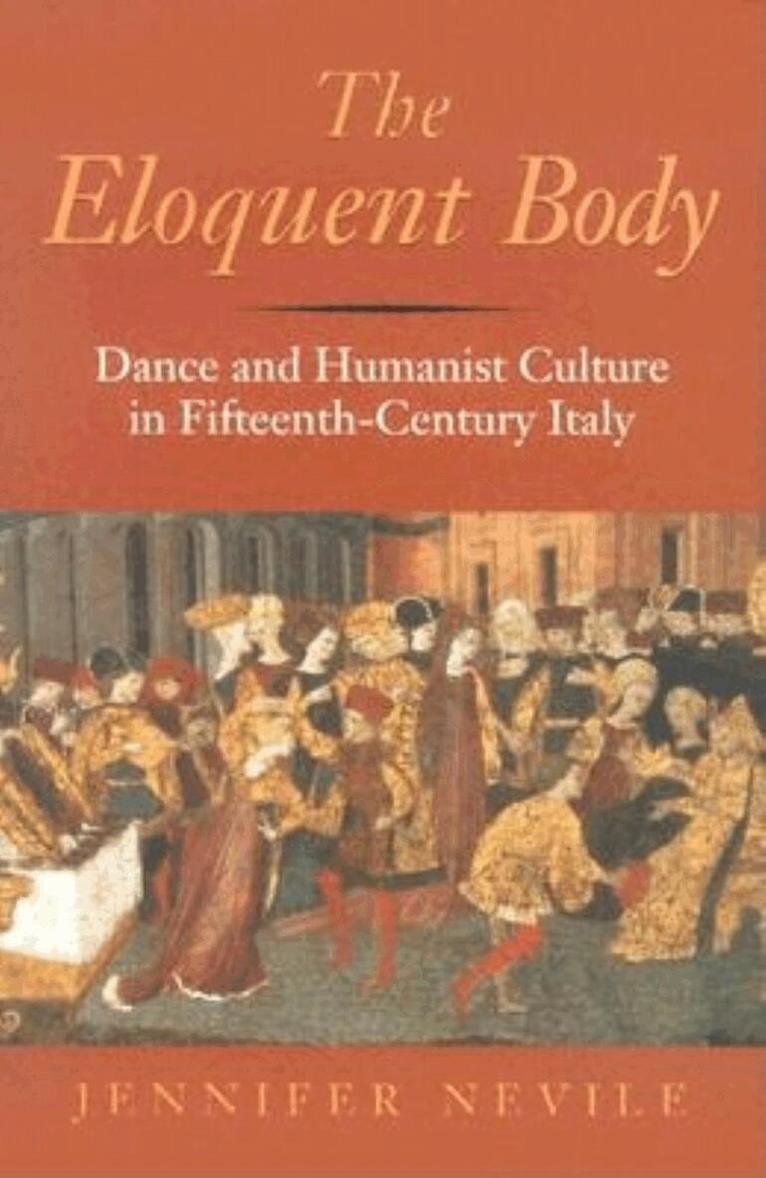
    Eloquent Body

    Dance and Humanist Culture in Fifteenth-Century Italy

    AvJennifer Nevile

    Inbunden, Engelska, 2004

    Del i serien Indiana University Press (IPS)

    465 kr

    Beställningsvara. Skickas inom 10-15 vardagar. Fri frakt över 249 kr.

    Beskrivning

    "This book adds an entirely new dimension to the consideration of Humanism and Italian culture. It will make a welcome addition to the field of cultural studies by broadening the subject to consider an important source of information that has been previously overlooked." —Timothy McGeeThe Eloquent Body offers a history and analysis of court dancing during the Renaissance, within the context of Italian Humanism. Each chapter addresses different philosophical, social, or intellectual aspects of dance during the 15th century. Some topics include issues of economic class, education, and power; relating dance treatises to the ideals of Humanism and the meaning of the arts; ideas of the body as they relate to elegance, nobility, and ethics; the intellectual history of dance based on contemporaneous readings of Pythagoras and Plato; and a comparison of geometric dance structures to geometric order in Humanist architecture.

    Produktinformation

    • Utgivningsdatum:2004-11-12
    • Mått:156 x 235 x 20 mm
    • Vikt:581 g
    • Format:Inbunden
    • Språk:Engelska
    • Serie:Indiana University Press (IPS)
    • Antal sidor:264
    • Förlag:Indiana University Press
    • ISBN:9780253344533

    Utforska kategorier

    • Dansböcker inom Kultur

    Mer om författaren

    Jennifer Nevile has a Ph.D. in musicology from the University of New South Wales. She has published many articles in early music, history, and dance journals, including Early Music and Renaissance Quarterly. She is currently an Honorary Research Fellow in the School of Music and Music Education at UNSW.

    Recensioner i media

    "This book makes a notable contribution to the history of dance. It brings the art of dance into the scholarly fold, arguing persuasively that humanism influenced dance treatises as much as it affected poetry, music and philosophy, and demonstrates that skill in dancing in the Early Renaissance was a grace that every courtier had to master in order to distinguish himself as a true gentleman and to do well at court.24.1 2006"—Dance Research"Musicologist Nevile (Univ. of New South Wales) documents the place of dance in the intellectual, social, and cultural world of 15th-century Italian elites. She analyzes treatises by three maestri di ballo (dance masters)—Domenico da Piacenza, Antonio Cornazano, and Guglielmo Ebreo da Pesaro—that apply to dancing the precepts of proportion, harmony, and moderation that humanists applied to rhetoric, painting, and architecture. Treating dance as an extension of music, which was part of the traditional quadrivium, these men elevated dance both as a means of moral education and as an articulation of the geometrical rules by which the universe was ordered. In thus dignifying their field of expertise, the maestri di ballo asserted their own importance as arbiters of style. Extensive passages from secondary and primary sources document the uncontroversial observation that dance was integral to Renaissance court culture. More original is Nevile's analysis of the dance treatises: attending to Pythagorean proportions, moral edification, and social decorum, these works paralleled contemporaneous theorizing by Guarino Guarini about literary education and by Leon Battista Alberti about painting and architecture. A helpful appendix details the floor tracks and music of four balli by Domenico. Summing Up: Recommended. Upper-division undergraduates and above."—K. Gouwens, University of Connecticut , 2005oct CHOICE". . . Neville highlights [dance's] . . . important role in fifteenth-century Italian society, focusing on how it embodied humanist concerns. Vol.32.2 2009"—Sue In Kim, DANCE CHRONICLE"[T]his is essential reading for anyone interested in the history of theatrical dance."—Early Music". . . the presence of this publication . . . will spur the kind of additional research that will help to fill in the picture."—Timothy J. McGee, Trent University

    Innehållsförteckning

    • AcknowledgementsManuscript AbbreviationsIntroductionChapter 1: Dance and SocietyChapter 2: The Dance Treatises and Humanist IdealsChapter 3: Eloquent Movement - Eloquent ProseChapter 4: Dance and the IntellectChapter 5: Order and VirtueConclusionAppendix 1: Transcription and translation of Florence, Biblioteca Nazionale Magl. VII 1121 f. 63r-69v by Giovanni CarsanigaAppendix 2: The use of mensuration signs as proportion signs in the dance treatisesAppendix 3: Floor track and music of Anello, La ingrata, Pizochara and Verçeppe EndnotesBibliographyIndex