• Fri frakt över 249 kr
  • •
  • Snabba leveranser
  • •
  • Billiga böcker
Kundservice

Du är på sajten för privatpersoner.

Företag, bibliotek eller offentlig verksamhet?

Du handlar på classic.bokus.com, där alla dina funktioner finns intakta.
Till classic.bokus.com
Bokus logotyp. Gå till startsidan.
  • Erbjudanden
  • Nyheter
  • Student
  • Topplistor
  • Barn & ungdom
  • Bokus Play
  • E-böcker
  • Pocketböcker
  • Spel & pussel

10% rabatt på allt med kod: NYSTART10 →

Sidfot

Mina sidor

    Hjälp

    • Kundservice
    • Vanliga frågor och svar
    • Frakt och leverans
    • Retur vid ångerrätt
    • Reklamera vara
    • Betalning
    • Köpvillkor
    • Allmänna villkor
    • Information om webbplatsens tillgänglighet

    Om Bokus

    • Om oss
    • Pressrum
    • För studenter
    • För företag
    • För bibliotek och offentlig verksamhet
    • För leverantörer
    • Hållbarhet

    Populärt

    • Aktuella erbjudanden
    • Presentkort
    • Studentlitteratur
    • Nya böcker
    • Topplistor
    • Signerade böcker
    • Engelska böcker

    Inspiration

    • Boktips
    • BookTok
    • Populära bokserier
    • Barnbokskaraktärer
    • Populära författare
    Logotyp för Bokus
    Följ oss på Facebook (extern länk)Följ oss på Instagram (extern länk)Följ oss på YouTube (extern länk)Följ oss på TikTok (extern länk)
    bokus @ CookiesAnpassa cookiesIntegritetspolicyKöpvillkor
    Till Citymail hemsida (extern länk)Till Budbee hemsida (extern länk)Till Postnord hemsida (extern länk)Till Schenker hemsida (extern länk)Till Early Bird hemsida (extern länk)Till Walleys hemsida (extern länk)
    1. Filosofi och religion
    2. Religion och tro
    3. Religion: allmänt

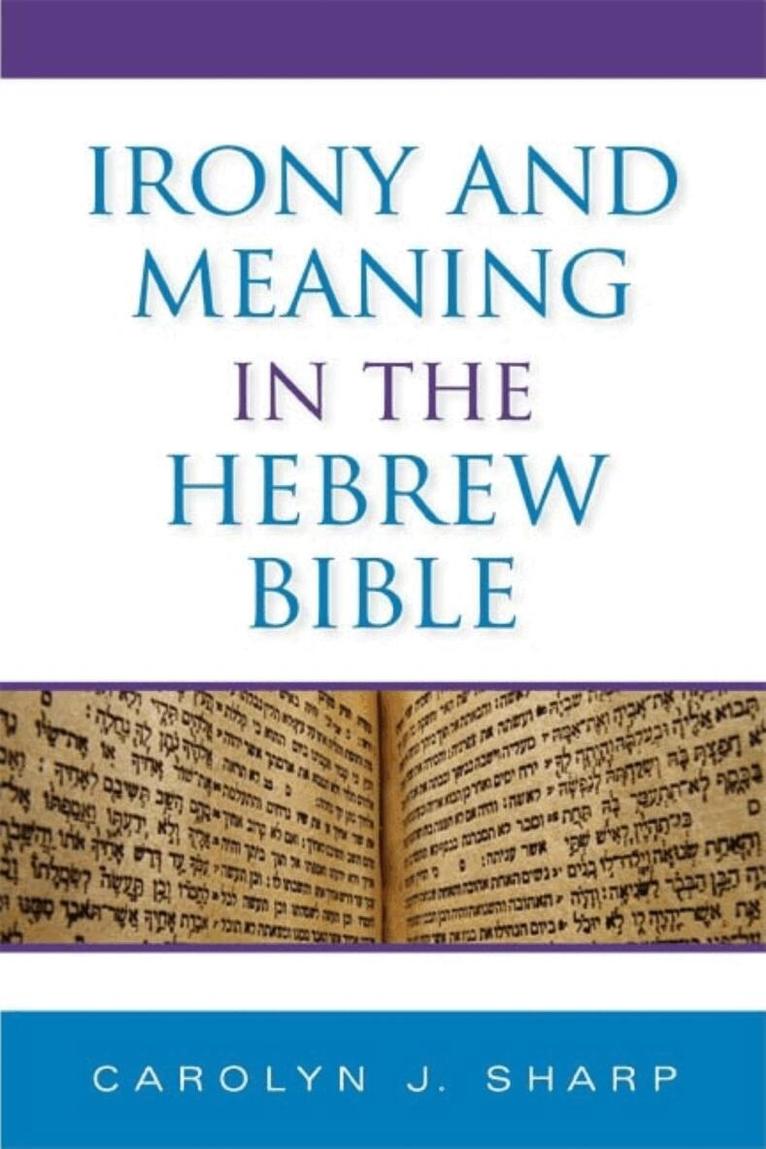
    Irony and Meaning in the Hebrew Bible

    AvCarolyn J. Sharp

    Inbunden, Engelska, 2008

    Del i serien Biblical Literature

    451 kr

    Beställningsvara. Skickas inom 10-15 vardagar. Fri frakt över 249 kr.

    Beskrivning

    Was God being ironic in commanding Eve not to eat fruit from the tree of wisdom? Carolyn J. Sharp suggests that many stories in the Hebrew Scriptures may be ironically intended. Deftly interweaving literary theory and exegesis, Sharp illumines the power of the unspoken in a wide variety of texts from the Pentateuch, the Prophets, and the Writings. She argues that reading with irony in mind creates a charged and open rhetorical space in the texts that allows character, narration, and authorial voice to develop in unexpected ways. Main themes explored here include the ironizing of foreign rulers, the prostitute as icon of the ironic gaze, indeterminacy and dramatic irony in prophetic performance, and irony in ancient Israel's wisdom traditions. Sharp devotes special attention to how irony destabilizes dominant ways in which the Bible is read today, especially when it touches on questions of conflict, gender, and the Other.

    Produktinformation

    • Utgivningsdatum:2008-12-23
    • Mått:152 x 229 x 27 mm
    • Vikt:676 g
    • Format:Inbunden
    • Språk:Engelska
    • Serie:Biblical Literature
    • Antal sidor:376
    • Förlag:Indiana University Press
    • ISBN:9780253352446

    Utforska kategorier

    • Religion: allmänt inom Filosofi och religion
    • Kristendom inom Filosofi och religion

    Mer om författaren

    Carolyn J. Sharp is Associate Professor of Hebrew Scriptures at Yale Divinity School. She is author of Prophecy and Ideology in Jeremiah: Struggles for Authority in the Deutero-Jeremianic Prose; and Old Testament Prophets for Today.

    Recensioner i media

    "Author Carolyn J. Sharp, an associate professor of Hebrew Scriptures at Yale Divinity School, suggests that many stories in the Hebrew Scriptures may be ironically intended. In her new IU Press book, Irony and Meaning in the Hebrew Bible, she deftly interweaves literary theory and exegesis, while illuminating the power of the unspoken in a wide variety of texts from the Pentateuch, the Prophets and the Writings. She argues that reading with irony in mind creates a charged and open rhetorical space in the texts that allows character, narration and authorial voice to develop in unexpected ways. Main themes explored include the ironizing of foreign rulers, the prostitute as an icon of the ironic gaze, indeterminacy and dramatic irony in prophetic performance, and irony in ancient Israel's wisdom traditions. Sharp focuses on how irony destabilizes dominant ways in which the Bible is read today, especially when it touches on questions of conflict, gender and the Other. She is also the author of Prophecy and Ideology in Jeremiah: Struggles for Authority in the Deutero-Jeremianic Prose and Old Testament Prophets for Today."—Steve Hinnefeld, Media Contact, IU News Room, Book Marks, March 9, 2009"Sharp (Yale Divinity School) blends theoretically dense literary criticism with careful exegesis to explore the Hebrew Bible's use of irony. The first chapter focuses on defining irony in dialogue with literary scholarship. Subsequent chapters offer exegesis of selected texts, arguing why ironic readings seem more apt to textual features then do literal or 'straight' readings that take the texts at face value. Sharp's exegeses, done in conversation with other scholarship, are a good model for exegetes in training. Commentators often pronounce the 'best reading' of a text, but Sharp admits she might find irony where none is intended. She challenges those advocating non-ironic readings to give textual clues, rather than notions of biblical authority read theologically into a literary text, to prove her wrong. This sophisticated work might be too dense for those not versed in biblical studies, but those willing to wade through its dense theoretical argumentation will be rewarded with an example of Hebrew Bible scholarship at its finest. This rich, dense work of literary scholarship is a must for serious collections of biblical studies. Summing Up: Highly recommended. Upper-level undergraduates and above. — Choice"—A. W. Klink, Duke University, August 2009"Carolyn J. Sharp suggests that many stories in the Hebrew Scriptures may be ironically intended. Interweaving literary theory and exegesis, Sharp argues that reading with irony in mind creates a charged and open rhetorical space in the texts that allows character, narration, and authorial voice to develop in unexpected ways. Main themes explored here include the ironizing of foreign rulers, the prostitute as icon of the ironic gaze, indeterminacy and dramatic irony in prophetic performance, and irony in ancient Israel's wisdom traditions. Sharp devotes special attention to how irony destabilizes dominant ways in which the Bible is read today, especially when it touches on questions of conflict, gender, and the Other."—Shofar, Vol. 28.1 Fall 2009"'Universes hang in the balance with every act of reading an ironic sacred text'—this first line of the first chapter is the book's 'White Rabbit,' which instantly seduces the reader to follow the author into a newly-charted wonderland of biblical rhetoric. Highly recommended . . . .Sept./Oct. 2009"—Dr. Yaffa Weisman, Hebrew Union College, Los Angeles, CA"[This book] offers a fascinating exploration of the the presence and the power of irony in the Hebrew bible.Summer 2009"—Tony Cartledge, Campbell University Divinity School"Careful readers must be especially attentive to the possibilities [that] the biblical texts mean otherwise than what they say."—Mark Minster, Rose-Hulman Institute of Technology"[Sharp] negotiates between a modernist and post—modernist understanding of the biblical text, taking authorial intent seriously while attending to textual self—subversion."—Steven Weitzman, Indiana University"Carolyn Sharp has offered a magnificent exhibit of the thickness of the Hebrew Bible. Her work is a profound and exquisite invitation to reflect on prophetic imagination in its subtle subversion."—Walter Brueggemann, Columbia Theological Seminary"Engaging, erudite, and rich with insight, Sharp's book invites us to dwell between the said and the unsaid, to 'hear word and silence together' in a way that reveals irony at the very core of biblical tradition. This is a must-read for anyone interested in literary criticism, theory, and the Hebrew Bible."—Timothy K. Beal, Case Western Reserve University

    Innehållsförteckning

    • ContentsPreface and AcknowledgmentsIntroduction1. Interpreting Irony: Rhetorical, Hermeneutical, and Theological PossibilitiesIrony and Contemporary Methodological DebatesMethod: Multiaxial CartographyLeaving the Garden: The Wisdom of Irony2. Foreign Rulers and the Fear of GodPharaoh and Abimelech as Innocents Ensnared"Am I in the Place of God?": Joseph the PretenderBelshazzar, Darius, and Hermeneutical Risk-TakingThe Ending of Esther and Narratological Excess3. The Prostitute as Icon of the Ironic GazeTamar the RighteousRahab the CleverJael the BoldGomer the BelovedRuth the Loyal4. The Irony of Prophetic PerformanceOracular Indeterminacy and Dramatic Irony in the Story of BalaamHermeneutics of De(con)struction: Amos as Samson RedivivusContested Hermeneutics and the Undecidability of Micah 2:12–13Irony as Emetic: Parody in the Book of Jonah5. "How Long Will You Love Being Simple?" Irony in Wisdom TraditionsIronic Representation, Authorial Voice, and Meaning in QoheletRereading Desire as Doublespeak in Psalm 736. ConclusionIrony and Scriptural SignifyingLeaving the Garden Again: New BeginningsNotesBibliographyIndex of Biblical PassagesAuthor IndexSubject Index