• Fri frakt över 249 kr
  • •
  • Snabba leveranser
  • •
  • Billiga böcker
Kundservice

Du är på sajten för privatpersoner.

Företag, bibliotek eller offentlig verksamhet?

Du handlar på classic.bokus.com, där alla dina funktioner finns intakta.
Till classic.bokus.com
Bokus logotyp. Gå till startsidan.
  • Erbjudanden
  • Nyheter
  • Student
  • Topplistor
  • Barn & ungdom
  • Bokus Play
  • E-böcker
  • Pocketböcker
  • Spel & pussel

10% rabatt på allt med kod NYSTART10 →

Sidfot

Mina sidor

    Hjälp

    • Kundservice
    • Vanliga frågor och svar
    • Frakt och leverans
    • Retur vid ångerrätt
    • Reklamera vara
    • Betalning
    • Köpvillkor
    • Allmänna villkor
    • Information om webbplatsens tillgänglighet

    Om Bokus

    • Om oss
    • Pressrum
    • För studenter
    • För företag
    • För bibliotek och offentlig verksamhet
    • För leverantörer
    • Hållbarhet

    Populärt

    • Aktuella erbjudanden
    • Presentkort
    • Studentlitteratur
    • Nya böcker
    • Topplistor
    • Signerade böcker
    • Engelska böcker

    Inspiration

    • Boktips
    • BookTok
    • Populära bokserier
    • Barnbokskaraktärer
    • Populära författare
    Logotyp för Bokus
    Följ oss på Facebook (extern länk)Följ oss på Instagram (extern länk)Följ oss på YouTube (extern länk)Följ oss på TikTok (extern länk)
    bokus @ CookiesAnpassa cookiesIntegritetspolicyKöpvillkor
    Till Citymail hemsida (extern länk)Till Budbee hemsida (extern länk)Till Postnord hemsida (extern länk)Till Schenker hemsida (extern länk)Till Early Bird hemsida (extern länk)Till Walleys hemsida (extern länk)
    1. Läromedel
    2. Läromedel: samhälle och humaniora
    3. Läromedel: historia

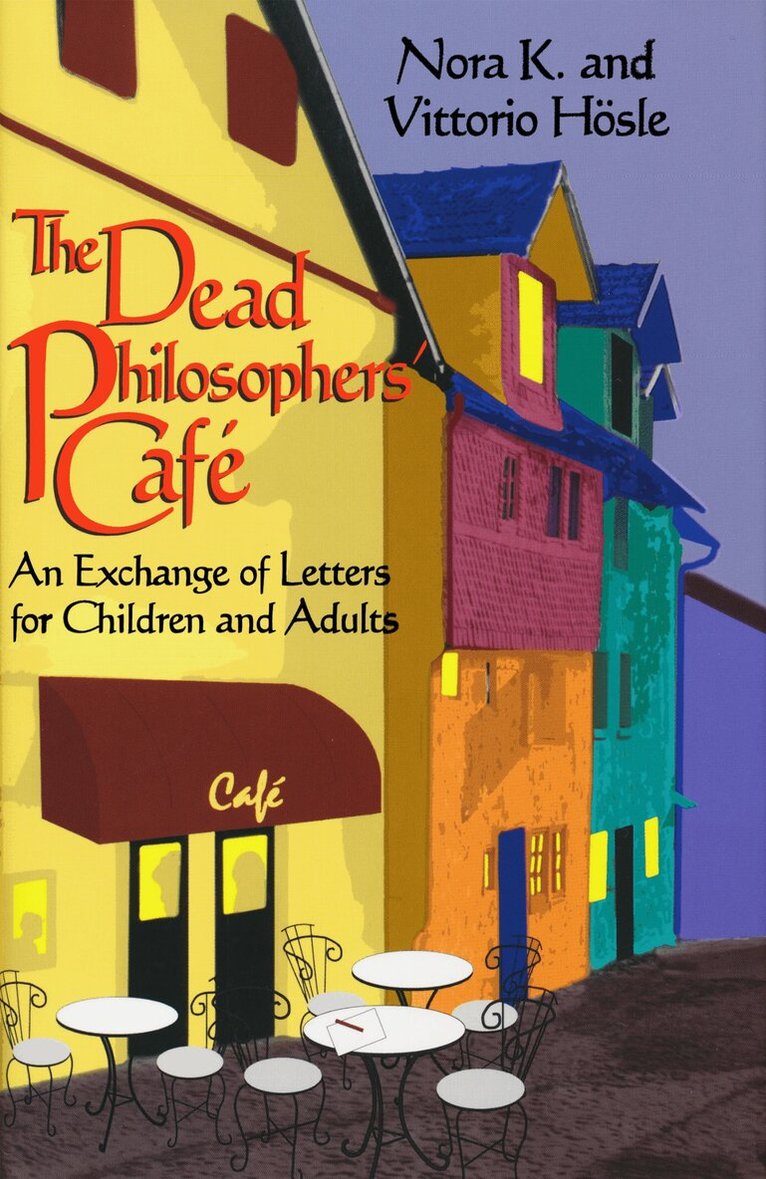
    Dead Philosophers' Cafe, the

    An Exchange of Letters for Children and Adults

    AvVittorio Hösle

    Inbunden, Engelska, 2002

    262 kr

    Beställningsvara. Skickas inom 5-8 vardagar. Fri frakt över 249 kr.

    Beskrivning

    Eleven-year-old Nora K. received Jostein Gaarder's Sophie's World as a birthday present, and in it she read about Plato's theory of ideas. One problem especially intrigued her: What about the Platonic idea of the dinosaur? Ideas are timeless and cannot die. The dinosaurs, however, became extinct ages ago. Does the idea of the dinosaur still exist all the same? Could it even be that the material world is a dream and time an illusion? Moreover, is there such a thing as free will, or is everything predetermined? Is the soul eternal? Do animals have a consciousness? Is the universe infinite? Is there such a thing as objective truth? Does God exist, and why is there evil in the world?These are some of Nora's questions which prompted her correspondence with Vittorio Hösle, a philosopher by profession, who invents a wonderful philosophical fantasy. Taking the film Dead Poets Society as his inspiration, he creates a place where the great philosophers of antiquity and their modern successors can all meet. They gather in the "Café of the Dead but Ever Young Philosophers" and discuss Nora's letters—Parmenides and Socrates, Descartes and Hobbes (whom Nora doesn't like at all), "Mac" (Machiavelli) and Kant, Nora's "patron philosopher" Giambattista Vico and Hans Jonas, and many others. The sparks fly from time to time, as the great thinkers squabble quite frequently—no wonder, since conflicting arguments from the entire history of philosophy collide with each other head-on.Nora's letters are intelligent, never precocious, and always imaginative. Vittorio Hösle provides answers which are entertaining but still critical, and he is clearly concerned about not setting his expectations of the child too low. In his afterword on children's philosophy and philosophy with children, he sketches what role philosophy could play in raising children. The correspondence with Nora, an authentic exchange of letters between January 1994 and January 1996, is a lovely document of a philosophical friendship between an adult and a child.The Dead Philosophers' Café has been widely translated and is now making its first appearance in the English language.

    Produktinformation

    • Utgivningsdatum:2002-03-20
    • Mått:140 x 216 x 14 mm
    • Vikt:376 g
    • Format:Inbunden
    • Språk:Engelska
    • Antal sidor:176
    • Förlag:University of Notre Dame Press
    • ISBN:9780268008949

    Utforska kategorier

    • Läromedel: historia inom Läromedel
    • Filosofiska discipliner inom Filosofi och religion

    Mer om författaren

    Vittorio Hösle is Professor of Philosophy at the University of Essen, and Director at the Research Institute for Philosophy in Hannover, Germany as well as Paul Kimball Professor of Arts and Letters at the University of Notre Dame. He is the author of numerous books, including Die Philosophie und die Wissenschaften (1999), Moral und Politik (1997), Philosophiegeschichte und objektiver Idealismus (1996), Philosophie der ökologischen Krise (1994), and Objective Idealism, Ethics, and Politics (Notre Dame Press, 1998).

    Recensioner i media

    "These discussions—related to Nora through Vittorio's letters—raise, challenge, and vigorously debate these issues in a philosophically satisfying and entertaining fashion. To its credit, this work implicitly argues that philosophical ideas and problems are not solely a playground for adults; they are equally relevant to children. It also illustrates that, by engaging the intellect and imagination in a comprehensive and constructive way, philosophy may even be fun." —International Philosophical Quarterly"Hösle (Univ. of Essen, Germany, and Univ. of Notre Dame, Indiana) presents two years of correspondence between himself and an 11- to 13- year-old girl identified as Nora K. Nora received a copy of Jostein Gaarder's Sophie's World (Eng., 1994); when Hösle first met her, she asked whether the Platonic idea of the dinosaur had ceased to exist, since there are no living dinosaurs. In a thank you note for a marzipan dinosaur present from Hösle, she mentioned that Aristotle's conception of women made her made. Hösle responded with a letter describing the "Cafe of the Dead but Ever Young Philosophers." where the philosophers Gaarder mentioned were encountered arguing among themselves. Nora was quick to play along with the fantasy, and 56 letters ensued. There is much of interest in the letters, but it is easy to miss the point of this book. A better beginning might have been prefaced by Nora; only late does Hösle reveal his intention: "What is new, and perhaps unique, about the present work is that it contains the philosohy of a child" rather than philosophy about children. Hösle ends with an insightful commentary but risks losing readers by failing to say earlier why and how they should attend to the exchange. Recommended; all levels." —Choice