• Fri frakt över 249 kr
  • •
  • Snabba leveranser
  • •
  • Billiga böcker
Kundservice

Du är på sajten för privatpersoner.

Företag, bibliotek eller offentlig verksamhet?

Du handlar på classic.bokus.com, där alla dina funktioner finns intakta.
Till classic.bokus.com
Bokus logotyp. Gå till startsidan.
  • Erbjudanden
  • Nyheter
  • Student
  • Topplistor
  • Barn & ungdom
  • Bokus Play
  • E-böcker
  • Pocketböcker
  • Spel & pussel

10% rabatt på allt med kod NYSTART10 →

Sidfot

Mina sidor

    Hjälp

    • Kundservice
    • Vanliga frågor och svar
    • Frakt och leverans
    • Retur vid ångerrätt
    • Reklamera vara
    • Betalning
    • Köpvillkor
    • Allmänna villkor
    • Information om webbplatsens tillgänglighet

    Om Bokus

    • Om oss
    • Pressrum
    • För studenter
    • För företag
    • För bibliotek och offentlig verksamhet
    • För leverantörer
    • Hållbarhet

    Populärt

    • Aktuella erbjudanden
    • Presentkort
    • Studentlitteratur
    • Nya böcker
    • Topplistor
    • Signerade böcker
    • Engelska böcker

    Inspiration

    • Boktips
    • BookTok
    • Populära bokserier
    • Barnbokskaraktärer
    • Populära författare
    Logotyp för Bokus
    Följ oss på Facebook (extern länk)Följ oss på Instagram (extern länk)Följ oss på YouTube (extern länk)Följ oss på TikTok (extern länk)
    bokus @ CookiesAnpassa cookiesIntegritetspolicyKöpvillkor
    Till Citymail hemsida (extern länk)Till Budbee hemsida (extern länk)Till Postnord hemsida (extern länk)Till Schenker hemsida (extern länk)Till Early Bird hemsida (extern länk)Till Walleys hemsida (extern länk)
    1. Filosofi och religion
    2. Religion och tro
    3. Religion: allmänt

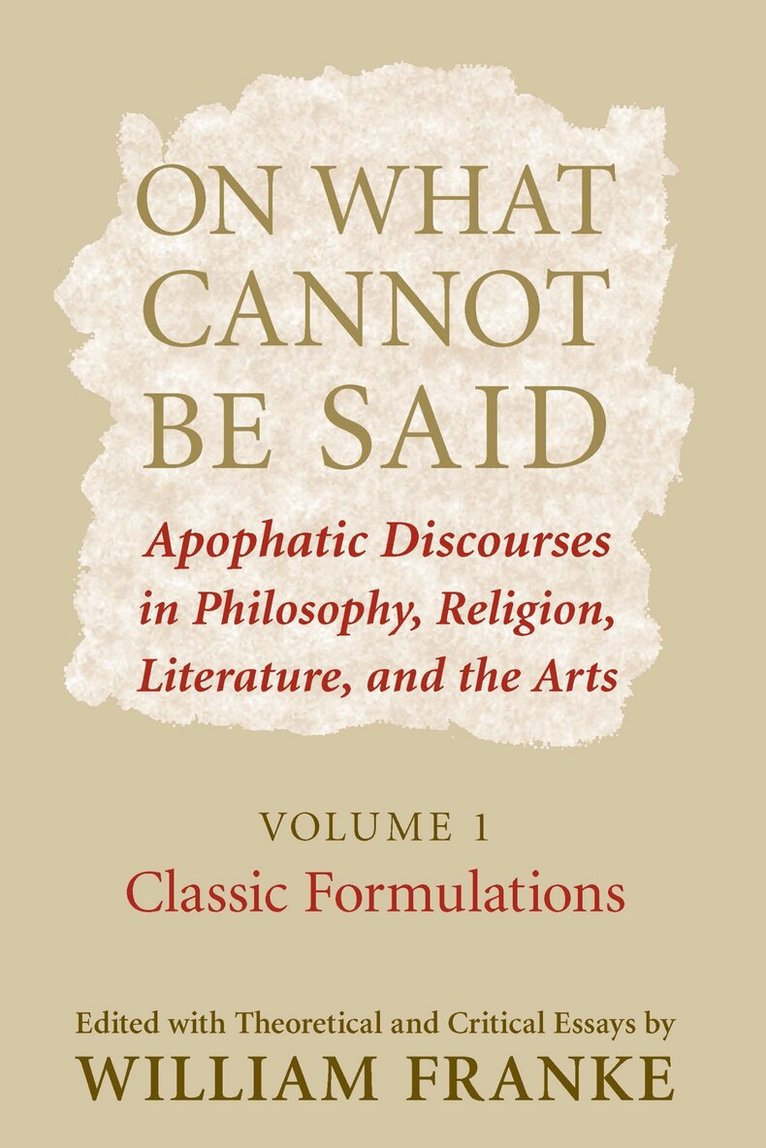
    On What Cannot Be Said

    Apophatic Discourses in Philosophy, Religion, Literature, and the Arts. Volume 1. Classic Formulations

    AvWilliam Franke

    Häftad, Engelska, 2007

    453 kr

    Beställningsvara. Skickas inom 5-8 vardagar. Fri frakt över 249 kr.

    Beskrivning

    Apophasis has become a major topic in the humanities, particularly in philosophy, religion, and literature. This monumental two-volume anthology gathers together most of the important historical works on apophaticism and illustrates the diverse trajectories of apophatic discourse in ancient, modern, and postmodern times. William Franke provides a major introductory essay on apophaticism at the beginning of each volume, and shorter introductions to each anthology selection. The first volume, Classic Formulations, offers excerpts from Plato, Plotinus, Damascius, the Bible, Gregory of Nyssa, Augustine, Pseudo-Dionysius, Maimonides, Rumi, Thomas Aquinas, Marguerite Porete, Dante, Teresa of Ávila, John of the Cross, and more.

    Produktinformation

    • Utgivningsdatum:2007-04-01
    • Mått:152 x 229 x 23 mm
    • Vikt:606 g
    • Format:Häftad
    • Språk:Engelska
    • Antal sidor:416
    • Förlag:University of Notre Dame Press
    • ISBN:9780268028824

    Utforska kategorier

    • Religion: allmänt inom Filosofi och religion
    • Kristendom inom Filosofi och religion

    Mer om författaren

    William P. Franke is professor of comparative literature and religious studies at Vanderbilt University and past professor of philosophy and religions at the University of Macao (2013–16). He is a research fellow of the Alexander von Humboldt-Stiftung and has been Fulbright-University of Salzburg Distinguished Chair in Intercultural Theology and Study of Religions. He is the author of A Philosophy of the Unsayable (University of Notre Dame Press, 2014).

    Recensioner i media

    "The genius of Franke's two-volume critical anthology on apophatic discourses is the work's breadth and depth of engagement with the concept in variously distinct and even conflicting contexts. . . . Franke manages his sweeping and inclusive exploration of apophatic discourses by identifying a thematic lens for selecting his sources as part of a larger, conceptually-rooted genre of discourse. . . . the greatest strength of Franke's two-volume collection resides in the sheer fact that nothing like it exists." —Essays in Philosophy". . . one of the most important and original contributions to the discussion of apophasis in recent years. . . . Franke's historical and disciplinary range, in light of his well-written and compelling essays, provides an illuminating insight into the pervasiveness of apophatic discourse. . . . Franke's anthology is a resource which should not be ignored. Few others, maybe no others, provide the same clarity, coherence, and scope." —Christianity and Literature"These two volumes successfully realize a massive project: to propose and delineate a new field of discourse that provides a fresh approach to Western thought as a whole. In short, William Franke demonstrates the centrality of apophaticism, 'what cannot be said,' to the Western tradition, from Plato (and before) to Derrida (and beyond). . . . The first volume covers the first 'cycles' of apophasis, as the Western tradition evolves, stretching from the commentary tradition of Plato's Parmenides to Eckhart and his progenitors. . . . Franke's work is nothing short of brilliant." —Religion and Literature"Developments in critical theory during the past two decades have led to renewed interest in negative theology. Books like Languages of the Unsayable (1989), Negation and Theology (1992), Derrida and Negative Theology (1992), and The Otherness of God (1998) have signaled the resurgence of this ancient tradition. William Franke's distinctive contribution is to provide the background and texts from which these recent developments have emerged." —Mark Taylor, Williams College"Any writer worth his salt knows that what cannot be spoken is ultimately the thing worth speaking about; yet most often this humbling awareness is unsaid or covered up. There are some who have made it their business, however, to court failure and acknowledge defeat, to explore the impasse of words before silence. William Franke has created an anthology of such explorations, undertaken in poetry and prose, that stretches from Plato to the present. Whether the subject of discourse is All or Nothing does not matter: the struggle of speech to name the unnameable is the same. This ambitious two-volume undertaking demonstrates a preoccupation as old as Western civilization itself: the limits of language and the virtue of being at a loss for words. How long we have been raiding the Inarticulate!" —Peter S. Hawkins, Boston University