• Fri frakt över 249 kr
  • •
  • Snabba leveranser
  • •
  • Billiga böcker
Kundservice

Du är på sajten för privatpersoner.

Företag, bibliotek eller offentlig verksamhet?

Du handlar på classic.bokus.com, där alla dina funktioner finns intakta.
Till classic.bokus.com
Bokus logotyp. Gå till startsidan.
  • Erbjudanden
  • Nyheter
  • Student
  • Topplistor
  • Barn & ungdom
  • Bokus Play
  • E-böcker
  • Pocketböcker
  • Spel & pussel

10% rabatt på allt med kod: NYSTART10 →

Sidfot

Mina sidor

    Hjälp

    • Kundservice
    • Vanliga frågor och svar
    • Frakt och leverans
    • Retur vid ångerrätt
    • Reklamera vara
    • Betalning
    • Köpvillkor
    • Allmänna villkor
    • Information om webbplatsens tillgänglighet

    Om Bokus

    • Om oss
    • Pressrum
    • För studenter
    • För företag
    • För bibliotek och offentlig verksamhet
    • För leverantörer
    • Hållbarhet

    Populärt

    • Aktuella erbjudanden
    • Presentkort
    • Studentlitteratur
    • Nya böcker
    • Topplistor
    • Signerade böcker
    • Engelska böcker

    Inspiration

    • Boktips
    • BookTok
    • Populära bokserier
    • Barnbokskaraktärer
    • Populära författare
    Logotyp för Bokus
    Följ oss på Facebook (extern länk)Följ oss på Instagram (extern länk)Följ oss på YouTube (extern länk)Följ oss på TikTok (extern länk)
    bokus @ CookiesAnpassa cookiesIntegritetspolicyKöpvillkor
    Till Citymail hemsida (extern länk)Till Budbee hemsida (extern länk)Till Postnord hemsida (extern länk)Till Schenker hemsida (extern länk)Till Early Bird hemsida (extern länk)Till Walleys hemsida (extern länk)
    1. Skönlitteratur
    2. Litteraturvetenskap

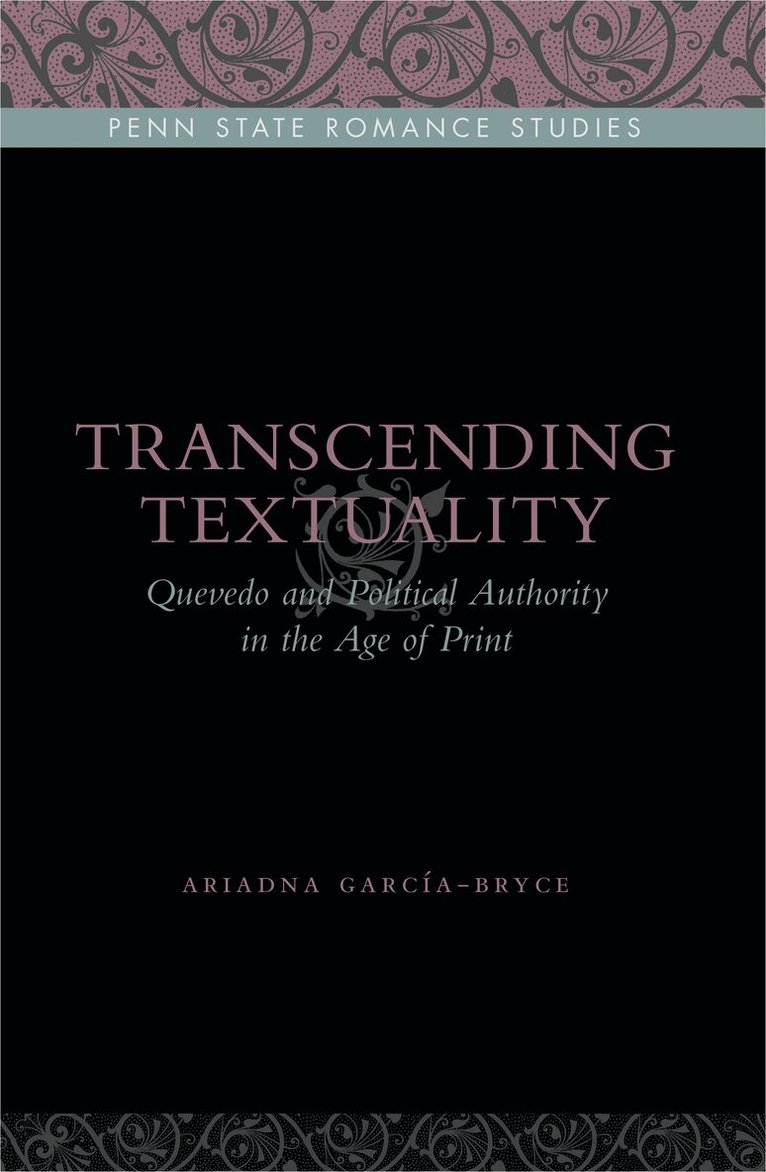
    Transcending Textuality

    Quevedo and Political Authority in the Age of Print

    AvAriadna García-Bryce

    Häftad, Engelska, 2011

    Del i serien Penn State Romance Studies

    669 kr

    Beställningsvara. Skickas inom 5-8 vardagar. Fri frakt över 249 kr.

    Fler format och utgåvor

    Inbunden

    921 kr

    Beskrivning

    In Transcending Textuality, Ariadna García-Bryce provides a fresh look at post-Trent political culture and Francisco de Quevedo’s place within it by examining his works in relation to two potentially rival means of transmitting authority: spectacle and print. Quevedo’s highly theatrical conceptions of power are identified with court ceremony, devotional ritual, monarchical and spiritual imagery, and religious and classical oratory. At the same time, his investment in physical and emotional display is shown to be fraught with concern about the decline of body-centered modes of propagating authority in the increasingly impersonalized world of print. Transcending Textuality shows that Quevedo’s poetics are, in great measure, defined by the attempt to retain in writing the qualities of live physical display.

    Produktinformation

    • Utgivningsdatum:2011-06-15
    • Mått:152 x 229 x 12 mm
    • Vikt:272 g
    • Format:Häftad
    • Språk:Engelska
    • Serie:Penn State Romance Studies
    • Antal sidor:176
    • Förlag:Pennsylvania State University Press
    • ISBN:9780271037769

    Utforska kategorier

    • Litteraturvetenskap inom Skönlitteratur

    Mer om författaren

    Ariadna García-Bryce is Professor of Spanish and Humanities at Reed College.

    Recensioner i media

    “Transcending Textuality is a fascinating study of the culture of display in early modern Spain. Focusing on the works of Quevedo, Ariadna García-Bryce brings together a multiplicity of approaches in order to provide new insights on his political views and his place in the culture of the Spanish Baroque. She clearly shows how Quevedo diverges from writers such as Saavedra Fajardo and Gracián, undermining the impetus of the emergent state and its uses of rhetorical artifice. Quevedo, in his writings, seeks to exalt art, evincing its prominent social and sacred role. And yet, in so doing, he rejects new mediated forms and the use of rhetorical artifice as exhibition. García-Bryce is able to show not only Quevedo’s conflictive stance toward modernity but also his reaction to the many changes that were taking place in the Spain of the Habsburgs. This is a thoughtful and complex study that will be of great interest to those who study the literature, culture, and history of the Baroque.”—Frederick A. de Armas, University of Chicago

    Innehållsförteckning

    • ContentsList of IllustrationsAcknowledgmentsIntroduction1. Crafting Royal Omnipotence2. The Power of the Passion3. The Agnostic Word4. Vacuous PrintEpilogueWorks CitedIndex