Inbunden, Engelska, 1995
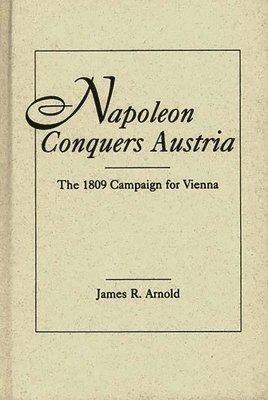
Napoleon Conquers Austria
1066 kr
Beställningsvara. Skickas inom 10-15 vardagar. Fri frakt över 249 kr.
Beskrivning
This is the first English language account of the 1809 campaign for Vienna to weave stories of individual persons into the larger motif of the struggle to dominate Europe. The book explores three themes: the decline of Napoleon's powers, the rise of German nationalism, the end of the era of cavalry dominance of the battlefield and the ascendance of artillery. The campaign for Vienna led to Napoleon's first defeat on the battlefield. In May, Napoleon sat with his defeated army at the end of a long and imperiled line of communications. At the moment of crisis, he displayed his formidable talents and prepared a masterful counterstroke. The Battle of Wagram—a battle of unprecedented lethality—was a triumph for Napoleon and led to a peace which he dictated.In 1809 the world's undisputed military genius—Napoleon Bonaparte—confronted his implacable continental foe, the Hapsburg Empire. During the Vienna campaign of that year, Napoleon suffered his first defeat since becoming Emperor, but rebounded to win Wagram, a battle of unprecedented lethality. Referring to the strategic importance of the battles he fought, Napoleon reflected: My power is dependent on my glory, and my glory on my victories. My power would fall if I did not base it on still more glory and still more victories. Conquest made me what I am; conquest alone can keep me there. Even in the midst of a life and death campaign struggle against Austria, Napoleon continued to make nearly every decision of state on a daily basis. During his bath, while being shaved, when eating his meals, aides presented petitions and requests for his tireless attention: a second lieutenant asks to retain his French citizenship while serving in the Dutch army? Granted. Emperor Alexander I of Russia asks that an English prisoner of war who is a relative of his personal surgeon be released? Granted. If genius lies in the attention to detail, here was genius at work.The sun rose on April 24, 1809, to illuminate a continent at war. From Poland to Spain, some 600,000 soldiers awakened to duty. Nowhere was the concentration of forces greater than in the Danube Valley where Napoleon had determined to launch his blow against the Austrian Generalissimus, Erzherzog (Archduke) Karl. If Karl triumphed, most of Europe stood poised to pounce. Napoleon and the French Empire would be attacked from all quarters. If Karl failed, all Europe—except England and perhaps Portugal and Spain—would make whatever accommodations were necessary to survive under Napoleonic hegemony. The ensuing campaign led to Napoleon's first defeat at Aspern-Essling. So, at the end of May, Napoleon sat with his battered army at the end of a long and imperiled line of communications while Europe erupted around him. Yet, at the moment of supreme crisis, Napoleon displayed his formidable talents and prepared a masterful counterstroke. French and Austrian alike suffered horrific losses at Wagram, but at battle's end, Napoleon's commanding presence produced a French triumph. It was a victory so complete that the Emperor forced Austria into unwilling alliance and even took the daughter of the Austrian Kaiser to be his new wife. For one last time, the French conqueror redrew Europe's map.
Produktinformation
- Utgivningsdatum: 1995-07-24
- Mått: 156 x 235 x 20 mm
- Vikt: 539 g
- Format: Inbunden
- Språk: Engelska
- Antal sidor: 278
- Förlag: Bloomsbury Publishing Plc
- ISBN: 9780275946944
Utforska kategorier
Betyg & recensioner
0 recensioner
Inga recensioner tillgängliga.