• Fri frakt över 249 kr
  • •
  • Snabba leveranser
  • •
  • Billiga böcker
Kundservice

Du är på sajten för privatpersoner.

Företag, bibliotek eller offentlig verksamhet?

Du handlar på classic.bokus.com, där alla dina funktioner finns intakta.
Till classic.bokus.com
Bokus logotyp. Gå till startsidan.
  • Erbjudanden
  • Nyheter
  • Student
  • Topplistor
  • Barn & ungdom
  • Bokus Play
  • E-böcker
  • Pocketböcker
  • Spel & pussel

10% rabatt på allt med kod: NYSTART10 →

Sidfot

Mina sidor

    Hjälp

    • Kundservice
    • Vanliga frågor och svar
    • Frakt och leverans
    • Retur vid ångerrätt
    • Reklamera vara
    • Betalning
    • Köpvillkor
    • Allmänna villkor
    • Information om webbplatsens tillgänglighet

    Om Bokus

    • Om oss
    • Pressrum
    • För studenter
    • För företag
    • För bibliotek och offentlig verksamhet
    • För leverantörer
    • Hållbarhet

    Populärt

    • Aktuella erbjudanden
    • Presentkort
    • Studentlitteratur
    • Nya böcker
    • Topplistor
    • Signerade böcker
    • Engelska böcker

    Inspiration

    • Boktips
    • BookTok
    • Populära bokserier
    • Barnbokskaraktärer
    • Populära författare
    Logotyp för Bokus
    Följ oss på Facebook (extern länk)Följ oss på Instagram (extern länk)Följ oss på YouTube (extern länk)Följ oss på TikTok (extern länk)
    bokus @ CookiesAnpassa cookiesIntegritetspolicyKöpvillkor
    Till Citymail hemsida (extern länk)Till Budbee hemsida (extern länk)Till Postnord hemsida (extern länk)Till Schenker hemsida (extern länk)Till Early Bird hemsida (extern länk)Till Walleys hemsida (extern länk)
    1. Samhälle och politik
    2. Krig och försvar

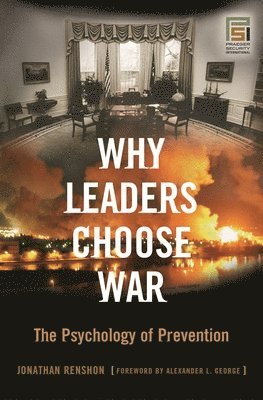
    Why Leaders Choose War

    The Psychology of Prevention

    AvJonathan Renshon

    Inbunden, Engelska, 2006

    Del i serien Praeger Security International

    701 kr

    Beställningsvara. Skickas inom 10-15 vardagar. Fri frakt över 249 kr.

    Fler format och utgåvor

    E-bok

    755 kr

    Beskrivning

    Preventive war has a long history in international politics, but until it became an instrumental part of the Bush Doctrine, it was mostly overlooked. Renshon argues that the best avenue for understanding decisions to initiate preventive action is through a close examination of the individual leader responsible for such decisions. In this work, he develops a theory of psychological motivations for preventive action. By examining five situations, including the Iraq war, he pinpoints the factors that matter most in decisions to take preventive military action.There have been preventive wars throughout history, but the motivations behind them have remained elusive, and many crucial questions remain unanswered. What exactly constitutes preventive action? What differentiates preventive action from pre-emptive action? Are there significant differences between preventive strikes and full-on preventive wars? What is the relationship of preventive action to traditional concepts of deterrence, compellence, and international law? Finally, why do states initiate preventive action?Renshon argues that the best avenue for understanding decisions to initiate preventive action is through a close examination of the individual leader responsible for such decisions.

    Produktinformation

    • Utgivningsdatum:2006-05-30
    • Mått:156 x 235 x 17 mm
    • Vikt:539 g
    • Format:Inbunden
    • Språk:Engelska
    • Serie:Praeger Security International
    • Antal sidor:240
    • Förlag:Bloomsbury Publishing Plc
    • ISBN:9780275990855

    Utforska kategorier

    • Krig och försvar inom Samhälle och politik
    • Internationella relationer inom Samhälle och politik

    Mer om författaren

    Jonathan Renshon is a doctoral student in the Government department at Harvard University, focusing on international security issues. He holds a master's degree in international relations from the London School of Economics and Political Science and has served on the editorial board of the Millennium Journal of International Relations.

    Recensioner i media

    The old American way of war, in which problems abroad were avoided until they spilled over and directly threatened American security interests, has been superseded by the new Bush doctrine of preventive attack. Renshon, writing while still in the PhD program at Harvard, uses the lens of political psychology to examine five historical cases of prevention. These include American war planning from 1946 to 1954; British action in the 1956 Suez Crisis; Israel's bombing of Iraq's nuclear reactor in 1981; Indian preventive war planning from 1982 to 2002; and America's preventive war plan against Iraq in 2003. Renshon's theory of psychological motivations highlights six factors thought to influence the preventive war decision, including declining relative power, bad faith image of the adversary, a conviction that war is inevitable, the perception that there is a brief window of opportunity in which to act, a situation that appears to favor a first strike, and black-and-white thinking. These are filtered through the psychology, beliefs, and judgments of individual leaders, supplemented by discussions of governing constraints, personal dynamics including risk tolerance, and state reputation. Ultimately, Renshon argues the most profitable manner in which to understand preventive war is through a detailed psychological examination of individual leaders. Highly recommended. Upper-division undergraduates through faculty.

    Innehållsförteckning

    • Foreword by Alexander L. GeorgePrefacePreventive War: An IntroductionPreventing What? The Suez Canal CrisisIsrael's Preventive Strike Against IraqHow Real Was Dr. Strangelove? American Preventive War Thinking Post World War IITo the Brink… India and Pakistan's Nuclear StandoffPreventive War as a Grand Strategy? George W. Bush and "Operation Iraqi Freedom"Preventive War in PerspectiveEpilogue: Preventive War in the Age of Terrorism and Rogue StatesNotesBibliographyIndex