• Fri frakt över 249 kr
  • •
  • Snabba leveranser
  • •
  • Billiga böcker
Kundservice

Du är på sajten för privatpersoner.

Företag, bibliotek eller offentlig verksamhet?

Du handlar på classic.bokus.com, där alla dina funktioner finns intakta.
Till classic.bokus.com
Bokus logotyp. Gå till startsidan.
  • Erbjudanden
  • Nyheter
  • Student
  • Topplistor
  • Barn & ungdom
  • Bokus Play
  • E-böcker
  • Pocketböcker
  • Spel & pussel

10% rabatt på allt med kod: NYSTART10 →

Sidfot

Mina sidor

    Hjälp

    • Kundservice
    • Vanliga frågor och svar
    • Frakt och leverans
    • Retur vid ångerrätt
    • Reklamera vara
    • Betalning
    • Köpvillkor
    • Allmänna villkor
    • Information om webbplatsens tillgänglighet

    Om Bokus

    • Om oss
    • Pressrum
    • För studenter
    • För företag
    • För bibliotek och offentlig verksamhet
    • För leverantörer
    • Hållbarhet

    Populärt

    • Aktuella erbjudanden
    • Presentkort
    • Studentlitteratur
    • Nya böcker
    • Topplistor
    • Signerade böcker
    • Engelska böcker

    Inspiration

    • Boktips
    • BookTok
    • Populära bokserier
    • Barnbokskaraktärer
    • Populära författare
    Logotyp för Bokus
    Följ oss på Facebook (extern länk)Följ oss på Instagram (extern länk)Följ oss på YouTube (extern länk)Följ oss på TikTok (extern länk)
    bokus @ CookiesAnpassa cookiesIntegritetspolicyKöpvillkor
    Till Citymail hemsida (extern länk)Till Budbee hemsida (extern länk)Till Postnord hemsida (extern länk)Till Schenker hemsida (extern länk)Till Early Bird hemsida (extern länk)Till Walleys hemsida (extern länk)
    1. Psykologi och pedagogik
    2. Psykologi
    3. Kognitiv psykologi

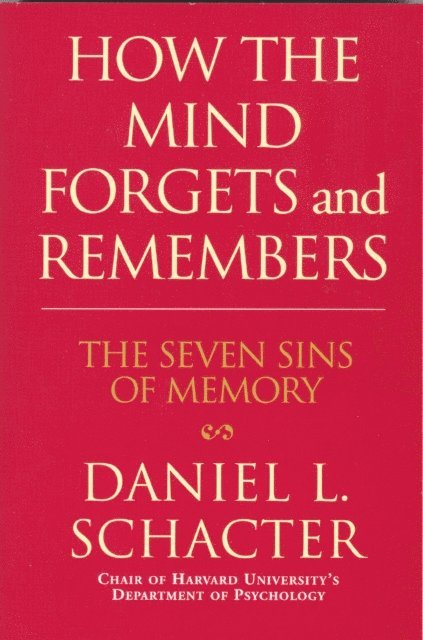
    How the Mind Forgets and Remembers

    The Seven Sins of Memory

    AvDaniel L. Schacter

    E-bok
    Engelska, 2011

    175 kr

    Läs direkt i Bokus Reader – eller ladda ned till din enhet

    Beskrivning

    Daniel L. Schacter, chairman of Harvard University''s Psychology Department, is internationally recognised as one of the world''s authorities on memory, explains that just as the seven deadly sins, the seven memory sins appear routinely in everyday life, and why it is a good thing that they happen and surprisingly vital to a keen mind. The author explains how transience reflects a weakening of memory over time, how absent-mindedness occurs when failures of attention sabotage memory and how blocking happens when we can''t retrieve a name we know well. Three other sins involve distorted memories: misattribution (assigning a memory to the wrong source), suggestibility (implanting false memories), and bias (rewriting the past based on present beliefs). The seventh sin, persistence, concerns intrusive recollections that we cannot forget - even when we wish we could. Daniel Schacter illustrates decades of research into memory lapses with compelling, and often bizarre, examples - for example, the violinist who placed a priceless Stradivarius on top of his car before driving off and the national memory champion who was plagued by absentmindedness. This book also explores recent research, such as the imaging of the brain that actually shows memories being formed. Together the stories and scientific findings examined in How The Mind Forgets and Remembers will reassure everyone from twenty-somethings who find their lives too busy to those in their fifties and sixties who are worried about early Alzheimers. Beautifully written, this original book provides a fascinating new look at our brains and what we more generally think of as our minds.

    Produktinformation

    • Utgivningsdatum:2011-12-01
    • Språk:Engelska
    • Filformat:EPUB
    • Kopieringsskydd:LCP
    • ISBN:9780285640894
    • Förlag:Profile Books Ltd

    Utforska kategorier

    • Kognitiv psykologi inom Psykologi och pedagogik

    Mer om författaren

    Daniel L. Schacter is chairman of the Psychology Department of Harvard University, and is internationally recognised as an authority on memory. Oliver Sacks described him as 'an acute and poetic observer of the human nature'. He has been awarded the American Psychological Association's Williams James Book Award.