• Fri frakt över 249 kr
  • •
  • Snabba leveranser
  • •
  • Billiga böcker
Kundservice

Du är på sajten för privatpersoner.

Företag, bibliotek eller offentlig verksamhet?

Du handlar på classic.bokus.com, där alla dina funktioner finns intakta.
Till classic.bokus.com
Bokus logotyp. Gå till startsidan.
  • Erbjudanden
  • Nyheter
  • Student
  • Topplistor
  • Barn & ungdom
  • Bokus Play
  • E-böcker
  • Pocketböcker
  • Spel & pussel

10% studentrabatt med kod TERM26

Sidfot

Mina sidor

    Hjälp

    • Kundservice
    • Vanliga frågor och svar
    • Frakt och leverans
    • Retur vid ångerrätt
    • Reklamera vara
    • Betalning
    • Köpvillkor
    • Allmänna villkor
    • Information om webbplatsens tillgänglighet

    Om Bokus

    • Om oss
    • Pressrum
    • För studenter
    • För företag
    • För bibliotek och offentlig verksamhet
    • För leverantörer
    • Hållbarhet

    Populärt

    • Aktuella erbjudanden
    • Presentkort
    • Studentlitteratur
    • Nya böcker
    • Topplistor
    • Signerade böcker
    • Engelska böcker

    Inspiration

    • Boktips
    • BookTok
    • Populära bokserier
    • Barnbokskaraktärer
    • Populära författare
    Logotyp för Bokus
    Följ oss på Facebook (extern länk)Följ oss på Instagram (extern länk)Följ oss på YouTube (extern länk)Följ oss på TikTok (extern länk)
    bokus @ CookiesAnpassa cookiesIntegritetspolicyKöpvillkor
    Till Citymail hemsida (extern länk)Till Budbee hemsida (extern länk)Till Postnord hemsida (extern länk)Till Schenker hemsida (extern länk)Till Early Bird hemsida (extern länk)Till Walleys hemsida (extern länk)
    1. Samhälle och politik
    2. Sociologi och antropologi

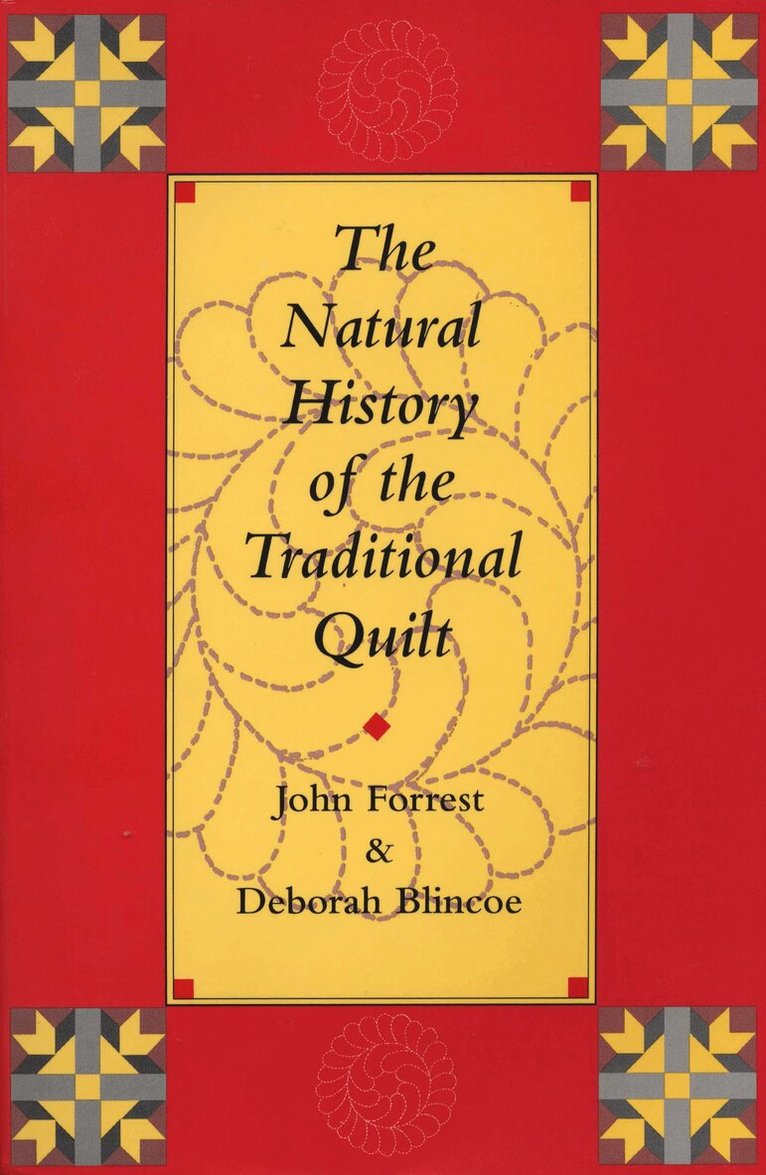
    Natural History of the Traditional Quilt

    AvJohn Forrest,Deborah Blincoe

    Häftad, Engelska, 1995

    382 kr

    Beställningsvara. Skickas inom 10-15 vardagar. Fri frakt över 249 kr.

    Beskrivning

    Traditional quilts serve many purposes over the course of a useful life. Beginning as a beautiful bed covering, a quilt may later function as a ground cover at picnics until years of wear relegate it to someone's ragbag for scrap uses.Observing this life cycle led authors John Forrest and Deborah Blincoe to the idea that quilts, like living things, have a natural history that can be studied scientifically. They explore that natural history through an examination of the taxonomy, morphology, behavior, and ecology of quilts in their native environment-the homes of humans who make, use, keep, and bestow them.The taxonomy proposed by Forrest and Blincoe is rooted in the mechanics of replicating quilts so that it can be used to understand evolutionary and genetic relationships between quilt types. The morphology section anatomizes normal and abnormal physical features of quilts, while the section on conception and birth in the life cycle discusses how the underlying processes of replication intersect with environmental factors to produce tangible objects.This methodology is applicable to many kinds of crafts and will be of wide interest to students of folklore, anthropology, and art history. Case studies of traditional quilts and their makers in the Catskills and Appalachia add a warm, human dimension to the book.

    Produktinformation

    • Utgivningsdatum:1995-12-01
    • Mått:152 x 229 x 22 mm
    • Vikt:454 g
    • Format:Häftad
    • Språk:Engelska
    • Antal sidor:374
    • Förlag:University of Texas Press
    • Illustratör:John Forrest, Deborah Blincoe
    • ISBN:9780292724976

    Utforska kategorier

    • Sociologi och antropologi inom Samhälle och politik

    Innehållsförteckning

    • “Toward the End of Winter …”“I Never Saw My Mamaw Making Quilts …”PrefaceAcknowledgements1. Taxonomy 1.1. Introduction1.2. The Cell1.3. Seamed Base Categories1.4. Unseamed Base Categories1.5. Hybrids and Anomalies2. Morphology 2.1. Introduction2.2. Overall Construction2.3. Materials2.4. Pathology and Anomaly3. Life Cycle 3.1. Introduction3.2. Conception3.3. Gestation3.4. Life Span3.5. Death (and Rebirth)4. Ecology 4.1. Introduction4.2. Interaction with Artifacts4.3. Interaction with People4.4. Interaction with the Natural Environment5. Case Study 5.1. Introduction5.2. Extant Quilts of Anna Butcher Mayo5.3. The Quilts in the Lives of the Quilter and Her Family5.4. Kindred Cells in Kindred Quilts5.5. Anomaly as a Clue to Innovation6. Conclusion 6.1. Quilts and the Transmission of CultureReferencesGeneral IndexIndex of Quilt Names