• Fri frakt över 249 kr
  • •
  • Snabba leveranser
  • •
  • Billiga böcker
Kundservice

Du är på sajten för privatpersoner.

Företag, bibliotek eller offentlig verksamhet?

Du handlar på classic.bokus.com, där alla dina funktioner finns intakta.
Till classic.bokus.com
Bokus logotyp. Gå till startsidan.
  • Erbjudanden
  • Nyheter
  • Student
  • Topplistor
  • Barn & ungdom
  • Bokus Play
  • E-böcker
  • Pocketböcker
  • Spel & pussel

10% rabatt på allt med kod: NYSTART10 →

Sidfot

Mina sidor

    Hjälp

    • Kundservice
    • Vanliga frågor och svar
    • Frakt och leverans
    • Retur vid ångerrätt
    • Reklamera vara
    • Betalning
    • Köpvillkor
    • Allmänna villkor
    • Information om webbplatsens tillgänglighet

    Om Bokus

    • Om oss
    • Pressrum
    • För studenter
    • För företag
    • För bibliotek och offentlig verksamhet
    • För leverantörer
    • Hållbarhet

    Populärt

    • Aktuella erbjudanden
    • Presentkort
    • Studentlitteratur
    • Nya böcker
    • Topplistor
    • Signerade böcker
    • Engelska böcker

    Inspiration

    • Boktips
    • BookTok
    • Populära bokserier
    • Barnbokskaraktärer
    • Populära författare
    Logotyp för Bokus
    Följ oss på Facebook (extern länk)Följ oss på Instagram (extern länk)Följ oss på YouTube (extern länk)Följ oss på TikTok (extern länk)
    bokus @ CookiesAnpassa cookiesIntegritetspolicyKöpvillkor
    Till Citymail hemsida (extern länk)Till Budbee hemsida (extern länk)Till Postnord hemsida (extern länk)Till Schenker hemsida (extern länk)Till Early Bird hemsida (extern länk)Till Walleys hemsida (extern länk)
    1. Naturvetenskap och teknik
    2. Geovetenskap
    3. Miljövetenskap och miljöpolitik

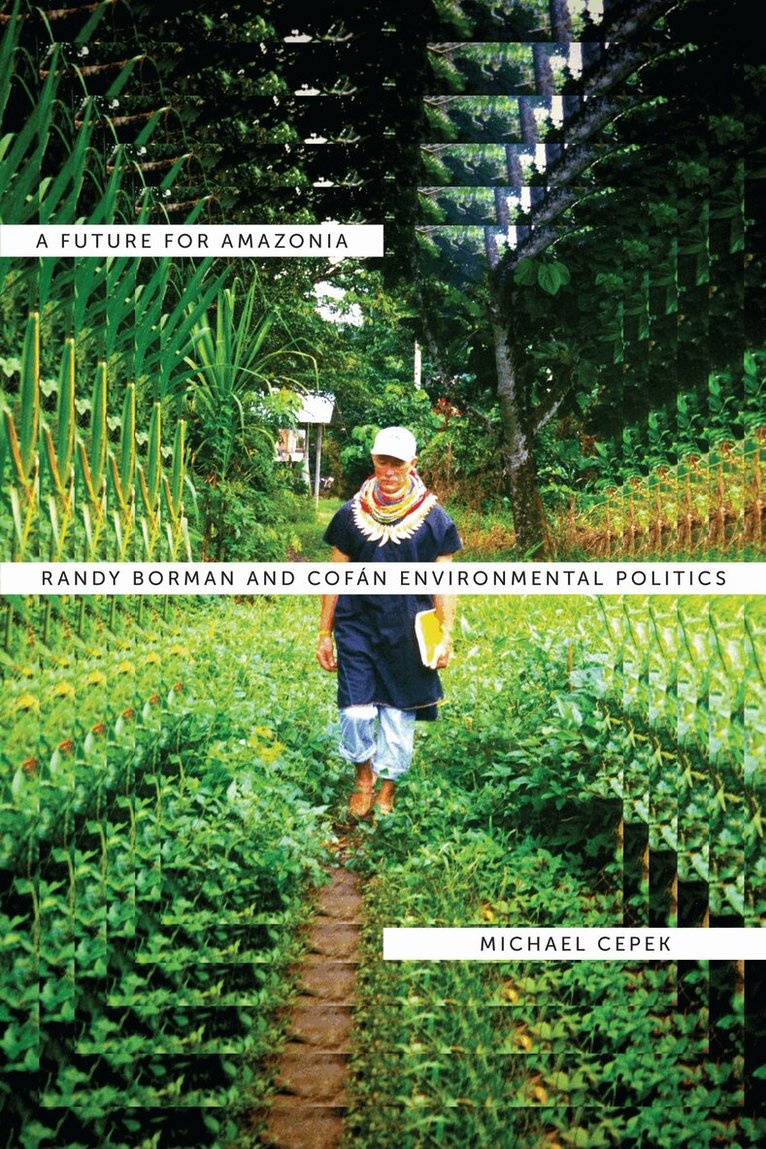
    Future for Amazonia

    Randy Borman and Cofán Environmental Politics

    AvMichael L. Cepek

    Häftad, Engelska, 2012

    271 kr

    Beställningsvara. Skickas inom 10-15 vardagar. Fri frakt över 249 kr.

    Beskrivning

    Blending ethnography with a fascinating personal story, A Future for Amazonia is an account of a political movement that arose in the early 1990s in response to decades of attacks on the lands and peoples of eastern Ecuador, one of the world’s most culturally and biologically diverse places. After generations of ruin at the hands of colonizing farmers, transnational oil companies, and Colombian armed factions, the indigenous CofÁn people and their rain forest territory faced imminent jeopardy. In a surprising turn of events, the CofÁn chose Randy Borman, a man of Euro-American descent, to lead their efforts to overcome the crisis that confronted them.Drawing on three years of ethnographic research, A Future for Amazonia begins by tracing the contours of CofÁn society and Borman’s place within it. Borman, a blue-eyed, white-skinned child of North American missionary-linguists, was raised in a CofÁn community and gradually came to share the identity of his adoptive nation. He became a global media phenomenon and forged creative partnerships between CofÁn communities, conservationist organizations, Western scientists, and the Ecuadorian state. The result was a collective mobilization that transformed the CofÁn nation in unprecedented ways, providing them with political power, scientific expertise, and a new role as ambitious caretakers of more than one million acres of forest. Challenging simplistic notions of identity, indigeneity, and inevitable ecological destruction, A Future for Amazonia charts an inspiring course for environmental politics in the twenty-first century.

    Produktinformation

    • Utgivningsdatum:2012-11-01
    • Mått:152 x 229 x 18 mm
    • Vikt:399 g
    • Format:Häftad
    • Språk:Engelska
    • Antal sidor:272
    • Förlag:University of Texas Press
    • ISBN:9780292739505

    Utforska kategorier

    • Miljövetenskap och miljöpolitik inom Naturvetenskap och teknik
    • Geografi inom Naturvetenskap och teknik

    Mer om författaren

    Michael Cepek is Assistant Professor of Anthropology at the University of Texas at San Antonio and a fellow in the Division of Environment, Culture, and Conservation at the Field Museum of Natural History. He began working with the Cofán people of Amazonian Ecuador in 1994 and continues to collaborate with them on academic and activist projects.

    Recensioner i media

    It is a well-crafted and nicely combined account of an ethnographic study with the personal story of Randy Borman…it is a must read for all those who want to understand the ecological sustainability efforts of indigenous people around the world in general, and the success story of the CofÁn in Amazonia in particular. (Indigenous Peoples, Issues, and Resources) We must thank Michael Cepek for an ethnography that not only sheds light on indigenous cultural resistance, but also allows us to imagine such questions. (Journal of Latin American Studies) What’s the fate of the Amazon’s ecology and indigenous people? Is cultural and biological destruction inevitable? This may be the predominant message we hear emanating from the global discourse, but, as we read in Michael Cepek’s lively and richly textured account of the CofÁn people of eastern Ecuador, we may have reason to be more optimistic. (American Ethnologist) It is exciting and always refreshing to read an ethnography that, as Cepek puts it, uses empirical investigation of an existing liberatory project to help us conceptualize alternative futures of hope and possibility. (American Anthropologist) A Future for Amazonia is ideal for those in search of a rich, readable, ethnography that provides a remarkably rich account of an Amazonian indigenous people and how they have developed the political capacity to take on multinational oil, negotiate the Ecuadorian state, and secure a future that is at least partially hopeful. In short, this book makes an argument for why ethnography remains important for understanding much of what defines Latin America, from natural resource extraction and imperialism to indigenous movements, the ‘NGOization’ of political life, and the broader struggle for cultural and economic survival. (Anthropology and Humanism) This book will be of interest to environmental anthropologists for its depiction of divergent cultural models of environmental conservation and ecological cosmovisions, and to scholars in Latin American studies for its analysis of indigenous social movements and their complex relationships with states and transnational NGO networks. It also makes important contributions to the emerging field of NGO studies by examining how the adoption of the NGO form entails the transformation of community identities and practices. Nonetheless, its greatest value lies in the way it challenges anthropologists to examine the cultural tools used by people to refashion their ways of living in order to secure some measure of control over their future in a complex and often unpredictable global context. (Journal of the Royal Anthropological Institute) Cepek has done a marvelous job in documenting and explaining the nuances and narratives of the CofÁn story. . . . The book, which is easy to read and very well written, is highly recommended, especially for anyone working in International Development, Development Education, Government, Conservation, or Anthropology. The larger value here is that Cepek provides a pragmatic vision, gained through his sustained relationship with Borman and the CofÁn, which might help the world with its problem of maintaining biodiversity. It is a real life story, implemented and worked on by real people, not just a utopian vision. The accomplishments of the 'CofÁn experiment' deserve to be carefully studied and debated (Journal of Latin American and Caribbean Anthropology)

    Innehållsförteckning

    • PrefaceAcknowledgmentsIntroduction: CofÁn PossibilitiesPart I: An Individual and a People 1. Agency: The Emergence of an Intercultural Leader2. Identity: Collectivity and Difference3. Value: The Dilemma of Being CofÁnPart II: An Experiment in Indigenous and Environmental Politics 4. The NGO: Institutionalizing Activism5. The Forest: Collaborating with Science and Conservation6. The School in the City: Producing the CofÁn of the FutureConclusion: A Possible ForestNotesBibliographyIndex