• Fri frakt över 249 kr
  • •
  • Snabba leveranser
  • •
  • Billiga böcker
Kundservice

Du är på sajten för privatpersoner.

Företag, bibliotek eller offentlig verksamhet?

Du handlar på classic.bokus.com, där alla dina funktioner finns intakta.
Till classic.bokus.com
Bokus logotyp. Gå till startsidan.
  • Erbjudanden
  • Nyheter
  • Student
  • Topplistor
  • Barn & ungdom
  • Bokus Play
  • E-böcker
  • Pocketböcker
  • Spel & pussel

10% rabatt på allt med kod: NYSTART10 →

Sidfot

Mina sidor

    Hjälp

    • Kundservice
    • Vanliga frågor och svar
    • Frakt och leverans
    • Retur vid ångerrätt
    • Reklamera vara
    • Betalning
    • Köpvillkor
    • Allmänna villkor
    • Information om webbplatsens tillgänglighet

    Om Bokus

    • Om oss
    • Pressrum
    • För studenter
    • För företag
    • För bibliotek och offentlig verksamhet
    • För leverantörer
    • Hållbarhet

    Populärt

    • Aktuella erbjudanden
    • Presentkort
    • Studentlitteratur
    • Nya böcker
    • Topplistor
    • Signerade böcker
    • Engelska böcker

    Inspiration

    • Boktips
    • BookTok
    • Populära bokserier
    • Barnbokskaraktärer
    • Populära författare
    Logotyp för Bokus
    Följ oss på Facebook (extern länk)Följ oss på Instagram (extern länk)Följ oss på YouTube (extern länk)Följ oss på TikTok (extern länk)
    bokus @ CookiesAnpassa cookiesIntegritetspolicyKöpvillkor
    Till Citymail hemsida (extern länk)Till Budbee hemsida (extern länk)Till Postnord hemsida (extern länk)Till Schenker hemsida (extern länk)Till Early Bird hemsida (extern länk)Till Walleys hemsida (extern länk)
    1. Historia och arkeologi
    2. Historia

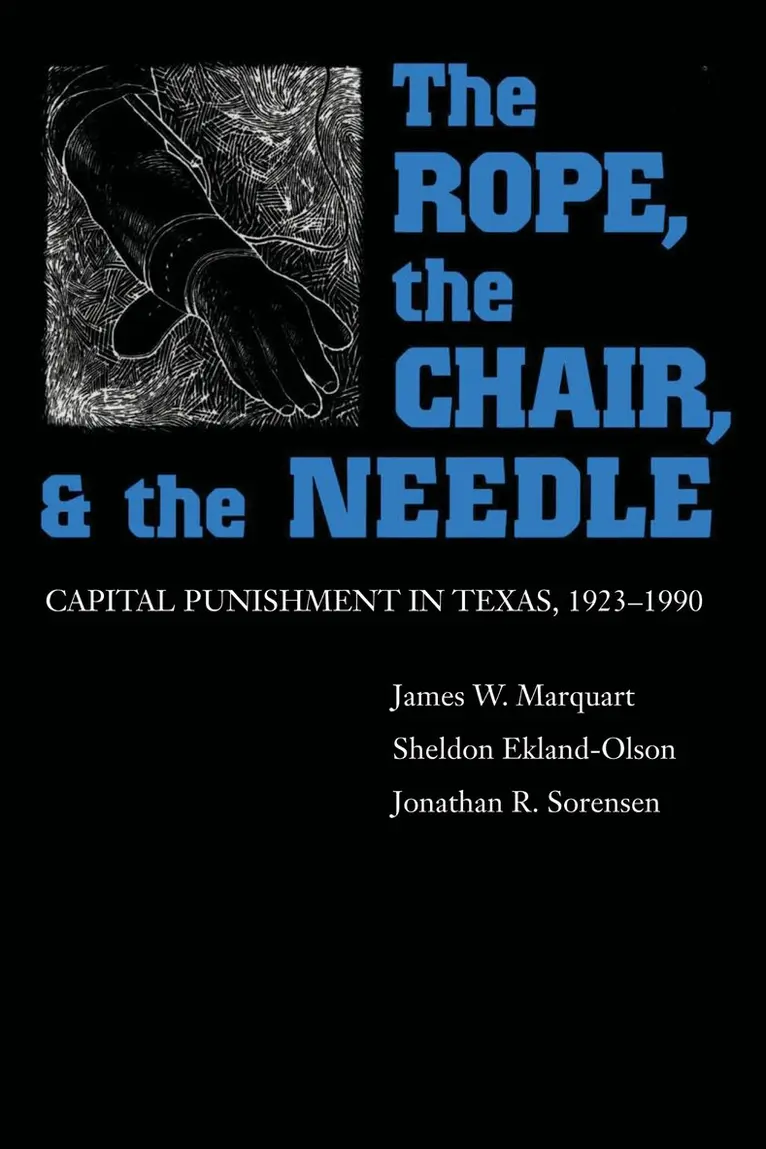
    Rope, the Chair, and the Needle

    Capital Punishment in Texas, 1923-1990

    AvJames W. Marquart,Sheldon Ekland-Olson

    Häftad, Engelska, 1998

    322 kr

    Beställningsvara. Skickas inom 10-15 vardagar. Fri frakt över 249 kr.

    Beskrivning

    In late summer 1923, legal hangings in Texas came to an end, and the electric chair replaced the gallows. Of 520 convicted capital offenders sentenced to die between 1923 and 1972, 361 were actually executed, thus maintaining Texas’ traditional reputation as a staunch supporter of capital punishment.This book is the single most comprehensive examination to date of capital punishment in any one state, drawing on data for legal executions from 1819 to 1990. The authors show persuasively how slavery and the racially biased practice of lynching in Texas led to the institutionalization and public approval of executions skewed according to race, class, and gender, and they also track long-term changes in public opinion up to the present.The stories of the condemned are masterfully interwoven with fact and interpretation to provide compelling reading for scholars of law, criminal justice, race relations, history, and sociology, as well as partisans on both sides of the debate.

    Produktinformation

    • Utgivningsdatum:1998-07-01
    • Mått:152 x 229 x 20 mm
    • Vikt:399 g
    • Format:Häftad
    • Språk:Engelska
    • Antal sidor:295
    • Förlag:University of Texas Press
    • ISBN:9780292752139

    Utforska kategorier

    • Historia inom Historia och arkeologi

    Mer om författaren

    James W. Marquart is Professor of Criminal Justice at Sam Houston State University in Huntsville, Texas. Sheldon Ekland-Olson is Dean of the College of Liberal Arts at the University of Texas at Austin. Jonathan R. Sorensen is Associate Professor of Criminal Justice at the University of Texas, Pan American.

    Recensioner i media

    A solid contribution to our understanding of the relationship between race, crime, and capital punishment in American history. (Law and History Review) An important new book . . . the first to explore in such depth the historical continuities in capital punishment in a single state, and especially the complex part played by racism in both past and present application of the death penalty. It is must-reading for anyone who seeks to understand capital punishment in the United States. (Criminal Justice Review) [The authors] have produced a book that is, on the one hand, a moving human document and, on the other, a model of dispassionate analysis. Readers will feel for the victims of the death penalty, whose humanity is glimpsed in their diaries, in their last words, and in pathetic pleas for clemency made on their behalf by loved ones. Equally, readers will be repelled by the patterns of bias in the administration of the death penalty so clearly reflected in social science tables. The authors have done us a great service by adding both detail and nuance to our knowledge of the human foibles and fallibilities of our justice system, which are revealed so glaringly when we presume to mete out final punishments. (Criminologist)

    Innehållsförteckning

    • PrefaceChapter 1. From Lynchings to ElectrocutionsChapter 2. The Initial "Harvest of Death": 1924-1972Chapter 3. Rape, Race, and a "Peculiar Chivalry"Chapter 4. Capital Murder and Midnight AppealsChapter 5. Spared the Chair and Sentenced to LifeChapter 6. Adoption of Lethal Injection and Contemporary Death RitualsChapter 7. Stages of Sentencing and Future Dangerousness of ConvictsChapter 8. Some Closing ThoughtsAppendix A. Statute Providing for the Electrocution of Convicts Condemned to DeathAppendix B. Death Row Prisoners, 1923-1988Appendix C. Post-1974 Department of Corrections Procedures for the Execution of Death-sentenced InmatesNotesReferencesCourt CasesIndex