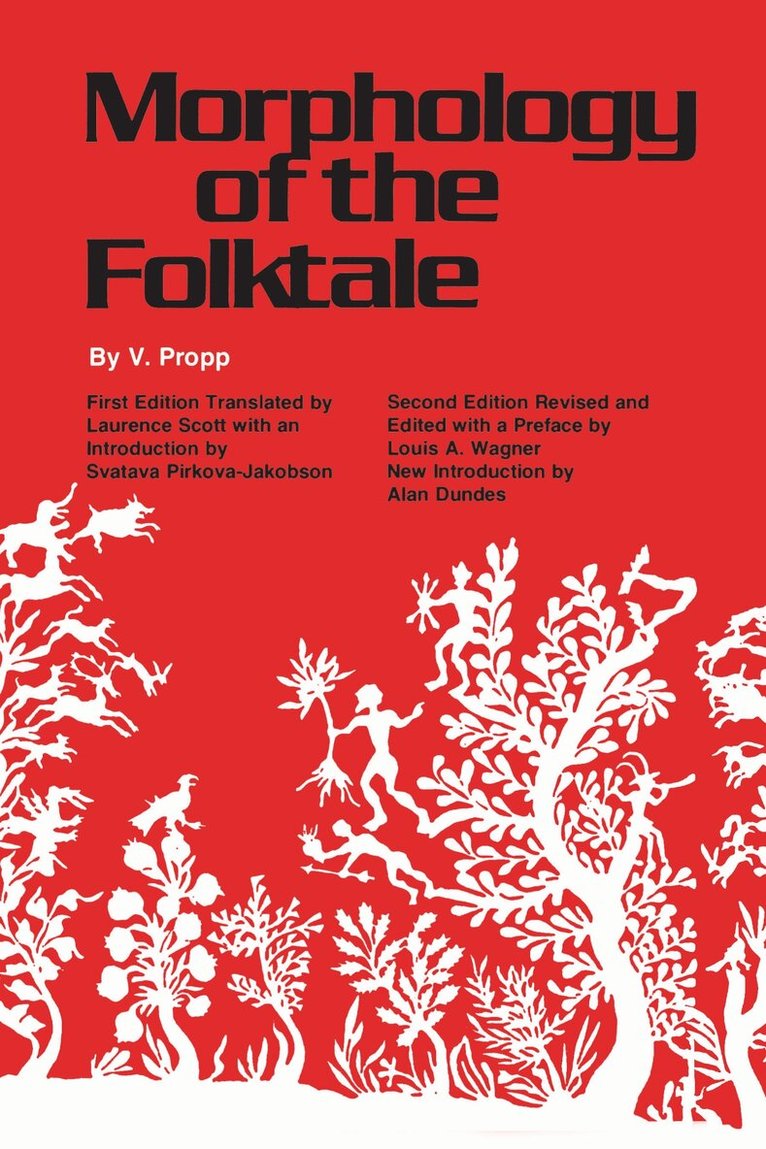
235 kr
Skickas . Fri frakt över 249 kr.
Fler format och utgåvor
Beskrivning
Produktinformation
- Utgivningsdatum:1968-01-01
- Mått:135 x 215 x 10 mm
- Vikt:240 g
- Format:Häftad
- Språk:Engelska
- Serie:American Folklore Society Bibliographical and Special Series
- Antal sidor:184
- Förlag:University of Texas Press
- ISBN:9780292783768
- Översättare:Laurence Scott
Utforska kategorier
Mer om författaren
Vladimir Propp was born in Petersburg, April 29, 1895. In 1932 he was called to a position at the University of Leningrad and went on to make major contributions to Russian folklore studies, comparative mythology, and the classification of folklore genres. His international fame is closely tied to the contributions he made to the structural analysis of folklore in Morphology of the Folktale.
Recensioner i media
Propp's work is seminal...[and], now that it is available in a new edition, should be even more valuable to folklorists who are directing their attention to the form of the folktale, especially to those structural characteristics which are common to many entries coming from even different cultures. (Choice) It was primarily Claude LÉvi-Strauss who made Propp's book popular outside the small circle of Western Slavicists: he immediately recognized the importance of Propp's methodology not only for the study of the fairy-tale, but generally for the study of narrative folklore. [LÉvi-Strauss] expressed his admiration for all those”'who for a long time have been Propp's successors without knowing it." (Times Literary Supplement)
Innehållsförteckning
- Preface to the Second EditionIntroduction to the Second EditionIntroduction to the First EditionAcknowledgementsAuthor's ForewordI. On the History of the ProblemII. The Method and MaterialIII. The Functions of Dramatis PersonaeIV. Assimilations: Cases of the Double Morphological Meaning of a Single FunctionV. Some Other Elements of the Tale A. Auxiliary Elements for the Interconnection of FunctionsB. Auxiliary Elements in TreblingC. MotivationsVI. The Distribution of Functions Among Dramatis PersonaeVII. Ways in Which New Characters Are Introduced into the Course of ActionVIII. On the Attributes of Dramatis Personae and their SignificanceIX. The Tale as a Whole A. The Ways in Which Stories Are CombinedB. An Example of Analysis of a TaleC. The Problem of ClassificationD. On the Relationship of Particular Forms of Structure to the General PatternE. The Problem of Composition and Theme, and of Themes and VariantsF. ConclusionAppendix I. Materials for a Tabulation of the TaleAppendix II. Further Techniques of AnalysesAppendix III. Schemes and CommentaryAppendix IV. List of AbbreviationsAppendix V. Comparative Chart of Tale Numbers