• Fri frakt över 249 kr
  • •
  • Snabba leveranser
  • •
  • Billiga böcker
Kundservice

Du är på sajten för privatpersoner.

Företag, bibliotek eller offentlig verksamhet?

Du handlar på classic.bokus.com, där alla dina funktioner finns intakta.
Till classic.bokus.com
Bokus logotyp. Gå till startsidan.
  • Erbjudanden
  • Nyheter
  • Student
  • Topplistor
  • Barn & ungdom
  • Bokus Play
  • E-böcker
  • Pocketböcker
  • Spel & pussel

10% rabatt på allt med kod: NYSTART10 →

Sidfot

Mina sidor

    Hjälp

    • Kundservice
    • Vanliga frågor och svar
    • Frakt och leverans
    • Retur vid ångerrätt
    • Reklamera vara
    • Betalning
    • Köpvillkor
    • Allmänna villkor
    • Information om webbplatsens tillgänglighet

    Om Bokus

    • Om oss
    • Pressrum
    • För studenter
    • För företag
    • För bibliotek och offentlig verksamhet
    • För leverantörer
    • Hållbarhet

    Populärt

    • Aktuella erbjudanden
    • Presentkort
    • Studentlitteratur
    • Nya böcker
    • Topplistor
    • Signerade böcker
    • Engelska böcker

    Inspiration

    • Boktips
    • BookTok
    • Populära bokserier
    • Barnbokskaraktärer
    • Populära författare
    Logotyp för Bokus
    Följ oss på Facebook (extern länk)Följ oss på Instagram (extern länk)Följ oss på YouTube (extern länk)Följ oss på TikTok (extern länk)
    bokus @ CookiesAnpassa cookiesIntegritetspolicyKöpvillkor
    Till Citymail hemsida (extern länk)Till Budbee hemsida (extern länk)Till Postnord hemsida (extern länk)Till Schenker hemsida (extern länk)Till Early Bird hemsida (extern länk)Till Walleys hemsida (extern länk)
    1. Historia och arkeologi
    2. Historia
    3. Historia: särskilda händelser och ämnen
    4. Slaveri

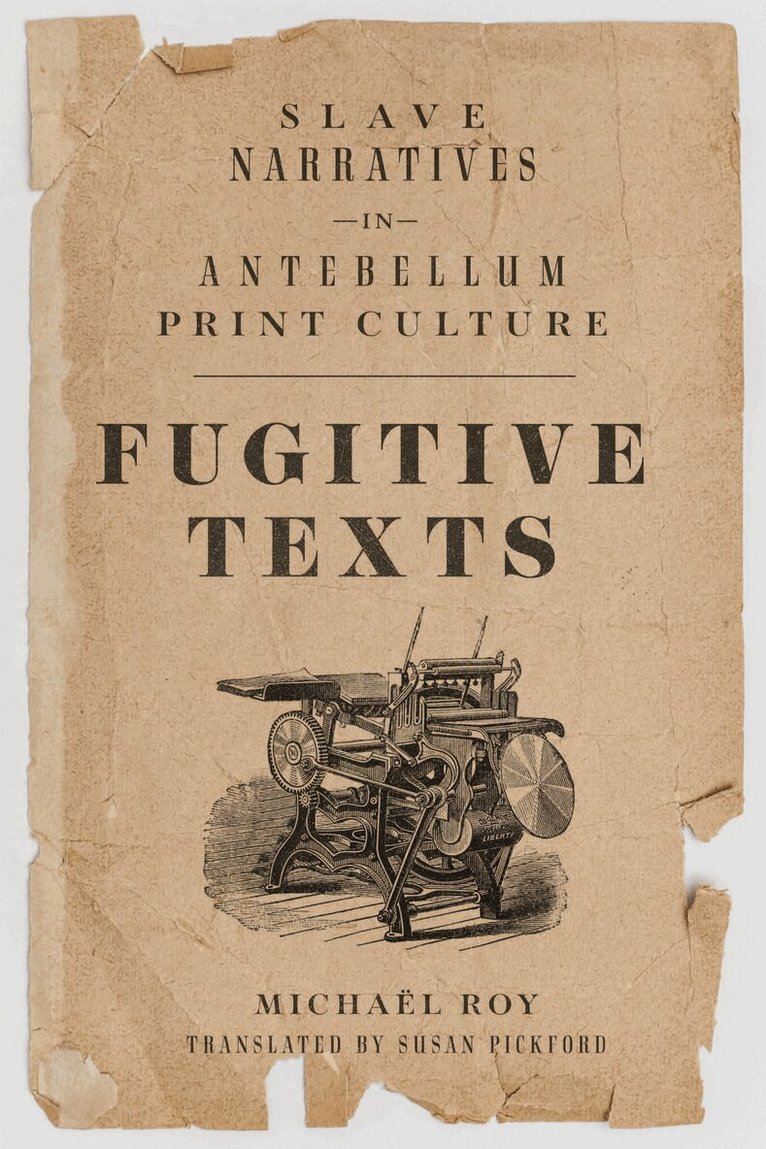
    Fugitive Texts

    Slave Narratives in Antebellum Print Culture

    AvMichaël Roy

    Häftad, Engelska, 2024

    343 kr

    Beställningsvara. Skickas inom 10-15 vardagar. Fri frakt över 249 kr.

    Fler format och utgåvor

    Inbunden

    1 030 kr

    Beskrivning

    Antebellum slave narratives have taken pride of place in the American literary canon. Once ignored, disparaged, or simply forgotten, the autobiographical narratives of Frederick Douglass, Harriet Jacobs, and other formerly enslaved men and women are now widely read and studied. One key aspect of the genre, however, has been left unexamined: its materiality. What did original editions of slave narratives look like? How were these books circulated? Who read them?In Fugitive Texts, MichaËl Roy offers the first book-length study of the slave narrative as a material artifact. Drawing on a wide range of sources, he reconstructs the publication histories of a number of famous and lesser-known narratives, placing them against the changing backdrop of antebellum print culture. Slave narratives, he shows, were produced through a variety of print networks. Remarkably few were published under the full control of white-led antislavery societies; most were self-published and distributed by the authors, while some were issued by commercial publishers who hoped to capitalize on the success of Harriet Beecher Stowe’s Uncle Tom’s Cabin. The material lives of these texts, Roy argues, did not end within the pages. Antebellum slave narratives were “fugitive texts” apt to be embodied in various written, oral, and visual forms.Published to rave reviews in French, Fugitive Texts illuminates the heterogeneous nature of a genre often described in monolithic terms and ultimately paves the way for a redefinition of the literary form we have come to recognize as “the slave narrative.”

    Produktinformation

    • Utgivningsdatum:2024-01-16
    • Mått:152 x 229 x 18 mm
    • Vikt:272 g
    • Format:Häftad
    • Språk:Engelska
    • Antal sidor:234
    • Förlag:University of Wisconsin Press
    • ISBN:9780299338442
    • Översättare:Susan Pickford

    Utforska kategorier

    • Slaveri inom Historia och arkeologi
    • Amerikas historia inom Historia och arkeologi
    • Litteraturvetenskap inom Skönlitteratur

    Mer om författaren

    MichaËl Roy is an associate professor of American studies at UniversitÉ Paris Nanterre and a fellow of the Institut Universitaire de France. His work has appeared in journals such as Slavery & Abolition, MELUS, and Papers of the Bibliographical Society of America. He is the editor of Frederick Douglass in Context.

    Recensioner i media

    “This evocative study throws into stark relief the material conditions of authors who not only produced texts but also shepherded them through print infrastructures and into the hands of readers. Making contributions to African American literary history, book history, and print culture studies, Fugitive Texts encourages continued conversations about the material conditions of this literary history.”—Brigitte Fielder, author of Relative Races: Genealogies of Interracial Kinship in Nineteenth-Century America Praise for the French edition:  “Offers a new approach to slave narratives.”—Études littÉraires africaines  “The historical sweep MichaËl Roy carries out here allows him to advance strong conclusions.”—Lectures  “Rethinking the place of slave narratives in the literary and political fields of the antebellum United States, revisiting presuppositions: these are the points which allow this rigorous, vigorous, and very well-written work to stand out from other analyses of these texts.”—Textes & Contexte “Gives slave narratives a renewed breath of life. . . . Fugitive Texts significantly contributes to studies on slavery, abolition, gender, print culture, the antebellum era, and African American studies. . . . Treating narratives as an artifact to unveil new layers of how the formerly enslaved asserted themselves and made their voices ‘heard’ broadens our understanding of the antebellum period. It allows us to grasp how people came to form meanings for these printed volumes.”—H-Net Reviews

    Innehållsförteckning

    • List of IllustrationsList of AbbreviationsIntroduction: Runaway Best Sellers?1 “The General Diffusion of Abolition Light”: The Institutional Origins of the Antebellum Slave Narrative2 “My Narrative Is Just Published”: Agency, Itinerancy, and the Slave Narrative3 “Quite a Sensation”: Slave Narratives in the Age of Uncle TomNotesIndex