Häftad, Engelska, 2015
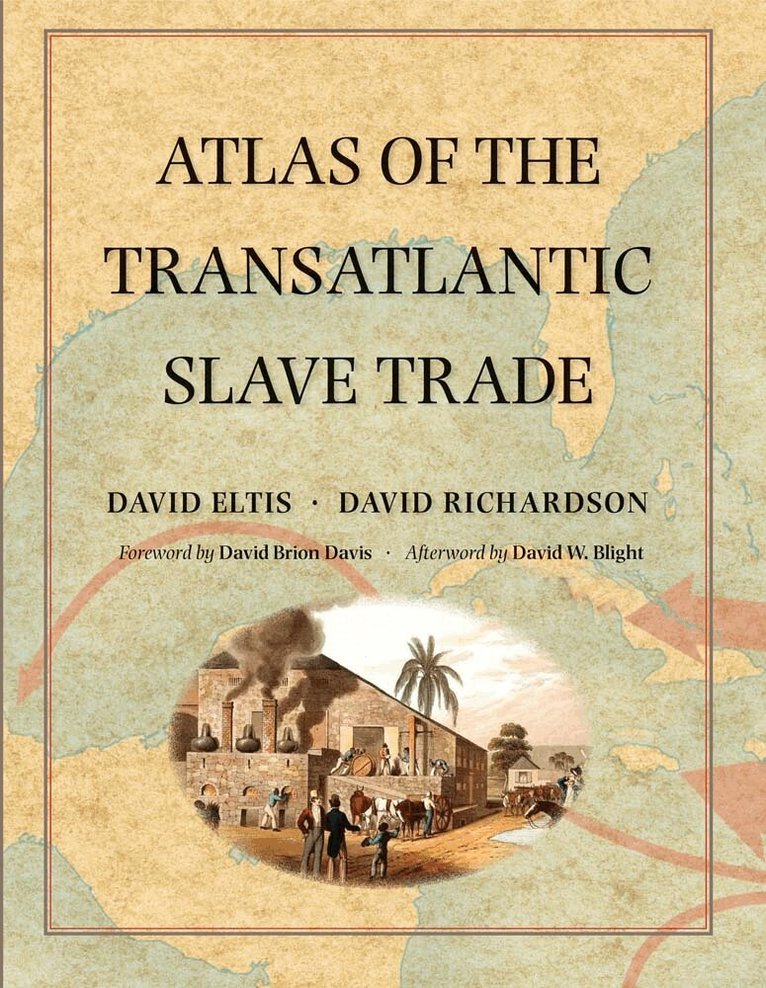
Atlas of the Transatlantic Slave Trade
Av David Eltis, David Richardson
Del i serien Lewis Walpole Series in Eighteenth-Century Culture and History
416 kr
Beställningsvara. Skickas inom 3-6 vardagar. Fri frakt över 249 kr.
Fler format och utgåvor
Beskrivning
Produktinformation
- Utgivningsdatum: 2015-02-16
- Mått: 229 x 305 x 20 mm
- Vikt: 1 397 g
- Format: Häftad
- Språk: Engelska
- Serie: Lewis Walpole Series in Eighteenth-Century Culture and History
- Antal sidor: 336
- Förlag: Yale University Press
- ISBN: 9780300212549
Utforska kategorier
Mer om författaren
David Eltis is Emeritus Robert W. Woodruff Professor at Emory University. David Richardson is the former director of the Wilberforce Institute for the Study of Slavery and Emancipation, and professor of economic history, University of Hull, England. Together, the authors coedited Extending the Frontiers: Essays on the New Transatlantic Slave Trade Database.
Recensioner i media
“A monumental chronicle of this historical tragedy, one that records some 35,000 individual slaving voyages, roughly 80 percent of those made. . . . [This book] is a human document as well as a rigorous accounting. It is filled with moving poems, photographs, letters and diary entries.”—Dwight Garner, New York Times“A remarkable resource. . . . The charts raise as many questions as they answer; this is entirely the point.”—James Delbourgo, Times Higher Education“A ground-breaking project: the Atlas will be indispensable for all those interested in the slave trade.”—Jane Webster, Times Literary Supplement“This groundbreaking work provides the fullest possible picture of the extent and inhumanity of one of the largest forced migrations in History.”—Global Journal“Beautifully produced, with period images and contemporary quotations, this is in a work of commemoration, but the best memorial, the authors clearly feel, is the historic truth.”—Michael Kerrigan, The Scotsman“We are indebted to Eltis and Richardson for opening up new evidence and pointing towards future projects. The importance of this book transcends the story of the slave trade itself.”—James Walvin, Family & Community HistoryWinner, 2010 R. R. Hawkins Award, Association of American PublishersWinner, PROSE Award for Excellence in Single Volume Reference/Humanities and Social Sciences category, Association of American PublishersWinner, Anisfield-Wolf Awards, Non-Fiction, 2011Honorable Mention, Dartmouth Medal for Outstanding Reference, 2011Honorable Mention, General Non-Fiction, Los Angeles Book Festival, 2010“A brilliant rendition of the Trans-Atlantic Slave Trade Database. This atlas is essential to the study of chattel slavery. No student of slavery should be without it.”—Ira Berlin, University of Maryland“These magnificent maps—all 189—document almost every conceivable aspect of one of the world’s worst crimes. An epic and gruesome drama receives a fitting representation. A superb contribution to scholarship.”—Philip D. Morgan, Johns Hopkins University“Sophisticated and erudite, the maps and the introductions to them offer the best and most accessible interpretations on various aspects of the transatlantic slave trade. Full of insights and new findings, the strong analysis and evidence presented will create a permanent distinguished stamp on the book, confirming it as a groundbreaking text for both beginners and advanced students.”—Toyin Falola, University of Texas at Austin“Atlas of the Transatlantic Slave Trade is a dramatic step forward in the cartographic representation of the slave trade, tracing the flow of captives in much greater detail and with more precision than ever before. This atlas also systematically links African ports to American ports and hinterland African states to the ports from which their slaves were exported: an important step and a reminder that a great deal of the slave trade began deep in Africa.”—John Thornton, author of Africa and Africans in the Making of the Atlantic World, 1400–1800“This is a highly original work and represents a major contribution to historical analysis. There are no comparable works on this topic.”—Stanley Engerman, University of Rochester
Betyg & recensioner
0 recensioner
Inga recensioner tillgängliga.