• Fri frakt över 249 kr
  • •
  • Snabba leveranser
  • •
  • Billiga böcker
Kundservice

Du är på sajten för privatpersoner.

Företag, bibliotek eller offentlig verksamhet?

Du handlar på classic.bokus.com, där alla dina funktioner finns intakta.
Till classic.bokus.com
Bokus logotyp. Gå till startsidan.
  • Erbjudanden
  • Student
  • Topplistor
  • Barn & ungdom
  • Bokus Play
  • E-böcker
  • Ljudböcker
  • Pocketböcker
  • Spel och pussel

Pocketfynda! Hundratals böcker för 49 kr/st →

Sidfot

Mina sidor

    Hjälp

    • Kundservice
    • Vanliga frågor och svar
    • Frakt och leverans
    • Retur vid ångerrätt
    • Reklamera vara
    • Betalning
    • Köpvillkor
    • Allmänna villkor
    • Information om webbplatsens tillgänglighet

    Om Bokus

    • Om oss
    • Pressrum
    • För studenter
    • För företag
    • För bibliotek och offentlig verksamhet
    • För leverantörer
    • Hållbarhet

    Populärt

    • Aktuella erbjudanden
    • Presentkort
    • Studentlitteratur
    • Nya böcker
    • Topplistor
    • Signerade böcker
    • Engelska böcker

    Inspiration

    • Boktips
    • BookTok
    • Barnbokskaraktärer
    • Populära författare
    Logotyp för Bokus
    Följ oss på Facebook (extern länk)Följ oss på Instagram (extern länk)Följ oss på YouTube (extern länk)Följ oss på TikTok (extern länk)
    bokus @ CookiesAnpassa cookiesIntegritetspolicyKöpvillkor
    Till Citymail hemsida (extern länk)Till Budbee hemsida (extern länk)Till Postnord hemsida (extern länk)Till Schenker hemsida (extern länk)Till Early Bird hemsida (extern länk)Till Walleys hemsida (extern länk)
    1. Psykologi och pedagogik
    2. Psykologi
    3. Socialpsykologi och gruppsykologi

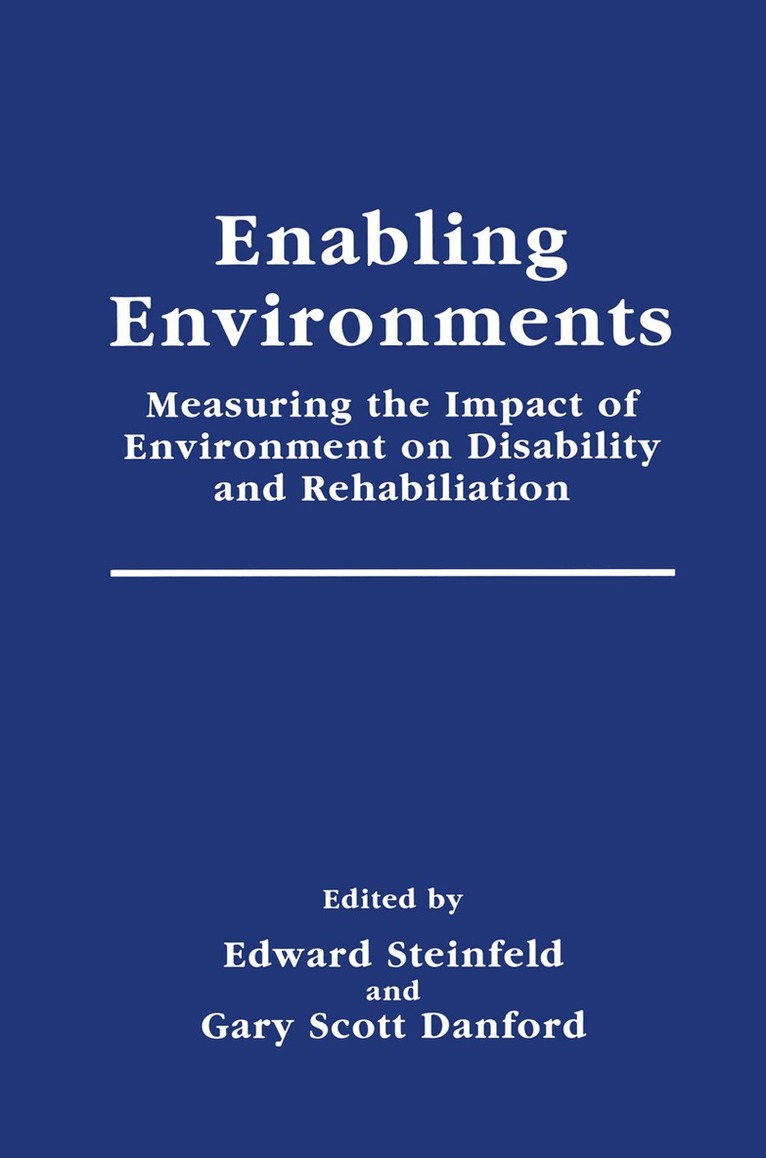
    Enabling Environments

    Measuring the Impact of Environment on Disability and Rehabilitation

    AvEdward Steinfeld,G. Scott Danford

    Inbunden, Engelska, 1999

    Del i serien Springer Series in Rehabilitation and Health

    1 568 kr

    Beställningsvara. Skickas inom 10-15 vardagar. Fri frakt över 249 kr.

    Beskrivning

    TItis volume is the first effort to compile representative work in the emerging research area on the relationship of disability and physical environment since Barrier-Free Environments, edited by Michael Bednar, was published in 1977. Since that time, disability rights legislation like the Americans, with Disabilities Act in the United States, the worldwide growth of the independent-living move­ ment, rapid deinstitutionalization, and the maturation of functional assessment methodology have all had their impact on this research area. The impact has been most noticeable in two ways-fostering the integration of environmental vari­ ables in rehabilitation research and practice, and changing paradigms for environ­ mental interventions. As the contributions in this volume demonstrate, the relationship of disabil­ ity and physical environment is no longer of interest primarily to designers and other professionals concerned with managing the resources of the built environ­ ment. The physical environment has always been recognized as an important variable affecting rehabilitation outcome. Until recently, however, concepts and tools were not available to measure its impact in clinical practic~ and outcomes research. In particular, lack of a theoretical foundation that integrated environ­ ment with the disablement process hampered development of both research and clinical methodology. Thus, the physical environment received little attention from the mainstream rehabilitation research community. However, this situation is changing rapidly.

    Produktinformation

    • Utgivningsdatum:1999-04-30
    • Mått:155 x 235 x 30 mm
    • Vikt:828 g
    • Format:Inbunden
    • Språk:Engelska
    • Serie:Springer Series in Rehabilitation and Health
    • Antal sidor:418
    • Upplaga:1999
    • Förlag:Springer Science+Business Media
    • ISBN:9780306458910

    Utforska kategorier

    • Socialpsykologi och gruppsykologi inom Psykologi och pedagogik
    • Sociala och etiska frågor inom Samhälle och politik

    Innehållsförteckning

    • I. Theory.- 1. Theory as a Basis for Research on Enabling Environments.- 2. Research Implications of Universal Design.- 3. Space Requirements for Accessibility: Cross-Cultural Comparisons.- II. Reliability and Validity.- 4. “The Enabler” Applied to Occupational Therapy: Reliability of a Usability Rating Scale.- 5. Measuring the Influences of Physical Environments on the Behaviors of People with Impairments.- 6. Measuring Constraints to Inhabitant Activities.- 7. Assessing Special Care Units for Dementia: The Professional Environmental Assessment Protocol.- 8. Using Environmental Simulation to Test the Validity of Code Requirements.- III. New Directions in Research Methods.- 9. A Day’s Journey Through life©: An Assessment Game.- 10. Detection and Discrimination of Tactile Warning Signals in Field Conditions.- 11. Stigma and Architecture.- 12. Evaluating Models and Measures of Environmental Performance.- IV. Measurment in Practice.- 13. Computer Simulation of Cane Techniques Used by People with Visual Impairments for Accessibility Anaylsis.- 14. Evaluating Accessibility Through Computer-Aided Design: A Software Model.- 15. Wayfinding Performance by People with Visual Impairments.- 16. Postoccupancy Evaluation of Universally Accessible Multi-Family Housing Units.- 17. Selecting Person—Environment Assessment.