• Fri frakt över 249 kr
  • •
  • Snabba leveranser
  • •
  • Billiga böcker
Kundservice

Du är på sajten för privatpersoner.

Företag, bibliotek eller offentlig verksamhet?

Du handlar på classic.bokus.com, där alla dina funktioner finns intakta.
Till classic.bokus.com
Bokus logotyp. Gå till startsidan.
  • Erbjudanden
  • Student
  • Topplistor
  • Barn & ungdom
  • Bokus Play
  • E-böcker
  • Ljudböcker
  • Pocketböcker
  • Spel och pussel

5% studentrabatt – använd koden KURSBOK27 →

Sidfot

Mina sidor

    Hjälp

    • Kundservice
    • Vanliga frågor och svar
    • Frakt och leverans
    • Retur vid ångerrätt
    • Reklamera vara
    • Betalning
    • Köpvillkor
    • Allmänna villkor
    • Information om webbplatsens tillgänglighet

    Om Bokus

    • Om oss
    • Pressrum
    • För studenter
    • För företag
    • För bibliotek och offentlig verksamhet
    • För leverantörer
    • Hållbarhet

    Populärt

    • Aktuella erbjudanden
    • Presentkort
    • Studentlitteratur
    • Nya böcker
    • Topplistor
    • Signerade böcker
    • Engelska böcker

    Inspiration

    • Boktips
    • BookTok
    • Barnbokskaraktärer
    • Populära författare
    Logotyp för Bokus
    Följ oss på Facebook (extern länk)Följ oss på Instagram (extern länk)Följ oss på YouTube (extern länk)Följ oss på TikTok (extern länk)
    bokus @ CookiesAnpassa cookiesIntegritetspolicyKöpvillkor
    Till Citymail hemsida (extern länk)Till Budbee hemsida (extern länk)Till Postnord hemsida (extern länk)Till Schenker hemsida (extern länk)Till Early Bird hemsida (extern länk)Till Walleys hemsida (extern länk)
    1. Naturvetenskap och teknik
    2. Matematik och naturvetenskap
    3. Kemi

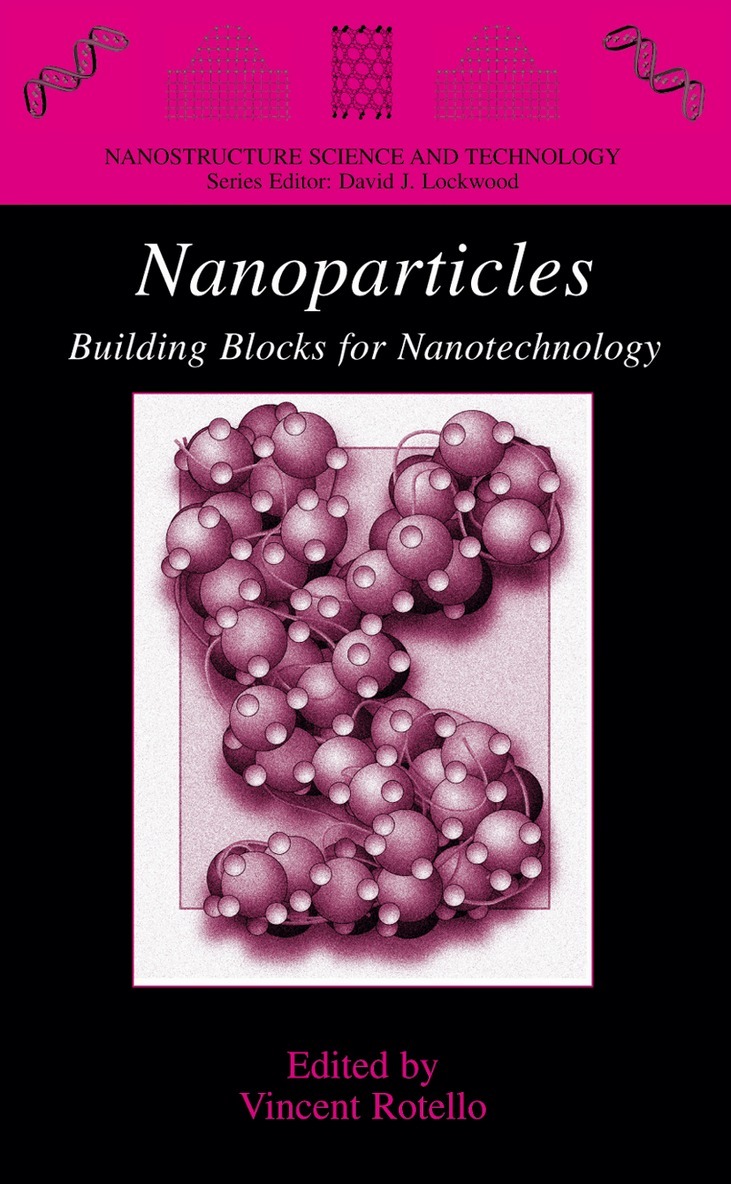
    Nanoparticles

    Building Blocks for Nanotechnology

    AvVincent Rotello

    Inbunden, Engelska, 2003

    Del i serien Nanostructure Science and Technology

    917 kr

    Beställningsvara. Skickas inom 10-15 vardagar. Fri frakt över 249 kr.

    Fler format och utgåvor

    E-bok

    1 176 kr

    Häftad

    917 kr

    Beskrivning

    The integration of top-down lithographic techniques with synthetic organic and inorganic technologies is a key challenge for the development of effective nanosca1e devices. In terms of assembly, nanoparticles provide an excellent tool for bridging the gap between the resolution of electron beam lithography (-60 nm) and the molecular level. Nanoparticles possess an array of unique properties associated with their core materials, including distinctive magnetic, photonic and electronic behavior. This behavior can be controlled and applied through monolayer functionalization and assembly strategies, making nanoparticles both scaffolds and building blocks for nanotechnology. The diverse structures and properties of nanoparticles makes them useful tools for both fundamental studies and pragmatic applications in a range of disciplines. This volume is intended to provide an integrated overview of the synthesis and assembly of nanoparticles, and their applications in chemistry, biology, and materials science. The first three chapters focus on the creation and intrinsic properties of nanoparticles, covering some of the myriad core materials and shapes that have been created. The remaining chapters of the book discuss the assembly of nanoparticles, and applications of both discrete particles and particle assemblies in a wide range of fields, including device and sensor fabrication, catalysis, biology, and nanosca1e electronic and magnetic systems.

    Produktinformation

    • Utgivningsdatum:2003-12-31
    • Mått:178 x 254 x 22 mm
    • Vikt:765 g
    • Format:Inbunden
    • Språk:Engelska
    • Serie:Nanostructure Science and Technology
    • Antal sidor:284
    • Förlag:Kluwer Academic Publishers Group
    • ISBN:9780306482878

    Utforska kategorier

    • Kemi inom Naturvetenskap och teknik

    Innehållsförteckning

    • 1. Synthesis and Applications of Magnetic Nanoparticles.- 1.1 Introduction.- 1.2 Applications of Magnetic Nanoparticles.- 1.3 Synthesis of Single Metal MNPs.- 1.4 Synthesis of Alloyed Metal Nanoparticles.- 1.5 Synthesis of Metal Oxide Nanoparticles.- 1.6 Self-assembled monolayers on Iron and Iron Oxide MNPs.- 1.7 Preparation of Bioconjugate MNPs.- 1.8 BlOsynthetic routes to MNPs.- 1.9 Synthesis of Diluted Magnetic Semiconductor Nanoparticles.- 1.10 Synthesis of Transition Metal Coordination Polymer Nanoparticles.- 1.11 The Limits of Nano: Single Molecule Magnets.- 1.12 Summary and Outlook.- 2. Semiconductor Nanoparticles: Synthesis, Properties, and Integration into Polymers for the Generation of Novel Composite Materials.- 2.1 Introduction.- 2.2 Nanoparticle Synthesis.- 2.3 Semiconductor Nanoparticle/Polymer Composites.- 2.4 Nanoparticle-Polymer Composites Obtained by End-Group Attachment.- 2.5 Self- and Directed-Assembly of Semiconducting Nanoparticles.- 2.6 Summary and Future Outlook.- 3. Architecture of Nanocrystal Building Blocks.- 3.1 Introduction.- 3.2 Recent Developments in the Architectural Control of Nanobuilding Blocks.- 3.3 Shape-Guiding Growth Mechanisms.- 3.4 Critical Parameters for Architecture Guiding Processes of Nanocrystals.- 3.5 Future Direction.- 4. Nanoparticle Scaffolds for Devices and Sensors.- 4.1 Introduction.- 4.2 Nanoparticles Modified with Molecular or Ionic Receptors.- 4.3 Thin Film Sensors Containing Metal Colloidal Particles.- 4.4 Organized Nanoparticle Assemblies.- 4.5 Conclusions and Outlook.- 5. Nanoparticles in Catalysis.- 5.1 Introduction.- 5.2 Fundamental Issues.- 5.3 Challenges and Opportunities.- 5.4 Fabrication of Nanoparticles as Catalysts.- 5.5 Traditional Approaches.- 5.6 Surface-Capping Approaches.- 5.7 Surpported Nanoparticle catalysts.- 5.8 Assembled Nanoparticle Catalysts.- 5.9 The Nanoparticle Assembly.- 5.10 The Catalytic Activation.- 5.11 Conclusions and Prospectus.- 6. Adventures with Smart Chemical Sensing: Electrooptically Responsive Photonic Crystals.- 6.1 Introduction.- 6.2 Diffraction from CCA Photonic Crystals.- 6.3 CCA Optical Switching and Optical Limiting.- 6.4 Polymerized Colloidal Array Switching and Optical Limiting.- 6.5 PCCA Photonic Crystal Chemical Sensing Materials.- 6.6 Conclusions.- 7. Plasmonic Nanomaterials: Enhanced Optical Properties from Metal Nanoparticles and Their Ensembles.- 7.1 Introduction.- 7.2 Surface Plasmons in Spherical Metal Nanoparticles.- 7.3 Surface Plasmons: Theoretical Considerations.- 7.4 Surface Plasmons and the Material function.- 7.5 Metal Nanoparticle Ensembles.- 7.6 Conclusion.- 8. Nanoparticle Polymer Ensembles.- 8.1 Introduction.- 8.2 Assembly of Polymer-Nanoparticle Composite Materials.- 8.3 Nanoparticle Building Blocks and Polymer Scaffolds.- 8.4 Polymer-Nanoparticle Assemblies for Catalyic Applications.- 8.5 Fabrication of Polymer-Mediated Organized Nanoparticle Assemblies.- 8.6 Organized Polymer-Nanoparticle Assemblies on Surfaces.- 8.7 Dendrimers in Catalytic and Assembly.- 8.8 Conclusion.- 9. Electrostatic Assembly of Nanoparticles.- 9.1 Introduction.- 9.2 Electrostatic Nanoparticle Assembly in Solution.- 9.3 Electrostatically Driven Nanoparticle Assembly in Thin Films.- 10. Biological and Biomimetic Applications of Nanoparticles.- 10.1 Introduction.- 10.2 Colloidal Gold Bioconjugates.- 10.3 Low and High Nuclearity Metal Clusters Conjugates.- 10.4 Biological Applications of Semiconductors Quantum Dots.- 10.5 DNA and Nanoparticles.- 10.6 DNA Recognition.- 10.7 DNA-Nanoparticle-Based Devices.- 10.8 Biomimetic Applications: Mimicry of Carbohydrate-Protein and Carbohydrate-Carbohydrate Interactions.- 10.9 Mimicry of Polyvalency and Cooperativity.- 10.10 Nanomaterials as Delivery Systems.- 10.11 Conclusion.- 283.