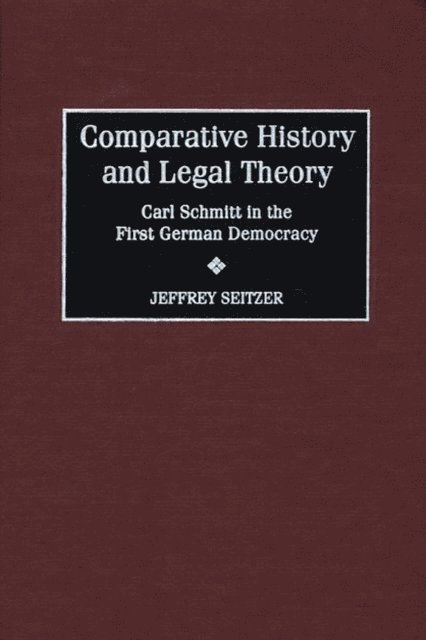
E-bok, Engelska, 2001
Comparative History and Legal Theory
1169 kr
Läs direkt i Bokus Reader – eller ladda ned till din enhet (PDF kräver ofta zoom och scroll på små skärmar).
Beskrivning
It is a commonplace of Schmitt scholarship that the controversial thinker sought to recapture some of the elan of the pre-Weimar state through his advocacy of effectively almost unlimited presidential government. Seitzer demonstrates how Schmitt believed comparative history itself could reinvigorate the ailing German state by subtly altering prevailing understandings of the relation of theory and practice in law and politics.
Treating Schmitt's Constitutional Theory and Guardian of the Constitution as methodologically sophisticated comparative histories, Seitzer turns Schmitt's argument against itself. He shows how Schmitt's comparative histories, when properly executed, support a decentralized solution to the Republic's difficulties directly contrary to Schmitt's in terms of its purpose and effect. Problem-oriented, comparative-historical studies of key features of the Weimar system suggest that the dispersion of political power facilitates an institutional dialogue over constitutional principle and practice that better provides for political stability and democratic experimentation. These studies also suggest that linking forms of justification with institutions establishes a productive tension among norms and institutions that is essential to maintaining the viability of constitutional democracy, both in the short- and long-term. This work will be of considerable value to Schmitt scholars and those interested in German legal and political theory as well as those concerned with broad issues in comparative law and European history and political theory.
Treating Schmitt's Constitutional Theory and Guardian of the Constitution as methodologically sophisticated comparative histories, Seitzer turns Schmitt's argument against itself. He shows how Schmitt's comparative histories, when properly executed, support a decentralized solution to the Republic's difficulties directly contrary to Schmitt's in terms of its purpose and effect. Problem-oriented, comparative-historical studies of key features of the Weimar system suggest that the dispersion of political power facilitates an institutional dialogue over constitutional principle and practice that better provides for political stability and democratic experimentation. These studies also suggest that linking forms of justification with institutions establishes a productive tension among norms and institutions that is essential to maintaining the viability of constitutional democracy, both in the short- and long-term. This work will be of considerable value to Schmitt scholars and those interested in German legal and political theory as well as those concerned with broad issues in comparative law and European history and political theory.
Produktinformation
- Utgivningsdatum: 2001-05-30
- Språk: Engelska
- Antal sidor: 192
- Filformat: PDF
- Kopieringsskydd: LCP
- ISBN: 9780313000676
- Förlag: Bloomsbury Publishing Plc
- Serie: Global Perspectives in History and Politics
Utforska kategorier
Betyg & recensioner
0 recensioner
Inga recensioner tillgängliga.