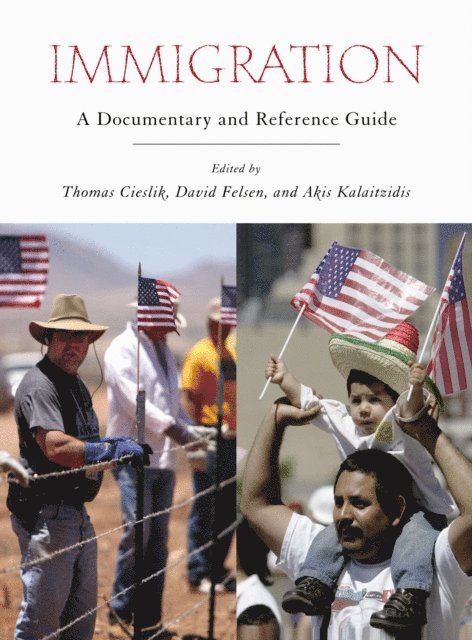
E-bok, Engelska, 2008
Immigration
Av Thomas Cieslik, David Felsen, Akis Kalaitzidis
1247 kr
Skickas tisdag 13/10
Beskrivning
The uncomfortable contemporary realities of immigration, enmeshed as they are in economic, human rights, and national security issues, have once again propelled foreign immigration to the United States toward the top of the list of U.S. domestic policy concerns. Three respected authorities on immigration and international affairs here present a carefully calibrated history of U.S. immigration in primary source documents, tracing the roots of the current debate in the history of our profoundly divided and surprisingly cyclical response to foreign immigration. This book documents this national ambivalence, identifying the major waves of immigration and clarifying the ways in which the existing social and political fabric conditioned both the response to the newcomers and their prospects of eventual integration into American society.
Part I introduces the historical record:
• The early days of the Republic, when most immigrants arrived from northern Europe
• The most important wave of immigration to the United States in the country's history, over 1880-1920, when most immigrants arrived from Asia or from southern and eastern Europe
• Virulent post-World War I anti-immigration sentiment
• The World War II-era absorption of huge numbers of displaced persons fleeing the misery and devastation of Europe
• Transition from a quota system to a preference system
• Heightened debate in the 1980s and 1990s
• The immigration policy repercussions of the terrorist attacks of September 11, 2001
Part II takes up special issues in the contemporary immigration debate, including the security debate and immigration, immigration and the U.S. judiciary, the immigration debate and the economy, and the spectrum of public opinion on immigration revealed during the 2008 presidential election campaign. The authors demonstrate that today's highly polarized immigration reform debate in many respects recapitulates the antagonisms and chaotic policies of the 1980s and 1990s, when Ronald Reagan's Republican administration implemented an amnesty program while the state of California adopted the punitive Proposition 187.
Paramount in today's immigration debate, however, are the homeland security concerns rendered acute by the 2001 bombing of the World Trade Center in New York City. The controversial USA PATRIOT Act of 2001 and the Homeland Security Act of 2002 are among the documents surveyed in relation to the contemporary immigration debate.
Part I introduces the historical record:
• The early days of the Republic, when most immigrants arrived from northern Europe
• The most important wave of immigration to the United States in the country's history, over 1880-1920, when most immigrants arrived from Asia or from southern and eastern Europe
• Virulent post-World War I anti-immigration sentiment
• The World War II-era absorption of huge numbers of displaced persons fleeing the misery and devastation of Europe
• Transition from a quota system to a preference system
• Heightened debate in the 1980s and 1990s
• The immigration policy repercussions of the terrorist attacks of September 11, 2001
Part II takes up special issues in the contemporary immigration debate, including the security debate and immigration, immigration and the U.S. judiciary, the immigration debate and the economy, and the spectrum of public opinion on immigration revealed during the 2008 presidential election campaign. The authors demonstrate that today's highly polarized immigration reform debate in many respects recapitulates the antagonisms and chaotic policies of the 1980s and 1990s, when Ronald Reagan's Republican administration implemented an amnesty program while the state of California adopted the punitive Proposition 187.
Paramount in today's immigration debate, however, are the homeland security concerns rendered acute by the 2001 bombing of the World Trade Center in New York City. The controversial USA PATRIOT Act of 2001 and the Homeland Security Act of 2002 are among the documents surveyed in relation to the contemporary immigration debate.
Produktinformation
- Utgivningsdatum: 2008-11-30
- Format: E-bok
- Språk: Engelska
- Antal sidor: 376
- Förlag: Bloomsbury Publishing Plc
- Serie: Documentary and Reference Guides
- ISBN: 9780313349119
Utforska kategorier
Betyg & recensioner
0 recensioner
Inga recensioner tillgängliga.