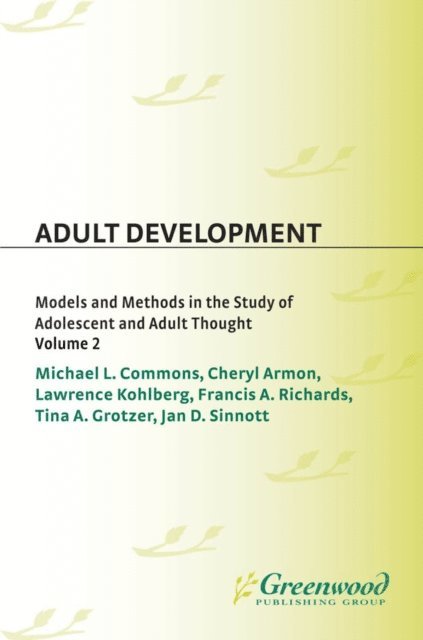
E-bok, Engelska, 1990
Adult Development
Av Michael L. Commons, Cheryl Armon, Lawrence Kohlberg, Francis A. Richards, Tina A. Grotzer, Jan D. Sinnott
1103 kr
Läs direkt i Bokus Reader – eller ladda ned till din enhet (PDF kräver ofta zoom och scroll på små skärmar).
Beskrivning
In recent years, researchers have begun to focus attention on postformal thought--the development of thought in late adolescence and adulthood--questioning Piaget's early terminus of structural development in adolescence. This volume brings together the works of distinguished authors in the field of postformal-operational cognitive, social, and perceptual development to examine the models and methodology used to investigate postformal thought. The contributors represent the variety of approaches that characterize this body of research, while, at the same time, seeking to unify this diverse literature with a common language. An ideal text for advanced courses in adult development, this volume is also a primary reference for developmental and educational psychologists and students working in the fields of cognitive development, adolescent and adult development, and lifespan development.
Divided into four parts, the volume begins by examining both Piagetian and nonstructural models of adult cognitive development, considering them in light of current research developments. Individual papers address models of equilibrium, knowledge, reflective judgment, ego-development, and consciousness. In Part II, the contributors discuss the measurement and comparison of cognitive development in adults, exploring such topics as construct validity and theories of adult development, the structural and developmental relations between formal and postformal capacities, and the relationship between Piagetian and Kohlbergian stages. The third section assesses the research and theory of adult reasoning in the moral domain, while the concluding chapter investigates critical evaluations of postformal research. Numerous tables and figures enhance the discussions.
Divided into four parts, the volume begins by examining both Piagetian and nonstructural models of adult cognitive development, considering them in light of current research developments. Individual papers address models of equilibrium, knowledge, reflective judgment, ego-development, and consciousness. In Part II, the contributors discuss the measurement and comparison of cognitive development in adults, exploring such topics as construct validity and theories of adult development, the structural and developmental relations between formal and postformal capacities, and the relationship between Piagetian and Kohlbergian stages. The third section assesses the research and theory of adult reasoning in the moral domain, while the concluding chapter investigates critical evaluations of postformal research. Numerous tables and figures enhance the discussions.
Produktinformation
- Utgivningsdatum: 1990-05-23
- Språk: Engelska
- Antal sidor: 304
- Filformat: PDF
- Kopieringsskydd: LCP
- ISBN: 9780313382826
- Förlag: Bloomsbury Publishing Plc
Utforska kategorier
Betyg & recensioner
0 recensioner
Inga recensioner tillgängliga.