• Fri frakt över 249 kr
  • •
  • Snabba leveranser
  • •
  • Billiga böcker
Kundservice

Du är på sajten för privatpersoner.

Företag, bibliotek eller offentlig verksamhet?

Du handlar på classic.bokus.com, där alla dina funktioner finns intakta.
Till classic.bokus.com
Bokus logotyp. Gå till startsidan.
  • Erbjudanden
  • Nyheter
  • Student
  • Topplistor
  • Barn & ungdom
  • Bokus Play
  • E-böcker
  • Pocketböcker
  • Spel & pussel

10% studentrabatt med kod TERM26

Sidfot

Mina sidor

    Hjälp

    • Kundservice
    • Vanliga frågor och svar
    • Frakt och leverans
    • Retur vid ångerrätt
    • Reklamera vara
    • Betalning
    • Köpvillkor
    • Allmänna villkor
    • Information om webbplatsens tillgänglighet

    Om Bokus

    • Om oss
    • Pressrum
    • För studenter
    • För företag
    • För bibliotek och offentlig verksamhet
    • För leverantörer
    • Hållbarhet

    Populärt

    • Aktuella erbjudanden
    • Presentkort
    • Studentlitteratur
    • Nya böcker
    • Topplistor
    • Signerade böcker
    • Engelska böcker

    Inspiration

    • Boktips
    • BookTok
    • Populära bokserier
    • Barnbokskaraktärer
    • Populära författare
    Logotyp för Bokus
    Följ oss på Facebook (extern länk)Följ oss på Instagram (extern länk)Följ oss på YouTube (extern länk)Följ oss på TikTok (extern länk)
    bokus @ CookiesAnpassa cookiesIntegritetspolicyKöpvillkor
    Till Citymail hemsida (extern länk)Till Budbee hemsida (extern länk)Till Postnord hemsida (extern länk)Till Schenker hemsida (extern länk)Till Early Bird hemsida (extern länk)Till Walleys hemsida (extern länk)
    1. Medicin
    2. Medicin: icke kliniska discipliner
    3. Fysiologi

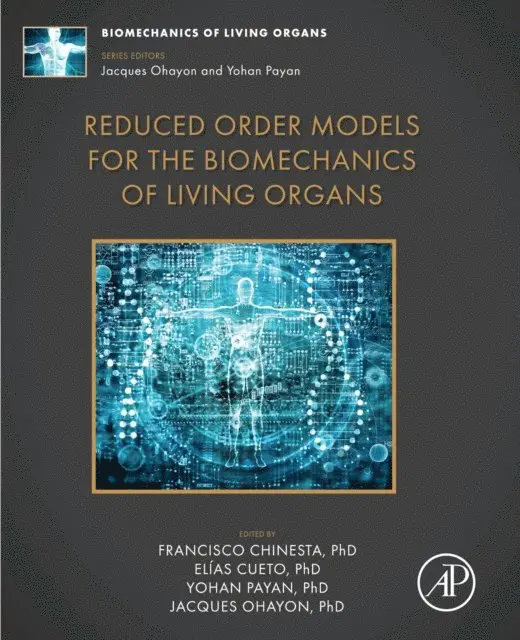
    Reduced Order Models for the Biomechanics of Living Organs

    AvFrancisco Chinesta,Elias Cueto

    Inbunden, Engelska, 2023

    Del i serien Biomechanics of Living Organs

    1 996 kr

    Beställningsvara. Skickas inom 10-15 vardagar. Fri frakt över 249 kr.

    Beskrivning

    Reduced Order Models for the Biomechanics of Living Organs, a new volume in the Biomechanics of Living Organisms series, provides a comprehensive overview of the state-of-the-art in biomechanical computations using reduced order models, along with a deeper understanding of the associated reduction algorithms that will face students, researchers, clinicians and industrial partners in the future. The book gathers perspectives from key opinion scientists who describe and detail their approaches, methodologies and findings. It is the first to synthesize complementary advances in Biomechanical modelling of living organs using reduced order techniques in the design of medical devices and clinical interventions, including surgical procedures.

    This book provides an opportunity for students, researchers, clinicians and engineers to study the main topics related to biomechanics and reduced models in a single reference, with this volume summarizing all biomechanical aspects of each living organ in one comprehensive reference.


    • Introduces the fundamental aspects of reduced order models
    • Presents the main computational studies in the field of solid and fluid biomechanical modeling of living organs
    • Explores the use of reduced order models in the fields of biomechanical electrophysiology, tissue growth and prosthetic designs

    Produktinformation

    • Utgivningsdatum:2023-05-26
    • Mått:191 x 235 x 32 mm
    • Vikt:1 180 g
    • Format:Inbunden
    • Språk:Engelska
    • Serie:Biomechanics of Living Organs
    • Antal sidor:492
    • Förlag:Elsevier Science
    • ISBN:9780323899673

    Utforska kategorier

    • Fysiologi inom Medicin
    • Systemvetenskap och AI inom Data och IT

    Mer om författaren

    Francisco Chinesta is currently a full Professor of computational physics at ENSAM ParisTech (Paris, France). He was (2008-2012) an AIRBUS Group chair professor. He is an honorary fellow of the “Institut Universitaire de France”, plus a Fellow of the Spanish Royal Academy of Engineering. He has received many scientific awards in four different fields: bio-engineering, material forming processes, rheology, and computational mechanics. He is the author of 300 papers in peer-reviewed international journals and has made more than 600 contributions in conferences.He is the president of the French association of computational mechanics (CSMA) and director of the CNRS research group on model order reduction techniques in engineering sciences. He is an editor and associate editor of many journals. Since 2013 he has been ESI chair professor on advanced modeling and simulation of materials, structures, processes and systems, and he is the president of ESI Group Scientific Committee. Elias Cueto is a Professor of continuum and computational mechanics, Universidad de Zaragoza. His research interests include the development of numerical methods for computational mechanics in its broadest sense. He has worked on finite element and meshless methods or model order reduction techniques, with applications on forming process simulation, real-time simulation, haptics, computational surgery, and, more recently, on data-intensive computational mechanics and Augmented/Mixed Reality. He has more than 100 articles in leading peer reviewed journals and has worked on 8 books. He is an editor for the International Journal of Material Forming and the ESAFORM book series on Material Forming with Springer. He is on 7 editorial boards for journals. Yohan Payan is Director of Research at the French National Center for Scientific Research (CNRS). In 1997, he received an award from the University of Grenoble for his doctoral research on the biomechanics of speech production. In 2012, the French Biomechanics Society awarded him the Senior Prize for his research on the biomechanics for computer-assisted surgery. His main research interests concern the biomechanical modeling of soft tissues and their integration into medical devices used to assist surgeons for planning or to guide them during surgery. The corresponding applications concern plastic and maxillofacial surgery, breast cancer treatment, neurosurgery, orthopedics and pressure ulcer prevention, based on organs or musculoskeletal models. He was a Research Affiliate at the Massachusetts Institute of Technology (1999, Boston, USA) and visiting professor at University of Chile (2004, Santiago de Chile) and University of British Columbia (2010, Vancouver, Canada). Yohan Payan is the co-head of the Biomechanics TIMC research team (Univ. Grenoble Alpes) and the Associate Editor of the Clinical Biomechanics journal (Elsevier).Jacques Ohayon is Professor of Mechanics at the Engineering school Polytech, Univ. Savoie Mont-Blanc, France. From 1985 to 1988, he was visiting fellow at the Biomedical Engineering Branch of the National Institutes of Health (NIH), Bethesda MD, USA. He received the 1998 Junior Prize of the French Biomechanics Society (SB) for his research on the biomechanics of the left ventricle. His current research focuses on the biomechanics of atherosclerotic plaque and the development of new clinical tools for imaging the elasticity of vulnerable plaques. From 2006 to 2007, he was visiting professor at the National Institute of Biomedical Imaging and Bioengineering at the NIH, USA. Jacques Ohayon was the Chairman of the SB, which also awarded him the Senior Prize in 2016 for his work on the biomechanics of coronary plaque rupture. In 2020, he was a visiting professor at Texas A & M University and conducted his research in the field of endothelial cell mechanobiology at the Houston Methodist Research Institute (HMRI). Since 2020, he is also Adjunct Professor of Cardiovascular Sciences at HMRI, Texas, USA.

    Innehållsförteckning

    • Part 1: Backgrounds and Fundamentals of Reduced Order Models1. An introduction to Model Order Reduction Techniques2. Linear and nonlinear dimensionality reduction of biomechanical models3. Shape parameterizations for reduced order modeling in biophysics4. Data-driven modelling and artificial intelligence5. Deep Learning for Real-Time Computational Biomechanics6. An introduction to Pod-Greedy-Galerkin reduced basis method7. Machine learning and biophysical models: how to benefit each other?Part 2: Applications to Computational Fluid Biomechanics8. Fast and accurate numerical simulations for the study of coronary artery  bypass grafts  by artificial neural network9. Reduced Order Models for Fluid inside Aneurysms using Proper Orthogonal Decomposition10. Isogeometric Hierarchical Model Reduction for advection-diffusion process simulation in microchannels11. Fast closed-loop CFD model for patient-specific aortic dissection management12. Reduced order modelling for direct and inverse problems in haemodynamicsPart 3: Applications to Computational Solid Biomechanics and living tissues13. Model Order Reduction of a 3D biome-chanical tongue model: a necessary step for quantitative evaluation of models of speech motor control and planning14. Deep learning contributions for reducing the complexity of prostate biomechanical models15. Reduced Mechanical model of trunk-lumbar belt interaction for design-oriented in-silico clinical trials16. ROM-based patient-specific structural analysis of vertebrae affected by metastasis17. Reduced Order Models for Prediction of Successful Course of Vaginal Delivery18. Modeling and simulation of a realistic knee joint using biphasic materials by the means of the proper generalized decomposition19. Comparison of three machine learning methods to estimate myocardial stiffness Part 4: Applications to Biomechanical Electrophysiology, Image processing and Surgical protocols20. Real-time numerical prediction of strain localization using dictionary-based ROM-nets for sitting-acquired deep tissue injury prevention21. Reduced order modeling of the cardiac function across the scales22. Surgery simulators based on model order reduction