• Fri frakt över 249 kr
  • •
  • Snabba leveranser
  • •
  • Billiga böcker
Kundservice

Du är på sajten för privatpersoner.

Företag, bibliotek eller offentlig verksamhet?

Du handlar på classic.bokus.com, där alla dina funktioner finns intakta.
Till classic.bokus.com
Bokus logotyp. Gå till startsidan.
  • Erbjudanden
  • Nyheter
  • Student
  • Topplistor
  • Barn & ungdom
  • Bokus Play
  • E-böcker
  • Pocketböcker
  • Spel & pussel

10% rabatt på allt med kod: NYSTART10 →

Sidfot

Mina sidor

    Hjälp

    • Kundservice
    • Vanliga frågor och svar
    • Frakt och leverans
    • Retur vid ångerrätt
    • Reklamera vara
    • Betalning
    • Köpvillkor
    • Allmänna villkor
    • Information om webbplatsens tillgänglighet

    Om Bokus

    • Om oss
    • Pressrum
    • För studenter
    • För företag
    • För bibliotek och offentlig verksamhet
    • För leverantörer
    • Hållbarhet

    Populärt

    • Aktuella erbjudanden
    • Presentkort
    • Studentlitteratur
    • Nya böcker
    • Topplistor
    • Signerade böcker
    • Engelska böcker

    Inspiration

    • Boktips
    • BookTok
    • Populära bokserier
    • Barnbokskaraktärer
    • Populära författare
    Logotyp för Bokus
    Följ oss på Facebook (extern länk)Följ oss på Instagram (extern länk)Följ oss på YouTube (extern länk)Följ oss på TikTok (extern länk)
    bokus @ CookiesAnpassa cookiesIntegritetspolicyKöpvillkor
    Till Citymail hemsida (extern länk)Till Budbee hemsida (extern länk)Till Postnord hemsida (extern länk)Till Schenker hemsida (extern länk)Till Early Bird hemsida (extern länk)Till Walleys hemsida (extern länk)
    1. Naturvetenskap och teknik
    2. Teknik och industri
    3. Elektronik och kommunikationer

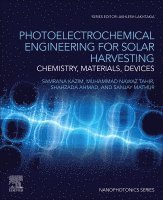
    Photoelectrochemical Engineering for Solar Harvesting

    Chemistry, Materials, Devices

    AvSamrana Kazim,Muhammad Nawaz Tahir

    Häftad, Engelska, 2024

    Del i serien Nanophotonics

    2 430 kr

    Beställningsvara. Skickas inom 10-15 vardagar. Fri frakt över 249 kr.

    Beskrivning

    Photoelectrochemical Engineering for Solar Harvesting: Chemistry, Materials, Devices provides an up-to-date appraisal of the photon engineering of innovative catalysts for solar energy harvesting. This book analyzes the overall progress, potential challenges, and the industrialization of new catalysts in the near future. The primary emphasis is on experimental approaches from materials synthesis to device applications, however, there is also an introduction to relevant photochemistry concepts. This book is suitable for materials scientists and chemists who, through the use of photonics, are in continuous pursuit of improving the efficiencies of different devices used to capture solar energy for the generation of sustainable fuel.

    Sunlight-driven fuel synthesis is the most sustainable and potentially economical option for producing energy vectors through water splitting. Thus, this book focuses on the design of photocatalysts and water oxidation catalysts, as artificial photosynthesis and hydrogen fuel production via water oxidation (in place of fossil fuels) are two promising approaches towards renewable energy.

    • Covers design of innovative energy materials such as photocatalysts and water oxidation catalysts for solar energy harvesting
    • Reviews briefly computational and theoretical approaches before providing comprehensive overview of experimental directions
    • Provides information to guide photon and photoelectrochemical engineering of catalysts for solar application

    Produktinformation

    • Utgivningsdatum:2024-06-25
    • Mått:191 x 235 x 26 mm
    • Vikt:1 000 g
    • Format:Häftad
    • Språk:Engelska
    • Serie:Nanophotonics
    • Antal sidor:502
    • Förlag:Elsevier Science
    • ISBN:9780323954945

    Utforska kategorier

    • Elektronik och kommunikationer inom Naturvetenskap och teknik
    • Energiteknik inom Naturvetenskap och teknik
    • Maskinteknik och material inom Naturvetenskap och teknik

    Mer om författaren

    Dr. Samrana Kazim is an Ikerbasque fellow and Group leader at Basque Centre for Materials, Applications, and Nanostructures (UPV). Before this, she worked as a tenured senior scientist, at Abengoa Research, a corporate research center of a multinational energy company in Spain. She obtained her doctoral degree (Ph.D.) in Materials chemistry. After finishing her Ph.D., she briefly worked as a post-doc at the Indian Institute of Technology (IIT Kanpur) and then moved to the Institute of Macromolecular Chemistry (IMC), Prague on an IUPAC/UNESCO fellowship and then later was a staff scientist there. She has authored over 80 research articles in reputed journals in the fields of material science, nanotechnology, and energy; also authored and edited book chapters and inventor of numerous patents in energy conversion and storage. Her research interests include synthesis and electro-optical characterization of organic semiconductors, hybrid nanostructured materials for optoelectronics applications, and perovskite solar cells. Muhammad Nawaz Tahir earned his Ph.D. in 2006 from Johannes Gutenberg University (JGU) of Mainz, Germany with the distinction “Summa Cum Laude” under the supervision of Prof. W. Tremel. Later, as a post-doctoral fellow, he underwent many research projects funded by DFG, MWFZ, and Max Plank Society. In 2010, he joined the Institute of Inorganic and Analytical Chemistry JGU Mainz, as senior scientist and group leader for nanomaterials synthesis, characterization, and applications. Since September 2017, he joined the Chemistry Department, King Fahd University of Petroleum and Minerals, Dhahran, Kingdom of Saudi Arabia, as an Assistant Professor. His research publication list reflects interdisciplinary contributions. His research interests involve the synthesis of innovative nanomaterials, characterization, surface engineering for renewable energy conversion and energy storage applications. Shahzada Ahmad is an Ikerbasque professor; his scientific interests include materials for energy. From 2012 to 2017, he was program director at Abengoa Research, a corporate research center. His scientific publications list reflects his diverse fields of interest in the domains of physical chemistry and materials science, with a research mission to develop advanced materials for energy application. His work has led to the invitation to speak at many scientific or policy-based conferences. He is an inventor of patents, Chief Editor of “Emergent Materials”, editorial board member of journals, European research council consolidator grant awardee, an elected fellow of the European Academies, distinguished scientist (<40) World Economic Forum. He is a strong advocate for renewable energy and regularly writes popular science articles for the public at large at the World Economic Forum. Dr. Sanjay Mathur is the director of the Institute of Inorganic Chemistry at the University of Cologne in Germany. He is the Co-Director of the Institute of Renewable Energy Sources at the Xian Jiao Tong University, Xian, China and a World Class University Professor at the Chonbuk University in Korea. He also holds Visiting Professorships at the Central South University, China, Tokyo University of Agriculture and Technology, Japan and National Institute of Science Education and Research (NISER), India. He has been awarded the Honorary Doctorate of the Vilnius University in 2016.

    Innehållsförteckning

    • 1. Solar fuel generation based on first-row transition metal catalysts 12. Au nanoparticles decorated textured Si with Fc/Fc+ and I-/I3- redox active gels for photoelectrochemical light harvesting3. Dual photoelectrodes in photoelectrochemical water splitting4. Metal-organic framework as light harvesting for photoelectrochemical water splitting: from fundamental to recent progress5. Applications of metal ferrites as photocatalyst for solar fuel production, water splitting and carbon dioxide reduction6. Redefining solar conversion: advancing technologies with metal-organic framework nanocomposites7. Photoelectrochemical water splitting based on 2D-transition metal dichalcogenide materials8. Perovskite materials: from synthesis to solar energy conversion applications9. Photo-valorization of biomass into H2 fuel and value-added chemicals10. Main group metal chalcogenides for photoelectrochemical water splitting11. Photoelectrochemical characterization of metal oxide semiconductors for solar water splitting using intensity-modulated photocurrent spectroscopy12. Graphitic carbon nitride-based materials for photoelectrochemical water splitting13. Hematite (α-Fe2O3) as a solar energy harvesting photoanode for photo-electrochemical (PEC) water splitting14. New photoelectrochemical processes for small molecule activation: the case of methane15. Quantum dots in photoelectrochemical hydrogen production