• Fri frakt över 249 kr
  • •
  • Snabba leveranser
  • •
  • Billiga böcker
Kundservice

Du är på sajten för privatpersoner.

Företag, bibliotek eller offentlig verksamhet?

Du handlar på classic.bokus.com, där alla dina funktioner finns intakta.
Till classic.bokus.com
Bokus logotyp. Gå till startsidan.
  • Erbjudanden
  • Nyheter
  • Student
  • Topplistor
  • Barn & ungdom
  • Bokus Play
  • E-böcker
  • Pocketböcker
  • Spel & pussel

10% rabatt på allt med kod: NYSTART10 →

Sidfot

Mina sidor

    Hjälp

    • Kundservice
    • Vanliga frågor och svar
    • Frakt och leverans
    • Retur vid ångerrätt
    • Reklamera vara
    • Betalning
    • Köpvillkor
    • Allmänna villkor
    • Information om webbplatsens tillgänglighet

    Om Bokus

    • Om oss
    • Pressrum
    • För studenter
    • För företag
    • För bibliotek och offentlig verksamhet
    • För leverantörer
    • Hållbarhet

    Populärt

    • Aktuella erbjudanden
    • Presentkort
    • Studentlitteratur
    • Nya böcker
    • Topplistor
    • Signerade böcker
    • Engelska böcker

    Inspiration

    • Boktips
    • BookTok
    • Populära bokserier
    • Barnbokskaraktärer
    • Populära författare
    Logotyp för Bokus
    Följ oss på Facebook (extern länk)Följ oss på Instagram (extern länk)Följ oss på YouTube (extern länk)Följ oss på TikTok (extern länk)
    bokus @ CookiesAnpassa cookiesIntegritetspolicyKöpvillkor
    Till Citymail hemsida (extern länk)Till Budbee hemsida (extern länk)Till Postnord hemsida (extern länk)Till Schenker hemsida (extern länk)Till Early Bird hemsida (extern länk)Till Walleys hemsida (extern länk)
    1. Psykologi och pedagogik
    2. Psykologi
    3. Psykologiska teorier och skolor
    4. Freudiansk psykologi

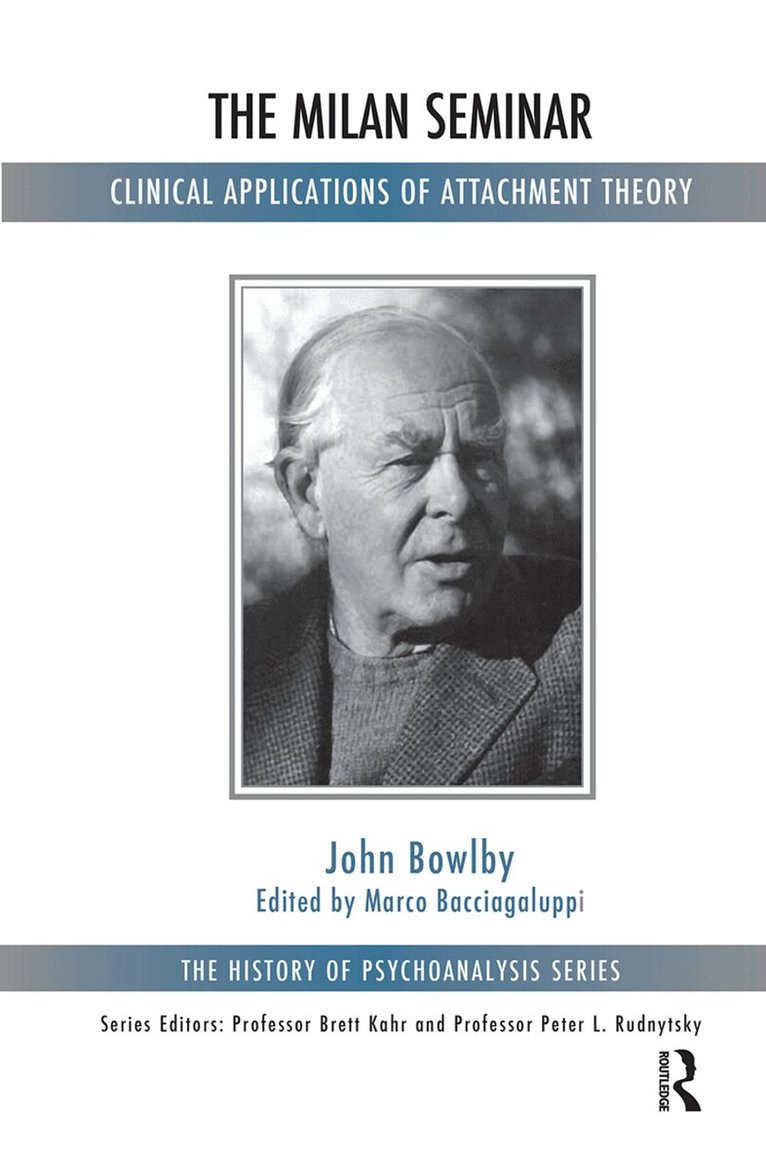
    Milan Seminar

    Clinical Applications of Attachment Theory

    AvJohn Bowlby,Marco Bacciagaluppi

    Inbunden, Engelska, 2019

    Del i serien History of Psychoanalysis Series

    2 352 kr

    Beställningsvara. Skickas inom 10-15 vardagar. Fri frakt över 249 kr.

    Fler format och utgåvor

    E-bok

    518 kr

    E-bok

    518 kr

    Häftad

    416 kr

    Beskrivning

    This edited book contains a hitherto unpublished seminar held by the author in Milan, Italy in 1985. The seminar is preceded by a foreword by Kate White, of the Bowlby Centre, and by an introduction by the editor, Marco Bacciagaluppi. The introduction contains excerpts from unpublished correspondence between the author and the editor, carried out over a span of eight years, between 1982 and 1990. After the seminar there are the follow-ups of the three cases presented by Leopolda Pelizzaro, Ferruccio Osimo and Emilia Fumagalli, and a report by Germana Agnetti and Angelo Barbato, who gave hospitality to the author and his wife. This is followed by a contribution by Ferruccio Osimo on experiential dynamic psychotherapy, an application of attachment theory, with a long case study. At the end there are some concluding remarks by the editor.

    Produktinformation

    • Utgivningsdatum:2019-07-05
    • Mått:152 x 229 x 14 mm
    • Vikt:470 g
    • Format:Inbunden
    • Språk:Engelska
    • Serie:History of Psychoanalysis Series
    • Antal sidor:166
    • Förlag:Taylor & Francis Ltd
    • ISBN:9780367101749

    Utforska kategorier

    • Freudiansk psykologi inom Psykologi och pedagogik

    Mer om författaren

    John Bowlby

    Innehållsförteckning

    • Series Editor’s Foreword , Foreword , Introduction and correspondence , General discussion , First case presentation: Medusa the revolutionary , Discussion of first case presentation , Second case presentation: the boarding school boy , Discussion of second case presentation , Third case presentation: the case of Adriana , Discussion of third case presentation , Conclusion of the seminar , Follow-up of first case presented , Follow-up of second case presented , Surprisingly simple: planning the seminar , A strange guest at our house. The encounter with Bowlby in 1985 viewed in retrospect , Experiential–dynamic psychotherapy: a therapeutic application of attachment theory , Concluding remarks