• Fri frakt över 249 kr
  • •
  • Snabba leveranser
  • •
  • Billiga böcker
Kundservice

Du är på sajten för privatpersoner.

Företag, bibliotek eller offentlig verksamhet?

Du handlar på classic.bokus.com, där alla dina funktioner finns intakta.
Till classic.bokus.com
Bokus logotyp. Gå till startsidan.
  • Erbjudanden
  • Nyheter
  • Student
  • Topplistor
  • Barn & ungdom
  • Bokus Play
  • E-böcker
  • Pocketböcker
  • Spel & pussel

10% rabatt på allt med kod: NYSTART10 →

Sidfot

Mina sidor

    Hjälp

    • Kundservice
    • Vanliga frågor och svar
    • Frakt och leverans
    • Retur vid ångerrätt
    • Reklamera vara
    • Betalning
    • Köpvillkor
    • Allmänna villkor
    • Information om webbplatsens tillgänglighet

    Om Bokus

    • Om oss
    • Pressrum
    • För studenter
    • För företag
    • För bibliotek och offentlig verksamhet
    • För leverantörer
    • Hållbarhet

    Populärt

    • Aktuella erbjudanden
    • Presentkort
    • Studentlitteratur
    • Nya böcker
    • Topplistor
    • Signerade böcker
    • Engelska böcker

    Inspiration

    • Boktips
    • BookTok
    • Populära bokserier
    • Barnbokskaraktärer
    • Populära författare
    Logotyp för Bokus
    Följ oss på Facebook (extern länk)Följ oss på Instagram (extern länk)Följ oss på YouTube (extern länk)Följ oss på TikTok (extern länk)
    bokus @ CookiesAnpassa cookiesIntegritetspolicyKöpvillkor
    Till Citymail hemsida (extern länk)Till Budbee hemsida (extern länk)Till Postnord hemsida (extern länk)Till Schenker hemsida (extern länk)Till Early Bird hemsida (extern länk)Till Walleys hemsida (extern länk)
    1. Psykologi och pedagogik
    2. Pedagogik
    3. Pedagogisk psykologi

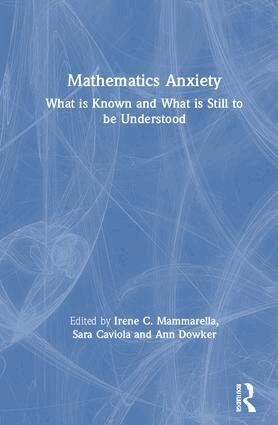
    Mathematics Anxiety

    What is Known and What is still to be Understood

    AvIrene C. Mammarella,Sara Caviola

    Inbunden, Engelska, 2019

    2 056 kr

    Beställningsvara. Skickas inom 10-15 vardagar. Fri frakt över 249 kr.

    Beskrivning

    Feelings of apprehension and fear brought on by mathematical performance can affect correct mathematical application and can influence the achievement and future paths of individuals affected by it. In recent years, math anxiety has become a subject of increasing interest both in educational and clinical settings. This ground-breaking collection presents theoretical, educational and psychophysiological perspectives on the widespread phenomenon of mathematics anxiety.Featuring contributions from leading international researchers, Mathematics Anxiety challenges preconceptions and clarifies several crucial areas of research, such as the distinction between math anxiety from other forms of anxiety (i.e., general or test anxiety); the ways in which math anxiety has been assessed (e.g., throughout self-report questionnaires or psychophysiological measures); the need to clarify the direction of the relationship between math anxiety and mathematics achievement (which causes which). Offering a re-evaluation of the negative connotations usually associated with math anxiety and prompting avenues for future research, this book will be invaluable to academics and students in the psychological and educational sciences, as well as teachers working with students who are struggling with math anxiety.

    Produktinformation

    • Utgivningsdatum:2019-02-26
    • Mått:156 x 234 x 17 mm
    • Vikt:480 g
    • Format:Inbunden
    • Språk:Engelska
    • Antal sidor:228
    • Förlag:Taylor & Francis Ltd
    • ISBN:9780367190330

    Utforska kategorier

    • Pedagogisk psykologi inom Psykologi och pedagogik
    • Matematik inom Naturvetenskap och teknik

    Mer om författaren

    Irene C. Mammarella is Associate Professor at the University of Padova, Italy. Her research interests include the role of working memory and emotional aspects in specific learning disorders, and other neurodevelopmental disorders. She is the cofounder of a clinical university centre for neurodevelopmental disorders (LabDA srl) and coauthored the book Nonverbal learning disabilities (Guilford Press, 2016). Sara Caviola is a Lecturer in Developmental Psychology, at the School of Psychology, University of Leeds, UK. She won a Marie Skłodowska-Curie fellowship and spent two years at the Centre for Neuroscience in Education, University of Cambridge. Her main interests include analyses of cognitive and emotional underpinnings of mathematical cognition, in both children and adult populations.Ann Dowker is University Research Lecturer at the Department of Experimental Psychology, Oxford University, UK. She has edited and coedited several books, and is the author of Individual Differences in Arithmetic: Implications for Psychology, Neuroscience and Education (Psychology Press, 2005; second edition to be published in 2019). She is the lead researcher on the Catch Up Numeracy intervention project.

    Innehållsförteckning

    • Preface Chapter 1 - Models of Math Anxiety by Mark H. AshcraftChapter 2 - Different Ways to Measure Math Anxiety by Krzysztof Cipora, Christina Artemenko and Hans-Christoph NuerkChapter 3 - Psychophysiological correlates of Mathematics Anxiety by Chiara Avancini & Denes SzücsChapter 4 – Mathematics Anxiety and Peformance by Ann DowkerChapter 5 - Acquisition, Development and Maintenance of Maths Anxiety in Young Children by Dominic Petronzi, Paul Staples, David Sheffield and Thomas HuntChapter 6 - Mathematics Anxiety and Working Memory: What is the Relationship? By Maria Chiara Passolunghi, Marija Živković, and Sandra PellizzoniChapter 7 - The Different Involvement of Working Memory in Math and Test Anxiety by Ee Lynn Ng, Kerry LeeChapter 8 - Math Anxiety in Children with and without Mathematical Difficulties:The role of Gender and Genetic Factors by Sara Caviola, Irene C. Mammarella and Yulia KovasChapter 9 - Probing the Nature of Deficits in Math Anxiety: Drawing Connections between Attention and Numerical Cognition by Orly Rubinsten, Hili Eidlin Levy and Lital Daches CohenChapter 10 - Gender Stereotypes, Anxiety, and Math Outcomes in Adults and Children byCarlo TomasettoChapter 11 - The Role of Parents’ and Teachers’ Math Anxiety in Children’s Math Learning and Attitudes by Julianne B. Herts, Sian L. Beilock, and Susan C. Levine Concluding Remarks by Irene C. Mammarella, Sara Caviola, and Ann Dowker