• Fri frakt över 249 kr
  • •
  • Snabba leveranser
  • •
  • Billiga böcker
Kundservice

Du är på sajten för privatpersoner.

Företag, bibliotek eller offentlig verksamhet?

Du handlar på classic.bokus.com, där alla dina funktioner finns intakta.
Till classic.bokus.com
Bokus logotyp. Gå till startsidan.
  • Erbjudanden
  • Nyheter
  • Student
  • Topplistor
  • Barn & ungdom
  • Bokus Play
  • E-böcker
  • Pocketböcker
  • Spel & pussel

10% rabatt på allt med kod NYSTART10 →

Sidfot

Mina sidor

    Hjälp

    • Kundservice
    • Vanliga frågor och svar
    • Frakt och leverans
    • Retur vid ångerrätt
    • Reklamera vara
    • Betalning
    • Köpvillkor
    • Allmänna villkor
    • Information om webbplatsens tillgänglighet

    Om Bokus

    • Om oss
    • Pressrum
    • För studenter
    • För företag
    • För bibliotek och offentlig verksamhet
    • För leverantörer
    • Hållbarhet

    Populärt

    • Aktuella erbjudanden
    • Presentkort
    • Studentlitteratur
    • Nya böcker
    • Topplistor
    • Signerade böcker
    • Engelska böcker

    Inspiration

    • Boktips
    • BookTok
    • Populära bokserier
    • Barnbokskaraktärer
    • Populära författare
    Logotyp för Bokus
    Följ oss på Facebook (extern länk)Följ oss på Instagram (extern länk)Följ oss på YouTube (extern länk)Följ oss på TikTok (extern länk)
    bokus @ CookiesAnpassa cookiesIntegritetspolicyKöpvillkor
    Till Citymail hemsida (extern länk)Till Budbee hemsida (extern länk)Till Postnord hemsida (extern länk)Till Schenker hemsida (extern länk)Till Early Bird hemsida (extern länk)Till Walleys hemsida (extern länk)
    1. Språk och ordböcker
    2. Språk: referensverk och allmänt

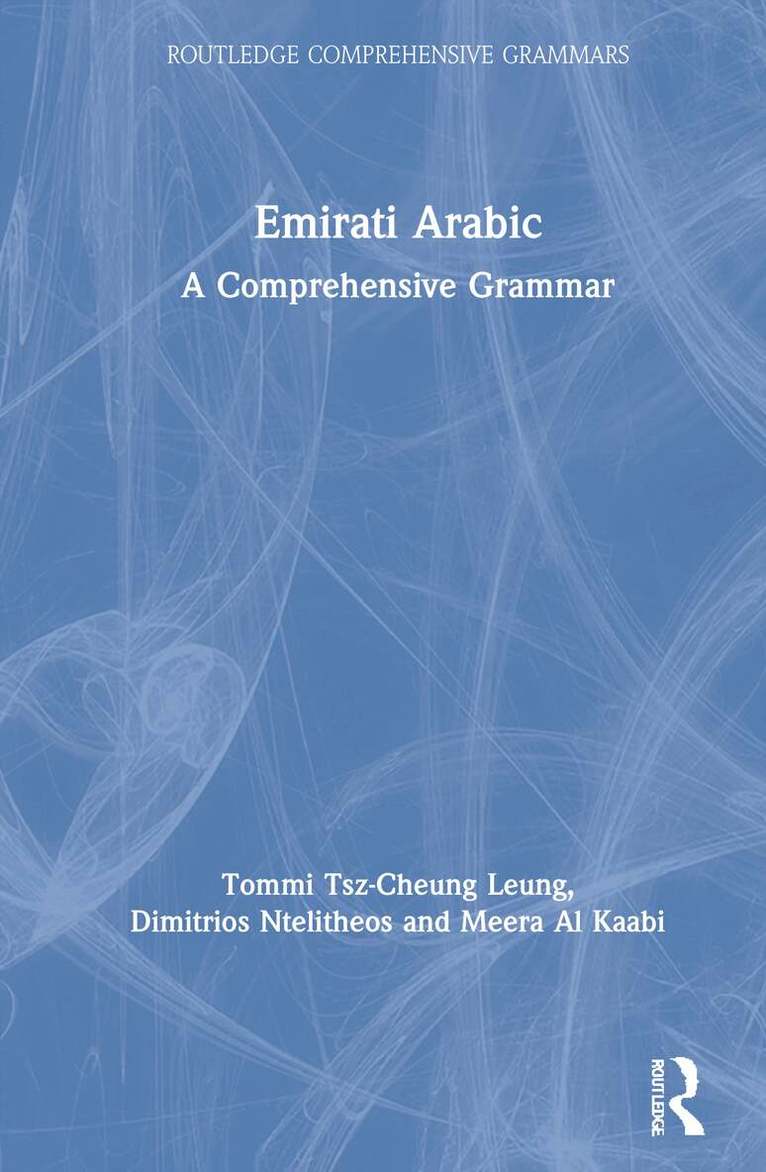
    Emirati Arabic

    A Comprehensive Grammar

    AvTommi Tsz-Cheung Leung,Dimitrios Ntelitheos

    Inbunden, Engelska, 2020

    Del i serien Routledge Comprehensive Grammars

    2 140 kr

    Skickas . Fri frakt över 249 kr.

    Fler format och utgåvor

    Häftad

    1 439 kr

    Beskrivning

    Emirati Arabic: A Comprehensive Grammar offers readers a reference tool for discovering and studying in detail the specific dialect of Arabic spoken in the United Arab Emirates. It covers all major areas of Emirati Arabic grammar, describing in detail its phonological, morphological, syntactic, and semantic systems. Each grammatical point is illustrated with numerous examples drawn from native Emirati Arabic speakers and is thoroughly discussed providing both accessible and linguistically informed grammatical description.This book is a useful reference for students of Gulf Arabic and/or Modern Standard Arabic or other Arabic dialects with an interest in the dialect spoken in the UAE, researchers interested in Arabic language and linguistics as well as graduate students and scholars interested in Arabic studies.

    Produktinformation

    • Utgivningsdatum:2020-12-30
    • Mått:156 x 234 x 31 mm
    • Vikt:1 120 g
    • Format:Inbunden
    • Språk:Engelska
    • Serie:Routledge Comprehensive Grammars
    • Antal sidor:500
    • Förlag:Taylor & Francis Ltd
    • ISBN:9780367220822

    Utforska kategorier

    • Språk: referensverk och allmänt inom Språk och ordböcker
    • Språkvetenskap och lingvistik inom Språk och ordböcker

    Mer om författaren

    Tommi Tsz-Cheung Leung is Associate Professor in the Department of Cognitive Sciences at the United Arab Emirates University. His research specializes in syntax, phonology, typology, and psycholinguistics.Dimitrios Ntelitheos is Associate Professor in the Department of Cognitive Sciences at the United Arab Emirates University. His research interests include the investigation of morphological and syntactic structures from a theoretical perspective, as well as their cross-linguistic realization and their development in child language.Meera Al Kaabi is Assistant Professor and Chair in the Department of Cognitive Sciences at the United Arab Emirates University and a visiting academic at New York University Abu Dhabi. Her research interests include neurolinguistics, psycholinguistics, language disorders, morphology, and Semitic languages.

    Innehållsförteckning

    • Table of ContentsAcknowledgmentsList of TablesList of FiguresList of Abbreviations1 Introduction1.1 Emirati Arabic1.2 Triglossia in the UAE1.3. The Descriptive Approach to Emirati Arabic1.4 Transcription1.5. Glossing1.6. AbbreviationsFurther Reading2 Sounds of Emirati Arabic2.1 Consonants2.2 VowelsFurther Reading3 Phonological Processes3.1 Feature-Level Processes3.2 Segment-Level Processes3.3 Suprasegmental Processes and PhonotacticsFurther Reading4 Morphology and Word Formation4.1 Non-Linear Morphological Processes4.2 Affixation4.3 Reduplication4.4 Compounding4.5 Loanwords4.6 Acronyms, Abbreviations and Blending4.7 Back Formation4.8 ConversionFurther Reading5 Syntactic Categories and Parts of Speech5.1 Nouns5.2 Verbs5.3. Adjectives5.4 Adverbs and Adverbial Expressions5.5 Prepositions5.6. Quantification: Numerals and Quantifiers5.7 Complementizers5.8 PronounsFurther Reading6 The Noun Phrase6.1 Definiteness6.2 Possession6.3 Appositives6.4 Nominal modifiers6.5 Agreement in the Noun Phrase6.6 Demonstratives6.7 Word Order in the Noun PhraseFurther Reading7 The Verb Phrase7.1 The Copular Structure7.2 State Verbs7.3 Experiencer Verbs7.4 Unergative Verbs7.5 Unaccusative Verbs7.6 Ditransitive Verbs7.7 Existential and Possessive Predicates7.8 Raising Predicates7.9 Control Verbs7.10 Reflexive Verbs7.11 Complex Predicates7.12 Causative Verbs7.13 Passive Verbs7.14 Complement-taking VerbsFurther Reading8 Aspect8.1 The Perfective Aspect8.2 The Imperfective Aspect8.3 Participles8.4 Lexical Aspect8.5 Grammatical AspectFurther Reading9 Mood and Modality9.1 Deontic Modality9.2 Epistemic Modality9.3 Dynamic Modality9.4 Modal Adverbs9.5 Verbs Expressing Modality9.6 Evidential Modality9.7 Imperatives9.8 Counterfactuals9.9 Hortatives9.10 OptativesFurther Reading10 Negation10.1 Verbal Negation10.2 Non-Verbal Predicate Negation10.3 The Negative Particle لا laa ‘no’10.4 The Negative Prefix -لا laa- ‘not’ and -غير ɣeer- ‘non-’10.5 Negative Imperatives10.6 Negative Coordination10.7 Negation in Ellipsis10.8 Negative Polarity Items10.9 Negative ConcordFurther reading11 Word Order11.1 Subject-Verb (SV) and Verb-Subject (VS)11.2 Subject-Verb-Object (SVO)11.3 Double Object Constructions11.4 Word Order PermutationFurther reading12 Relative Clauses12.1 Restrictive Relative Clauses12.2 Nonrestrictive Relative Clauses12.3 Free Relative Clauses12.4 Noun Complement ClausesFurther Reading13 Questions13.1 Yes-No Questions13.2 Wh-Questions13.3 Echo Questions13.4 Embedded Questions13.5 Rhetorical Questions13.6 ExclamativesFurther Reading14 Subordination14.1 Temporal Clauses14.2 Reason Clauses14.3 Purpose Clauses14.4 Conditional Clauses14.5 Concessive Clauses14.6 Other Subordinators14.7 ParentheticalsFurther Reading15 Coordination15.1 Conjunction و w-/wa ‘and’15.2 Agreement in Coordination15.3 Fixed Expressions Formed by و w-/wa15.4 Pragmatic Uses of و w-/wa15.5 Informal Use of و w-/wa15.6 بس bas ‘but’15.7 Disjunction ولا wela ‘or’15.8 أو ʔaw ‘or’15.9 ف fa- ‘and then/so’15.10 Contrastive Coordinator أما ʔamma ‘as for’15.11 Comparative Coordinator عن ʕan ‘than’15.12 Negative Coordinator مب mub ‘not’15.13 Correlatives in Coordination15.14 Paratactic CoordinationFurther Reading16 Ellipsis16.1 Gapping16.2 Stripping16.3 NP Ellipsis16.4 VP Ellipsis16.5 PP Ellipsis16.6 Clausal Ellipsis16.7 Comparative Deletion16.8 SluicingFurther Reading17 Interjections17.1 Primary Interjections17.2 Borrowed Interjections17.3 Secondary InterjectionsFurther Reading18 Speech Conventions18.1 Politeness18.2 Terms of Address18.3 General Honorific Terms18.4 Trendy LanguageFurther ReadingGlossary of TermsReferencesIndex