• Fri frakt över 249 kr
  • •
  • Snabba leveranser
  • •
  • Billiga böcker
Kundservice

Du är på sajten för privatpersoner.

Företag, bibliotek eller offentlig verksamhet?

Du handlar på classic.bokus.com, där alla dina funktioner finns intakta.
Till classic.bokus.com
Bokus logotyp. Gå till startsidan.
  • Erbjudanden
  • Nyheter
  • Student
  • Topplistor
  • Barn & ungdom
  • Bokus Play
  • E-böcker
  • Pocketböcker
  • Spel & pussel

Må bättre, för mindre! Upp till 50% rabatt på hälsoböcker

Sidfot

Mina sidor

    Hjälp

    • Kundservice
    • Vanliga frågor och svar
    • Frakt och leverans
    • Retur vid ångerrätt
    • Reklamera vara
    • Betalning
    • Köpvillkor
    • Allmänna villkor
    • Information om webbplatsens tillgänglighet

    Om Bokus

    • Om oss
    • Pressrum
    • För studenter
    • För företag
    • För bibliotek och offentlig verksamhet
    • För leverantörer
    • Hållbarhet

    Populärt

    • Aktuella erbjudanden
    • Presentkort
    • Studentlitteratur
    • Nya böcker
    • Topplistor
    • Signerade böcker
    • Engelska böcker

    Inspiration

    • Boktips
    • BookTok
    • Populära bokserier
    • Barnbokskaraktärer
    • Populära författare
    Logotyp för Bokus
    Följ oss på Facebook (extern länk)Följ oss på Instagram (extern länk)Följ oss på YouTube (extern länk)Följ oss på TikTok (extern länk)
    bokus @ CookiesAnpassa cookiesIntegritetspolicyKöpvillkor
    Till Citymail hemsida (extern länk)Till Budbee hemsida (extern länk)Till Postnord hemsida (extern länk)Till Schenker hemsida (extern länk)Till Early Bird hemsida (extern länk)Till Walleys hemsida (extern länk)
    1. Djur och Natur
    2. Naturböcker
    3. Växtböcker

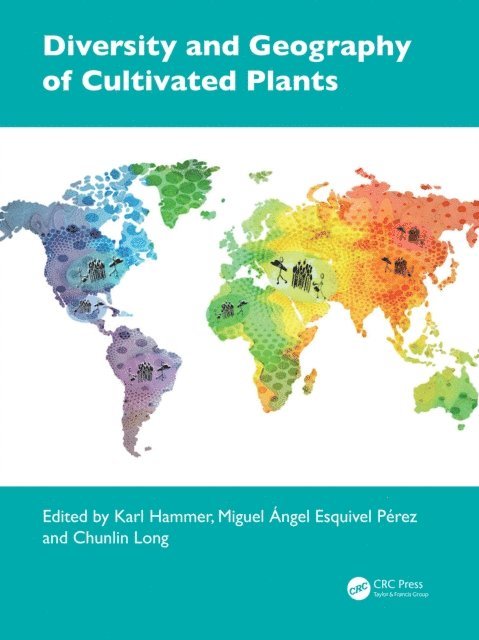
    Diversity and Geography of Cultivated Plants

    AvKarl Hammer,Miguel Ángel Esquivel Pérez

    Inbunden, Engelska, 2025

    7 304 kr

    Beställningsvara. Skickas inom 10-15 vardagar. Fri frakt över 249 kr.

    Beskrivning

    This book presents information on cultivated plants located within 12 different regions throughout the world. The content introduces cultural evolution and species richness in cultivated plants, considering domestication assessments, which make it possible to obtain a deeper insight into the diversity of these plants.Cultivated plants are evolutionary connected to man, human action for nature and culture is necessary to secure the basis for future existence of humanity. Cultivated plants are included in this compilation, plants are grown for food, food additives, fodder, medicine, fiber, seasoning or as green manure crops, shade trees or hedge shrubs. The large number of commodity groups characterize the number of interactions between man and plants.The aim of this book is to bring together an actualized list of cultivated plants. It was necessary to organize, store and analyze gathered data during the exploration and collection missions, as well as those resulting from the ethnobotanical, archaeological and genomics studies. The book presents essayistic introductions; short data on areas of distribution and cultivation areas; the use of the plant; the history and descent of the plant; and citations of common names as a part of the cultural evolution of mankind. Where necessary, the content explores "gene sources” as plants for different breeding purposes including resistance, quality, yield improvement and weeds.

    Produktinformation

    • Utgivningsdatum:2025-05-04
    • Mått:210 x 280 x 55 mm
    • Vikt:1 920 g
    • Format:Inbunden
    • Språk:Engelska
    • Antal sidor:940
    • Förlag:Taylor & Francis Ltd
    • ISBN:9780367227760

    Utforska kategorier

    • Växtböcker inom Djur och Natur
    • Botanik inom Naturvetenskap och teknik
    • Agronomi och lantbruk inom Naturvetenskap och teknik

    Mer om författaren

    Karl Hammer, emeritus professor at Kasssel University, Germany, is a well-known leading scientist in agrobiodiversity and plant genetic resources. After his study of agricultural sciences at the University of Leipzig, in 1968 he joined the Institute for Crop Plant Research and Plant Genetics in Gatersleben. He earned his Ph.D. in agricultural sciences from Martin-Luther-University Halle-Wittenberg and a Dr. sc. nat. from the Academy of Sciences in Berlin. At this time his research focused on pollination ecology of barley. Later, he finished his habilitation in plant breeding and the new field of plant genetic resources. In 1992, he became head of the Gatersleben Genebank and was appointed associate professorof plant breeding and plant genetic resources at the Georg-August-University Göttingen. In 1998, he became the first professor of agrobiodiversity and the Director of Tropical Greenhouse at the University of Kassel.His scientific work covers a wide range of research in plant genetic resources, ranging from ecology and taxonomy to plant domestication, evolution and genetic erosion, conservation and utilization of plant genetic resources, including underutilized and neglected species such as wild fruit trees. Since 1974, he has performed more than 70 missions for collecting and studying plant genetic resources in Europe, Africa, East Asia and Central America. His research results are summarized in more than 500 scientific journal articles and 43 books and book chapters. He is the main author of Mansfeld’s Encyclopedia of Agricultural and Horticultural Crops, which describes all agricultural and horticultural plants, grown throughout the world presently or in the past. From 1994 to 2007, he has headed the genetic resources section and the GenebankCommittee of EUCARPIA. He was co-founder and since many years editor-in-chief of Genetic Resources and Crop Evolution (GRACE), an international journal. He has served in editorial boards of seven national and international journals, such as Euphytica and Plant Systematics and Evolution. He earned a Dr.h.c. from Tirana University. He is one of the important advisors in the field of agrobiodiversity. During his time as a professor of agrobiodiversity, he used his encyclopedic knowledge about plants to inspire and vigorously support young scientists from all over the world. Miguel Ángel Esquivel Pérez was born in Havana, Cuba, on February 8, 1958. He graduated with a bachelor's degree in Biological Sciences from the Faculty of Biology at the University of Havana. He specialized in Botany at the National Botanical Garden in 1982, where he conducted research in plant taxonomy. He began his work in 1983 at the Alejandro de Humboldt Tropical Fundamental Research Institute (INIFAT), formerly the Agronomic Experimental Station of Santiago de Las Vegas in Havana. There, he initiated an intensive training and research program in plant genetic resources in collaboration with the then Central Institute of Genetics and Research of Cultivated Plants in Gatersleben, German Democratic Republic, now the Leibniz Institute of Plant Genetics and Crop Plant Research (IPK) in Germany. Dr. Esquivel complemented his training with experiences at the International Maize and Wheat Improvement Center (CIMMYT) in Mexico; the N. I. Vavilov All-Russian Institute of Plant Genetic Resources (VIR) in St. Petersburg; the Seed and Nursery Plants Institute (ISPV) in Spain; the Nordic Genebank (NGB) in Sweden; and Wageningen University in the Netherlands, among others. He served as Executive Secretary of the National Program for Plant Genetic Resources of Cuba and was an active collaborator with the FAO's Commission on Genetic Resources and the International Board for Plant Genetic Resources. He has been a reviewer and/or member of the editorial board for international journals such as Euphytica and Genetic Resources and Crop Evolution. He completed his doctoral thesis on documentation systems for germplasm banks in 1994.Between 1994 and 1999, Dr. Esquivel worked as a professor in the Agricultural Department at the University of Holguín (UHo), involved in various local development programs that combined historical aspects and biodiversity, with several national and international NGOs as German Agro Action and BORDA, Germany, as well as COSUDE, Sweden. Since 2000, he has simultaneously worked at the National Center for Laboratory Animal Production (CENPALAB), the Institute of Pastures and Forages Research (IIPF), and the Agricultural Engineering Institute (IAgric), all in Cuba, focusing on agricultural development projects and historical-geographical research. He has collaborated extensively with the Institute of History of Cuba (IHC). He is a member of the Expert Groups for the National Biotechnology and History Programs of Cuba. Currently he is working as FAO Consultant for biodiversity project too.Dr. Esquivel has undertaken work missions to Argentina, Australia, Brazil, Chile, Russia, and Serbia, among others. In the last decade, he has maintained an active research and local development program with various entities in Mexico, including the Universidad Autónoma Chapingo (UACh), Universidad Veracruzana (UV), and Universidad Tecnológica de Izúcar de Matamoros (UTIM). He has participated in 187 scientific events, delivering 242 presentations. He has published 161 articles, book chapters, and books on topics such as ethnobotany and history, and related topics.Dr. Esquivel is a member of the Cuban Society of Botany (SOCUBOT), the Cuban Association of Animal Production (ACPA), and the National Union of Historians of Cuba (UNAHIC).Chunlin Long is a professor at Minzu University of China, China.

    Innehållsförteckning

    • 1. Introduction 2. Material and methods 3. Results and discussion 4. Prospects of genomics - providing new insights into the evolutionary history of crop plants 5. East Asiatic region of diversity 6. Indochinese-Indonesian region of diversity 7. Australian Oceania region of diversity 8. Hindustani region of diversity 9. Central Asiatic region of diversity 10. Near Eastern region of diversity 11. Mediterranean region of diversity 12. African region of diversity 13. European Siberian region of diversity 14. South American region of diversity 15. Central American and Caribbean region of diversity 16. North American region of diversity 17. References