• Fri frakt över 249 kr
  • •
  • Snabba leveranser
  • •
  • Billiga böcker
Kundservice

Du är på sajten för privatpersoner.

Företag, bibliotek eller offentlig verksamhet?

Du handlar på classic.bokus.com, där alla dina funktioner finns intakta.
Till classic.bokus.com
Bokus logotyp. Gå till startsidan.
  • Erbjudanden
  • Nyheter
  • Student
  • Topplistor
  • Barn & ungdom
  • Bokus Play
  • E-böcker
  • Pocketböcker
  • Spel & pussel

10% rabatt på allt med kod: NYSTART10 →

Sidfot

Mina sidor

    Hjälp

    • Kundservice
    • Vanliga frågor och svar
    • Frakt och leverans
    • Retur vid ångerrätt
    • Reklamera vara
    • Betalning
    • Köpvillkor
    • Allmänna villkor
    • Information om webbplatsens tillgänglighet

    Om Bokus

    • Om oss
    • Pressrum
    • För studenter
    • För företag
    • För bibliotek och offentlig verksamhet
    • För leverantörer
    • Hållbarhet

    Populärt

    • Aktuella erbjudanden
    • Presentkort
    • Studentlitteratur
    • Nya böcker
    • Topplistor
    • Signerade böcker
    • Engelska böcker

    Inspiration

    • Boktips
    • BookTok
    • Populära bokserier
    • Barnbokskaraktärer
    • Populära författare
    Logotyp för Bokus
    Följ oss på Facebook (extern länk)Följ oss på Instagram (extern länk)Följ oss på YouTube (extern länk)Följ oss på TikTok (extern länk)
    bokus @ CookiesAnpassa cookiesIntegritetspolicyKöpvillkor
    Till Citymail hemsida (extern länk)Till Budbee hemsida (extern länk)Till Postnord hemsida (extern länk)Till Schenker hemsida (extern länk)Till Early Bird hemsida (extern länk)Till Walleys hemsida (extern länk)
    1. Samhälle och politik
    2. Samhälle och kultur
    3. Sociala grupper och identitet
    4. Genusvetenskap

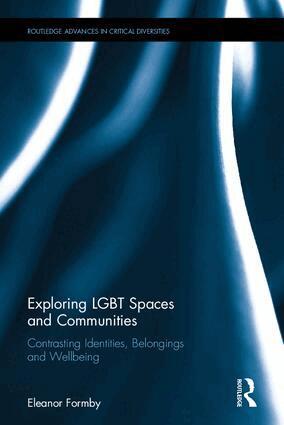
    Exploring LGBT Spaces and Communities

    Contrasting Identities, Belongings and Wellbeing

    AvEleanor Formby

    Häftad, Engelska, 2019

    Del i serien Routledge Advances in Critical Diversities

    723 kr

    Beställningsvara. Skickas inom 10-15 vardagar. Fri frakt över 249 kr.

    Fler format och utgåvor

    Inbunden

    2 423 kr

    E-bok

    855 kr

    E-bok

    855 kr

    Beskrivning

    The phrase ‘LGBT community’ is often used by policy-makers, service providers, and lesbian, gay, bisexual and trans (LGBT) people themselves, but what does it mean? What understandings and experiences does that term suggest, and ignore? Based on a UK-wide study funded by the Arts and Humanities Research Council, this book explores these questions from the perspectives of over 600 research participants. Examining ideas about community ‘ownership’; ‘difference’ and diversity; relational practices within and beyond physical spaces; imagined communities and belongings; the importance of ‘ritual’ spaces and symbols, and consequences for wellbeing, the book foregrounds the lived experience of LGBT people to offer a broad analysis of commonalities and divergences in relation to LGBT identities. Drawing on an interdisciplinary perspective grounded in international social science research, the book will appeal to students and scholars with interests in sexual and/or gender identities in the fields of community studies, cultural studies, gender studies, geography, leisure studies, politics, psychology, sexuality studies, social policy, social work, socio-legal studies, and sociology. The book also offers implications for practice, suitable for policy-maker, practitioner, and activist audiences, as well as those with a more personal interest.

    Produktinformation

    • Utgivningsdatum:2019-06-17
    • Mått:156 x 234 x 20 mm
    • Vikt:453 g
    • Format:Häftad
    • Språk:Engelska
    • Serie:Routledge Advances in Critical Diversities
    • Antal sidor:216
    • Förlag:Taylor & Francis Ltd
    • ISBN:9780367348106

    Utforska kategorier

    • Genusvetenskap inom Samhälle och politik

    Mer om författaren

    Eleanor Formby is Senior Research Fellow at the Centre for Education and Inclusion Research at Sheffield Hallam University, UK.

    Recensioner i media

    This important work, critically approaches a vexed topic that of ‘community’ in an informed, innovative and rigorous way. Its cross disciplinary approach and clear writing style means that it will be of interest to all who are interested and work with not only lesbian, gay, bisexual and trans communities, but also those who are interested in social cohesion, identities, exclusions and marginalisations. This is also a must read for policy makers and the LGBT community and voluntary sector. Katherine Browne, Professor Human Geography at University of Brighton, UKExploring LGBT Spaces and Communities interrogates the complexities that lurk behind the deceptively simple idea of "community." Page after page, Eleanor Formby shatters the stereotype of singularity and shows us the manifold experiences of communities—in the plural—for LGBT people. This book is sure to poke and provoke as it traverses tensions between sameness and difference, hostility from the outside and safe spaces within, forced labels that misalign with lived experiences, on-line and offline encounters, cynicism and celebration about membership, demanding conformity or celebrating individuality, and in broad strokes, whether sexuality is primary or peripheral in our lives.Amin Ghaziani, University of British Columbia, CanadaThis book will be a valuable addition to any undergraduate or postgraduate course of study that includes issues of sexuality, identity, community, (mental) health and wellbeing. It makes no apology about the complexities that the data unfolds and provides meticulous attention to the detail of people’s experiences and intersectional identities. Overall, the book explores the many ways in which ‘LGBT community’ – awkward, inadequate, limited, sometimes oppressive, discriminatory, hostile and exclusive – is aspired to (and is often a [temporary] reality).Catherine Donovan, University of Sunderland, UK

    Innehållsförteckning

    • IntroductionSpatial communities and ‘gay ghettos’Cultural communities and practicesImagined communities and the ‘gay imaginary’Friendships and personal communitiesVirtual communities and cyberian mailwaysCommunity is here to stay?The researchThe bookReferences2. ‘Owning’ and questioning LGBT communitiesIntroductionThe acronym that ‘lumps together’‘Managing’ the acronymAmbivalenceCommonalityAgencyChapter summaryReferences3. Diversity, inequality and prejudice amongst LGBT people IntroductionOverview of existing literatureDiversity and inequalityIdentity-based prejudiceFaith and religionParenting(Non)conformity Chapter summaryReferences 4. Lived experience and ‘doing’ communityIntroductionOverview of existing literatureSocialising, friendship and seeking intimacyFriendship familiesSafety in numbersAccessing ‘safe’ spacesSelf-censorshipActivismLived experience across the life courseChapter summaryReferences5. Relationships to, within and beyond physical spacesIntroductionOverview of existing literaturePhysical space and geographical areasRelocation Rural livingTravel and tourism Groups and servicesOnline spaces and virtual communities Chapter summaryReferences6. The pleasures and pains of scene spacesIntroductionOverview of existing literatureThe scene as ‘community’Positive experiencesScene exclusionsInvasion, choice and ownership Chapter summaryReferences7. Pride spaces, rituals and symbolsIntroductionOverview of existing literatureCreating communities?Safety and freedom Celebration ProtestPartying with politicsCommercialismAlcohol at Pride events Exclusion ‘Excess’ and ‘extreme’ displays of prideChapter summaryReferences8. Imagined communities and a sense of belongingIntroductionOverview of existing literatureBelonging and connectionCommonalities, similarities, and mutual understanding Differences and valuesShared experiences and the ‘bond’ of discrimination?Chapter summaryReferences9. Consequences for wellbeingIntroductionOverview of existing literatureImpacts on physical and mental health Seeking supportFriendships, confidence and self-esteemFinding people ‘like me’Alcohol, drugs and sex on the sceneParadoxical spacesChapter summaryReferences10. Conclusions and implicationsReferencesAppendix: Research methods and participantsResearch process and recruitmentOnline surveyInterviews and group discussions ParticipantsReferences