• Fri frakt över 249 kr
  • •
  • Snabba leveranser
  • •
  • Billiga böcker
Kundservice

Du är på sajten för privatpersoner.

Företag, bibliotek eller offentlig verksamhet?

Du handlar på classic.bokus.com, där alla dina funktioner finns intakta.
Till classic.bokus.com
Bokus logotyp. Gå till startsidan.
  • Erbjudanden
  • Nyheter
  • Student
  • Topplistor
  • Barn & ungdom
  • Bokus Play
  • E-böcker
  • Pocketböcker
  • Spel & pussel

10% rabatt på allt med kod: NYSTART10 →

Sidfot

Mina sidor

    Hjälp

    • Kundservice
    • Vanliga frågor och svar
    • Frakt och leverans
    • Retur vid ångerrätt
    • Reklamera vara
    • Betalning
    • Köpvillkor
    • Allmänna villkor
    • Information om webbplatsens tillgänglighet

    Om Bokus

    • Om oss
    • Pressrum
    • För studenter
    • För företag
    • För bibliotek och offentlig verksamhet
    • För leverantörer
    • Hållbarhet

    Populärt

    • Aktuella erbjudanden
    • Presentkort
    • Studentlitteratur
    • Nya böcker
    • Topplistor
    • Signerade böcker
    • Engelska böcker

    Inspiration

    • Boktips
    • BookTok
    • Populära bokserier
    • Barnbokskaraktärer
    • Populära författare
    Logotyp för Bokus
    Följ oss på Facebook (extern länk)Följ oss på Instagram (extern länk)Följ oss på YouTube (extern länk)Följ oss på TikTok (extern länk)
    bokus @ CookiesAnpassa cookiesIntegritetspolicyKöpvillkor
    Till Citymail hemsida (extern länk)Till Budbee hemsida (extern länk)Till Postnord hemsida (extern länk)Till Schenker hemsida (extern länk)Till Early Bird hemsida (extern länk)Till Walleys hemsida (extern länk)
    1. Språk och ordböcker
    2. Språkvetenskap och lingvistik

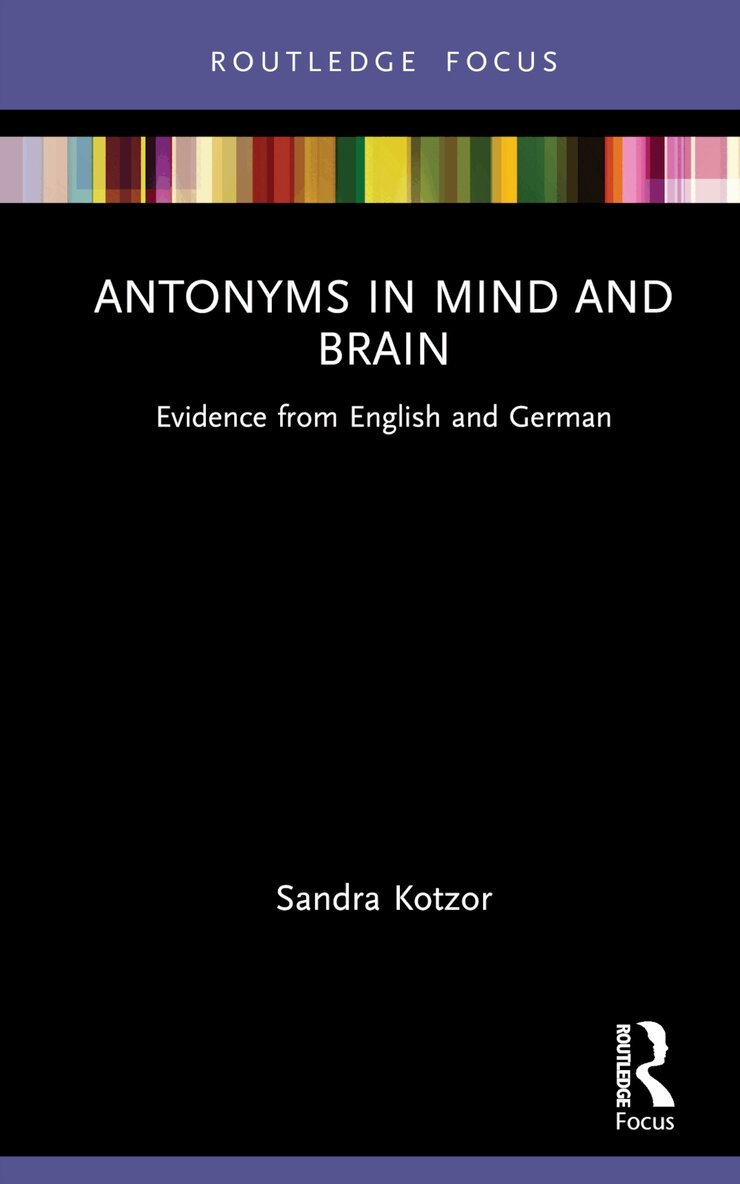
    Antonyms in Mind and Brain

    Evidence from English and German

    AvSandra Kotzor

    Inbunden, Engelska, 2021

    Del i serien Routledge Focus on Linguistics

    990 kr

    Beställningsvara. Skickas inom 10-15 vardagar. Fri frakt över 249 kr.

    Fler format och utgåvor

    E-bok

    380 kr

    E-bok

    381 kr

    Häftad

    325 kr

    Beskrivning

    Antonyms in Mind and Brain presents a multi-method empirical investigation of opposition with a particular focus on the processing of opposite pairs and their representation in the mental lexicon. Building on recent cognitive accounts of antonymy which highlight the fundamentally conceptual nature of antonymy, this book outlines previous literature to draw out criteria for good opposites and establish the state of the art on the question whether the strong connection of certain opposite pairs is primarily of a conceptual or lexical nature. presents a detailed cross-linguistic empirical study combining corpus data, speaker judgements and behavioural experiments for a wide range of central (e.g. big:little) and peripheral (e.g. buy:sell; wife:husband) opposite pairs to establish the contribution of individual factors. proposes a model of the representation of opposite pairs in the mental lexicon and illustrates how the processing consequences of such a model account for the patterns observed in the data. The approach taken in this book highlights the importance of using a number of different methods to investigate complex phenomena such as antonymy. Such an approach forms the empirical foundation for a dynamic psycholinguistic model of opposition based on the conventionalisation and entrenchment of the conceptual and lexical relationship of antonyms.

    Produktinformation

    • Utgivningsdatum:2021-10-08
    • Mått:138 x 216 x 17 mm
    • Vikt:380 g
    • Format:Inbunden
    • Språk:Engelska
    • Serie:Routledge Focus on Linguistics
    • Antal sidor:184
    • Förlag:Taylor & Francis Ltd
    • ISBN:9780367461126

    Utforska kategorier

    • Språkvetenskap och lingvistik inom Språk och ordböcker

    Mer om författaren

    Sandra Kotzor is a Senior Researcher in the Language and Brain Laboratory at the University of Oxford and Senior Lecturer in English Linguistics and Applied Linguistics at Oxford Brookes University.

    Innehållsförteckning

    • PART I Theoretical foundations1. Introduction2. Previous perspectives on antonymyPART II Empirical investigation3. Antonymic and associative strength: evidence from English and German4. Processing opposite pairs: an antonym-decision task5. Case studiesPART III Theoretical implications6. Antonyms in mind and brain: towards a psycholinguistic model of opposition7. Conclusions