• Fri frakt över 249 kr
  • •
  • Snabba leveranser
  • •
  • Billiga böcker
Kundservice

Du är på sajten för privatpersoner.

Företag, bibliotek eller offentlig verksamhet?

Du handlar på classic.bokus.com, där alla dina funktioner finns intakta.
Till classic.bokus.com
Bokus logotyp. Gå till startsidan.
  • Erbjudanden
  • Nyheter
  • Student
  • Topplistor
  • Barn & ungdom
  • Bokus Play
  • E-böcker
  • Pocketböcker
  • Spel & pussel

10% studentrabatt med kod TERM26

Sidfot

Mina sidor

    Hjälp

    • Kundservice
    • Vanliga frågor och svar
    • Frakt och leverans
    • Retur vid ångerrätt
    • Reklamera vara
    • Betalning
    • Köpvillkor
    • Allmänna villkor
    • Information om webbplatsens tillgänglighet

    Om Bokus

    • Om oss
    • Pressrum
    • För studenter
    • För företag
    • För bibliotek och offentlig verksamhet
    • För leverantörer
    • Hållbarhet

    Populärt

    • Aktuella erbjudanden
    • Presentkort
    • Studentlitteratur
    • Nya böcker
    • Topplistor
    • Signerade böcker
    • Engelska böcker

    Inspiration

    • Boktips
    • BookTok
    • Populära bokserier
    • Barnbokskaraktärer
    • Populära författare
    Logotyp för Bokus
    Följ oss på Facebook (extern länk)Följ oss på Instagram (extern länk)Följ oss på YouTube (extern länk)Följ oss på TikTok (extern länk)
    bokus @ CookiesAnpassa cookiesIntegritetspolicyKöpvillkor
    Till Citymail hemsida (extern länk)Till Budbee hemsida (extern länk)Till Postnord hemsida (extern länk)Till Schenker hemsida (extern länk)Till Early Bird hemsida (extern länk)Till Walleys hemsida (extern länk)
    1. Historia och arkeologi
    2. Historia
    3. Historia: särskilda händelser och ämnen
    4. Socialhistoria och kulturhistoria

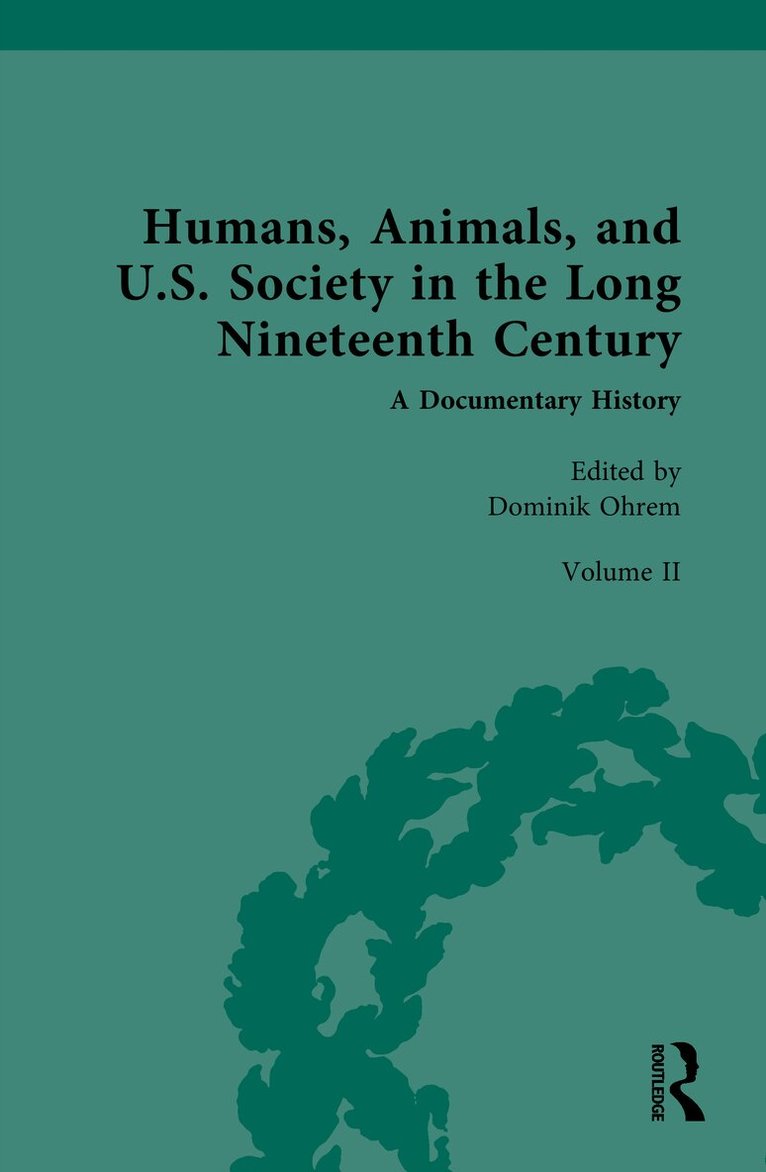
    Humans, Animals, and U.S. Society in the Long Nineteenth Century: A Documentary History

    Volume II: Animal and Human in American Thought (Part 2)

    AvDominik Ohrem

    Inbunden, Engelska, 2025

    1 824 kr

    Beställningsvara. Skickas inom 10-15 vardagar. Fri frakt över 249 kr.

    Beskrivning

    Volume II continues the discussion of animals/animality in U.S. social and scientific thought to address the ways in which the nexus of ideas surrounding human-animal distinctions became intertwined with interhuman hierarchies and power relations, including through the synergistic dynamics between race and species as co-implicating “taxonomies of power” (Claire Jean Kim) that informed both chattel slavery and settler violence against Indigenous peoples. A second section traces the evolution of animal advocacy from early individual voices to the formation of an organised movement following the Civil War, documenting a shift – however limited by structural constraints – from largely anthropocentric concerns with the social consequences of human cruelty towards other creatures to a broader moral consideration for nonhuman animals in their own right.

    Produktinformation

    • Utgivningsdatum:2025-11-18
    • Mått:156 x 234 x 27 mm
    • Vikt:950 g
    • Format:Inbunden
    • Språk:Engelska
    • Antal sidor:402
    • Förlag:Taylor & Francis Ltd
    • ISBN:9780367470029

    Utforska kategorier

    • Socialhistoria och kulturhistoria inom Historia och arkeologi
    • Sociala och etiska frågor inom Samhälle och politik
    • Amerikas historia inom Historia och arkeologi

    Mer om författaren

    Dominik Ohrem is Research Associate at MESH – Multidisciplinary Environmental Studies in the Humanities and Postdoctoral Researcher at HESCOR (Cultural Evolution in Changing Climate: Human and Earth System Coupled Research) at the University of Cologne, Germany. His research is focused on the history and philosophy of human-animal and multispecies relations.

    Innehållsförteckning

    • Volume 2: Animal and Human in American Thought (Part 2) General IntroductionVolume 2 IntroductionPart 1: The Contested Topography of the Human1. Blackness and Humanity in a Nation of Slavery (1839-1861)1.1 [Theodore Dwight Weld, Angelina Emily Grimké, and Sarah Moore Grimké], [The Treatment of Slaves], from American Slavery as It Is: Testimony of a Thousand Witnesses. New York: American Anti-Slavery Society, 1839.1.2 Frederick Douglass, extract from The Claims of the Negro, Ethnologically Considered: An Address Before the Literary Societies of Western Reserve College, at Commencement, July 12, 1854 (Rochester: Printed by Lee, Mann & Co., 1854), pp. 5-16, 34-6.1.3 John H. Van Evrie, [The Physical Characteristics of the Negro], from Negroes and Negro “Slavery:” The First an Inferior Race: The Latter Its Normal Condition (New York: Van Evrie, Horton & Co., 1861), pp. 92-7, 105-222. Josiah Clark Nott, “Geographical Distribution of Animals and the Races of Men”, The New-Orleans Medical and Surgical Journal 9 (May 1843): 727-746.3. John Fiske, “The Progress from Brute to Man”, The North American Review 117, no. 241 (October 1873): 251–82.4. Hubert Howe Bancroft, “Savagism and Civilization”, fromThe Native Races of the Pacific States of North America. Vol. 2 (San Francisco: A. L. Bancroft and Co., 1875), pp. 1-6, 9-13, 18-21, 36-7.5. Antoinette L. B. Blackwell, “Sex and Evolution”, from The Sexes Throughout Nature (New York: G. P. Putnam’s Sons, 1875), pp. 11-14, 16-46, 48-51, 54-59, 61-4, 79-83, 87-90, 96-99, 105-08, 111-24, 131-32, 135-37.6. Debating “Woman’s Place in Nature”: Lester F. Ward vs. Grant Allen in The Forum (1888-1890)6.1 Lester Frank Ward, “Our Better Halves”, The Forum 6 (November 1888): 266-75.6.2 Grant Allen, “Woman’s Place in Nature”, The Forum 7 (May 1889): 258-63.6.3 ––––, “Woman’s Intuition”, The Forum 9 (May 1890): 333-40.6.4 Lester Frank Ward, “Genius and Woman’s Intuition”, The Forum 9 (June 1890): 401-408.7. William G. Schell, [Does Scripture Deny the Humanity of the Negro?], from Is the Negro a Beast?: A Reply to Chas. Carroll’s Book Entitled “The Negro a Beast.” Proving That the Negro Is Human from Biblical, Scientific, and Historical Standpoints (Moundsville: Gospel Trumpet Pub. Co., 1901), pp. 11-14, 16-22, 26-42.8. Nathaniel S. Shaler, [On the Tribal Spirit and the Categoric Motive], from The Neighbor: The Natural History of Human Contacts (Boston: Houghton, Mifflin and Company, 1904), pp. 21-43, 46-47, 192-203.9. Improving the “Human Harvest”: The Promises of American Eugenics (1907-1915)9. 1 David Starr Jordan, The Human Harvest: A Study of the Decay of Races Through the Survival of the Unfit (Boston: Beacon Press, 1907), pp. 13-28-41-4.9.2 William Isaac Thomas, “Eugenics: The Science of Breeding Men”, American Magazine 68, no. 2 (June 1909): 190–97.9.3 Charles Benedict Davenport, “Eugenics and Euthenics”, from Heredity in Relation to Eugenics (New York: H. Holt, 1911), pp. 252-54, 260-63.9. 4 Orator Fuller Cook, “Eugenics and Breeding”, Journal of Heredity 5, no. 1 (1914): 30–33.10. Charlotte P. Gilman, “As to Humanness”, from The Man-Made World: Or, Our Androcentric Culture (New York: Charlton Co., 1911), pp. 9-25Part 2: Humane Ethics and Animal Democracy11. Voices of Animal Advocacy in the Early Republic (1787-1792)11.1 [Anon.], “On Cruelty to Inferior Animals”, The New Haven Chronicle, June 12, 1787, 1.11.2 [Anon.], “On Cruelty to Animals”, American Museum, or, Universal Magazine 11, no. 2 (February 1792): 54–56.11.3 Herman Daggett, The Rights of Animals: An Oration, Delivered at the Commencement of Providence-College, September 7, 1791 (Sagg-Harbour: David Frothingham, 1792).12. William A. Alcott, “The Moral Argument”, from Vegetable Diet: As Sanctioned by Medical Men and by Experiences in All Ages (Boston: Marsh, Capen, and Lyon, 1838), pp. 266-73.13. John Comly, [Learning Kindness to Animals], Journal of the Life and Religious Labours of John Comly, Late of Byberry, Pennsylvania (Philadelphia: T. E. Chapman, 1853), pp. 5-7, 24-6, 46-8.14. Henry Bergh, “The Cost of Cruelty”, The North American Review 133, no. 296 (July 1881): 75–81.15. George T. Angell, “Lessons on Kindness to Animal”, from The Primary Teacher 5, no. 1-10 (September 1881-June 1882): 24-26, 64-65, 108-109, 145-146, 188-189, 226-228, 264-266, 307-308, 345-346, 382-383.16. Henry Childs Merwin, “The Ethics of Horse-Keeping”, The Atlantic Monthly 67 (May 1891): 631–39.17. Vivisection: Perspectives on a Controversial Practice (1884-1912)17.1 Albert Leffingwell, “Vivisection”, Lippincott’s Magazine 34 (August 1884): 126–132.17.2 Henry Pickering Bowditch, “The Advancement of Medicine by Research” Science 4, no. 82 (July 24, 1896): 85-8, 91-7, 99–101.17.3 Sarah Norcliffe Cleghorn, “Is Vivisection a Peculiar Institution?”, Journal of Zoöphily 18, no. 10 (October 1909): 108–110.17.4 William Williams Keen, “The Influence of Antivivisection on Character”, The Boston Medical and Surgical Journal 166, no. 18 & 19 (May 2 & 9, 1912): 651–58, 687–94.18. John Harvey Kellogg, “The Ethics of Diet”, from Shall We Slay to Eat? (Battle Creek: Good Health Pub. Co., 1899), pp. 124-38, 141-47, 156-6219. John Howard Moore, “The Ethical Kinship”, from The Universal Kinship (Chicago: Charles H. Kerr, 1906), pp. 245-52, 272-82, 291- , 314-2420. Charles Loomis Dana, “The Zoophil-Psychosis: A Modern Malady,” Medical Record 75, no. 10 (March 6, 1909): 381–83.21. Francis Harold Rowley, extract from Slaughter-House Reform in the United States and the Opposing Forces (Boston: Massachusetts Society for the Prevention of Cruelty to Animals, 1913, pp. 1-18, 23-2722. Marie L.Darrach, “Dogs Have a Soul – and Now They Have a Church.” Duluth News Tribune [Duluth, MN], May 15, 1921, 49.Index