• Fri frakt över 249 kr
  • •
  • Snabba leveranser
  • •
  • Billiga böcker
Kundservice

Du är på sajten för privatpersoner.

Företag, bibliotek eller offentlig verksamhet?

Du handlar på classic.bokus.com, där alla dina funktioner finns intakta.
Till classic.bokus.com
Bokus logotyp. Gå till startsidan.
  • Erbjudanden
  • Nyheter
  • Student
  • Topplistor
  • Barn & ungdom
  • Bokus Play
  • E-böcker
  • Pocketböcker
  • Spel & pussel

10% studentrabatt med kod TERM26

Sidfot

Mina sidor

    Hjälp

    • Kundservice
    • Vanliga frågor och svar
    • Frakt och leverans
    • Retur vid ångerrätt
    • Reklamera vara
    • Betalning
    • Köpvillkor
    • Allmänna villkor
    • Information om webbplatsens tillgänglighet

    Om Bokus

    • Om oss
    • Pressrum
    • För studenter
    • För företag
    • För bibliotek och offentlig verksamhet
    • För leverantörer
    • Hållbarhet

    Populärt

    • Aktuella erbjudanden
    • Presentkort
    • Studentlitteratur
    • Nya böcker
    • Topplistor
    • Signerade böcker
    • Engelska böcker

    Inspiration

    • Boktips
    • BookTok
    • Populära bokserier
    • Barnbokskaraktärer
    • Populära författare
    Logotyp för Bokus
    Följ oss på Facebook (extern länk)Följ oss på Instagram (extern länk)Följ oss på YouTube (extern länk)Följ oss på TikTok (extern länk)
    bokus @ CookiesAnpassa cookiesIntegritetspolicyKöpvillkor
    Till Citymail hemsida (extern länk)Till Budbee hemsida (extern länk)Till Postnord hemsida (extern länk)Till Schenker hemsida (extern länk)Till Early Bird hemsida (extern länk)Till Walleys hemsida (extern länk)
    1. Juridik
    2. Rättsvetenskap
    3. Komparativ rätt

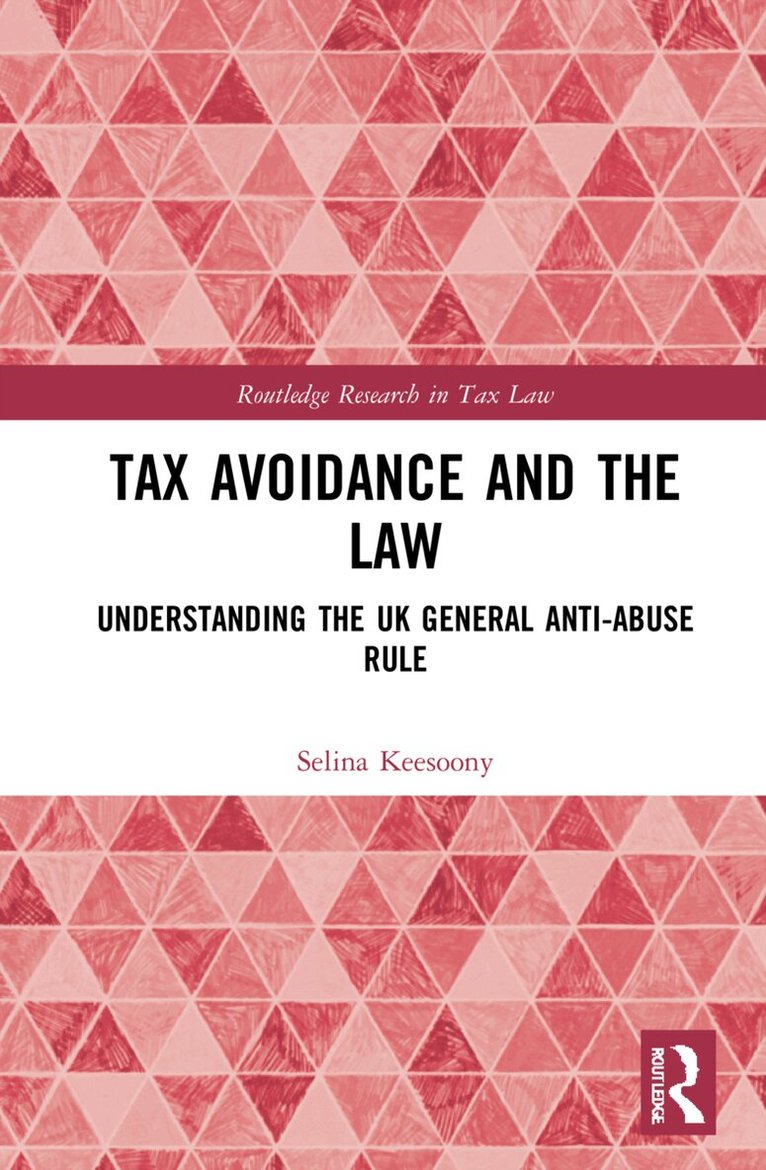
    Tax Avoidance and the Law

    Understanding the UK General Anti-Abuse Rule

    AvSelina Keesoony

    Inbunden, Engelska, 2022

    Del i serien Routledge Research in Tax Law

    2 239 kr

    Beställningsvara. Skickas inom 10-15 vardagar. Fri frakt över 249 kr.

    Fler format och utgåvor

    E-bok

    725 kr

    E-bok

    725 kr

    Häftad

    617 kr

    Beskrivning

    Tax Avoidance and the Law is a helpful guide for undergraduate and postgraduate students who want a thorough understanding of this dynamic area of law. The book is written in a way which is easy to follow and conveniently summarises complex case law on tax avoidance.Tax Avoidance and the Law explores the evolution of the UK’s General Anti- Abuse Rule. It provides a useful comparison with other Western jurisdictions’ anti-avoidance legislation, including the United States of America, Australia, New Zealand, South Africa, Canada and the EU. The underlying theme of the book rests on the notion that the taxpayer’s subjective motives, intentions or purposes are irrelevant when assessing tax liability.The book enables students to gain a good grasp of the fundamental issues in tax avoidance in a clear manner.

    Produktinformation

    • Utgivningsdatum:2022-05-31
    • Mått:156 x 234 x 18 mm
    • Vikt:520 g
    • Format:Inbunden
    • Språk:Engelska
    • Serie:Routledge Research in Tax Law
    • Antal sidor:234
    • Förlag:Taylor & Francis Ltd
    • ISBN:9780367472450

    Utforska kategorier

    • Komparativ rätt inom Juridik
    • Internationell skatterätt inom Juridik

    Mer om författaren

    Selina Keesoony has lectured law at Brunel University London for over five years. She has also lectured law at SOAS, University of London.Selina completed her law degree at Brunel University. Following this, she pursued an LLM in international and comparative tax law at BPP Law School. While undertaking her master’s, she secured a studentship from Brunel University to undertake a PhD in tax law. Selina was awarded the Vice Chancellor’s Prize for Doctoral Research following the completion of her PhD. She has since completed the Legal Practice Course.

    Innehållsförteckning

    • Acknowledgements Introduction Background 1 Defining motive, purpose and intention 1.1 Criminal law perspective 1.2 Psychological perspective 1.3 Philosophical perspective 1.4 Tax law perspective 1.4 (a) Trading 1.4 (b) Expenditure 1.4 (c) Dividend stripping 1.4 (d) Targeted anti-avoidance rules 1.5 Conclusions 2 A move towards motive, intention and purpose Introduction 2.1 Tackling tax avoidance 2.2 The divide between supporters of Ramsay and Westminster 2.2 (a) Supporters of Ramsay 2.2 (b) Supporters of Westminster 2.3 Motive, intention and purpose considered across othermareas of tax law 2.3 (a) Trades, professions and vocations 2.3 (b) Expenditure 2.3 (c) Accountancy standards 2.4 Why the “motive approach” is considered 2.5 How motive, intention and purpose are considered 2.5 (a) The “substance over form” doctrine 2.5 (b) Purpose 2.5 (c) Commercial or business purpose 2.5 (d) The step transaction doctrine 2.5 (e) Motive or intention 2.6 Suitability of the motive approach in tax law 2.6 (a) Is the motive approach necessary? 2.6 (b) Restructuring transactions 2.6 (c) Inconsistencies 2.6 (d) Constitutional legitimacy of the motive approach 2.7 Conclusion 3 The GAAR provisions analysed Introduction 3.1 The GAAR: An overview 3.2 The GAAR provisions 3.2 (a) Tax advantage 3.2 (b) Tax arrangement 3.2 (c) The main purpose test 3.2 (d) The double reasonableness test 3.2(d)(i) Reasonableness in tort and contract law 3.2(d)(ii) “Reasonableness” in public law 3.2(d)(iii) Reasonable man 3.2 (e) Abuse according to the GAAR 3.3 Abuse according to the GAAR guidance 3.4 What is not abusive 3.5 The scope of the GAAR 3.6 The Aaronson Report 3.7 Penalties 3.8 An EU-wide GAAR 3.9 Conclusion 4 General anti-avoidance legislation in other jurisdictions Introduction 4.1 The United States’ Economic Substance Doctrine (“ESD”) 4.1 (a) Common law background 4.1 (b) The ESD provisions4.1 (c) Case law post the American ESD 4.2 The Australian general anti-avoidance rule 4.2 (a) Scheme 4.2 (b) Tax benefit 4.2 (c) Purpose 4.3 Australian case law post the Australian general antiavoidance rule 4.4 The New Zealand general anti-avoidance rule 4.4 (a) Counteraction 4.4 (b) Case law post the New Zealand general antiavoidance rule 4.5 The South African general anti-avoidance rule 4.5 (a) Case law post the South African general antiavoidance rule 4.6 The Canadian general anti-avoidance rule 4.6 (a) Case law post the Canadian general anti-avoidance rule 4.7 Conclusion 5 Discretion under the UK GAAR Introduction 5.1 The ambiguous GAAR 5.2 HMRC’s role 5.3 Judicial discretion 5.3 (a) Judicial law-making 5.3 (b) Interpretation 5.4 Morality 5.5 Conclusion 6 Criticisms of the GAAR Introduction 6.1 The main purpose test 6.2 The double reasonableness test 6.3 The scope of the GAAR 6.4 HMRC GAAR guidance 6.5 The lack of a clearance system 6.6 The UK’s international competitiveness 6.7 Complexity 6.8 Uncertainty 6.9 Constitutional issues 6.10 Conclusion 7 Was the GAAR needed? Introduction 7.1 Ramsay versus the GAAR 7.1 (a) The overall Ramsay approach 7.1 (b) The main features of the GAAR 7.1 (c) The Ramsay approach versus the GAAR 7.2 Contemporary tax avoidance before the GAAR 7.3 Tax avoidance since the GAAR 7.4 The GAAR as a deterrent 7.5 Conclusion 8 Conclusion and recommendations for reform Recommendations for reform Index