• Fri frakt över 249 kr
  • •
  • Snabba leveranser
  • •
  • Billiga böcker
Kundservice

Du är på sajten för privatpersoner.

Företag, bibliotek eller offentlig verksamhet?

Du handlar på classic.bokus.com, där alla dina funktioner finns intakta.
Till classic.bokus.com
Bokus logotyp. Gå till startsidan.
  • Erbjudanden
  • Nyheter
  • Student
  • Topplistor
  • Barn & ungdom
  • Bokus Play
  • E-böcker
  • Pocketböcker
  • Spel & pussel

10% rabatt på allt med kod NYSTART10 →

Sidfot

Mina sidor

    Hjälp

    • Kundservice
    • Vanliga frågor och svar
    • Frakt och leverans
    • Retur vid ångerrätt
    • Reklamera vara
    • Betalning
    • Köpvillkor
    • Allmänna villkor
    • Information om webbplatsens tillgänglighet

    Om Bokus

    • Om oss
    • Pressrum
    • För studenter
    • För företag
    • För bibliotek och offentlig verksamhet
    • För leverantörer
    • Hållbarhet

    Populärt

    • Aktuella erbjudanden
    • Presentkort
    • Studentlitteratur
    • Nya böcker
    • Topplistor
    • Signerade böcker
    • Engelska böcker

    Inspiration

    • Boktips
    • BookTok
    • Populära bokserier
    • Barnbokskaraktärer
    • Populära författare
    Logotyp för Bokus
    Följ oss på Facebook (extern länk)Följ oss på Instagram (extern länk)Följ oss på YouTube (extern länk)Följ oss på TikTok (extern länk)
    bokus @ CookiesAnpassa cookiesIntegritetspolicyKöpvillkor
    Till Citymail hemsida (extern länk)Till Budbee hemsida (extern länk)Till Postnord hemsida (extern länk)Till Schenker hemsida (extern länk)Till Early Bird hemsida (extern länk)Till Walleys hemsida (extern länk)
    1. Språk och ordböcker
    2. Språkvetenskap och lingvistik

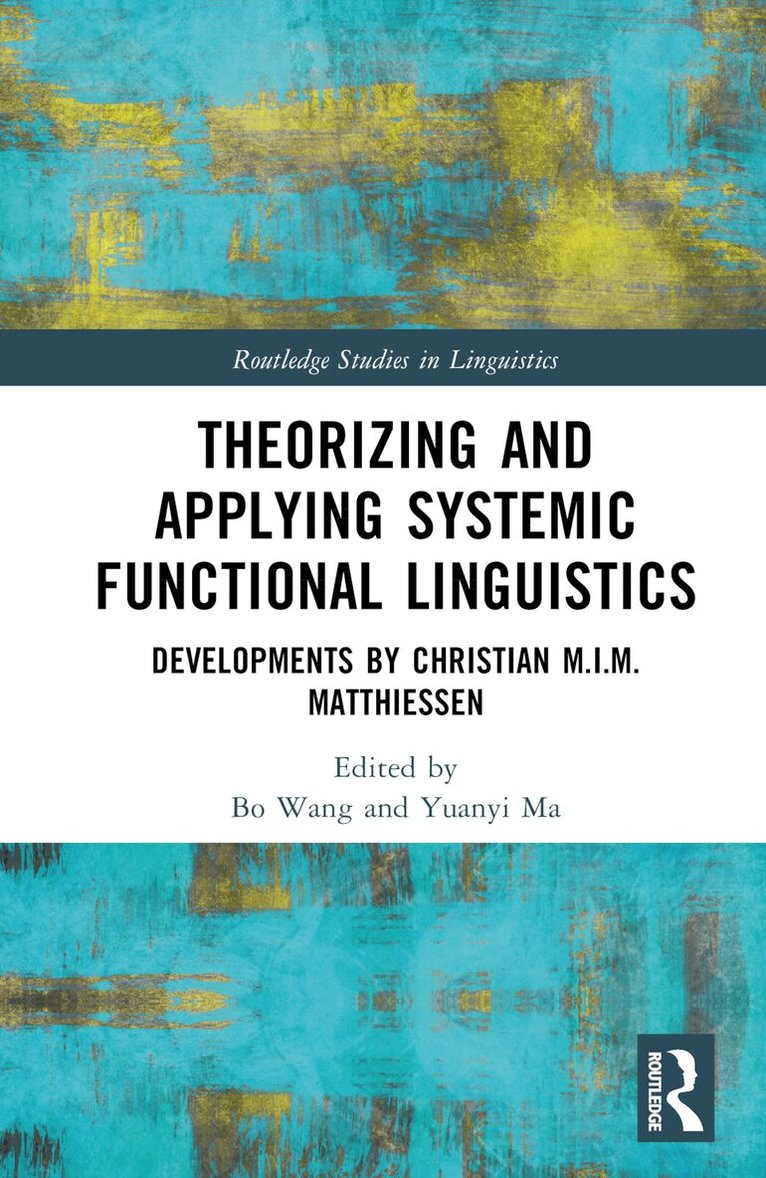
    Theorizing and Applying Systemic Functional Linguistics

    Developments by Christian M.I.M. Matthiessen

    AvBo Wang,Yuanyi Ma

    Inbunden, Engelska, 2023

    Del i serien Routledge Studies in Linguistics

    2 495 kr

    Beställningsvara. Skickas inom 10-15 vardagar. Fri frakt över 249 kr.

    Beskrivning

    This collection reflects on developments in the field of Systemic Functional Linguistics (SFL) as embodied in the work of Christian M.I.M. Matthiessen, highlighting his diverse contributions to the field from theoretical and applied perspectives. The book surveys Matthiessen’s academic career and illustrates the myriad ways in which his work has reverberated through to current innovations in SFL research. The book also exhibits his theoretical contributions to major linguistic topics and his influence on the development of SFL. Written by some of the world’s foremost scholars in the field, chapters cover such topics as theories of SFL and its applications in different domains as well as the developmental trajectories of SFL in major geographic areas. Addressing the key issues in SFL through the lens of Matthiessen’s career, this book is an accessible resource for students and scholars in systemic functional linguistics, as well as those interested in the systemic functional approach in related areas within linguistics.

    Produktinformation

    • Utgivningsdatum:2023-12-29
    • Mått:152 x 229 x 25 mm
    • Vikt:453 g
    • Format:Inbunden
    • Språk:Engelska
    • Serie:Routledge Studies in Linguistics
    • Antal sidor:352
    • Förlag:Taylor & Francis Ltd
    • ISBN:9780367484897

    Utforska kategorier

    • Språkvetenskap och lingvistik inom Språk och ordböcker

    Mer om författaren

    Bo Wang is Research Assistant Professor at the Faculty of Arts and Humanities, University of Macau.Yuanyi Ma is the co-author of several books on Systemic Functional Linguistics, such as Translating Tagore’s Stray Birds into Chinese, Systemic Functional Translation Studies, Systemic Functional Insights on Language and Linguistics, and Introducing M.A.K. Halliday.

    Innehållsförteckning

    • List of Figures List of TablesList of ContributorsAcknowledgements AbbreviationsIntroductionBO WANG AND YUANYI MAPART IChristian Matthiessen and systemic functional theory 1 Navigating in semiological space: Theory and Matthiessonian cartography, from typology to register and artificial intelligence DAVID G. BUTT AND ANNABELLE LUKINPreface 1.1 Introduction 1.2 An international troubadour of linguistics 1.3 A “magnum opus” 1.4 Matthiessen and the challenge of linguistic categories1.5 Grammars, and the centrality of the maps to sciences of society and mind1.6 Typological and multilingual work1.7 Realizational systems: Probabilistic, adaptive systems1.8 Teaching theory1.9 Managing complexity amid semiotic evolution: Semogenesis1.10 Conclusion: Linguistics for grown-upsNotes References 2 Christian Matthiessen and register ERICH STEINER2.1 Introduction2.2 Register – situating the concept 2.2.1 Register – origins in Firthian linguistics and Systemic Functional Linguistics2.2.2 Register – its place in SFL architecture2.2.3 Register – its place in other linguistic traditions 2.3 Matthiessen and register 2.3.1 Conceptual overviews 2.3.2 Context related to other semiotic systems and individuation/affiliation2.3.3 A comprehensive research programme: Field-based maps of registers of one language (English)2.4 Empirical claims and future development Notes References 3 Syllable and syllable onsets: Japanese and English: Some insights inspired by Halliday and Matthiessen’s systemic functional linguistic architecture GERARD O’GRADY3.1 Introduction 3.2 What would a systemic phonology look like?3.3 Japanese syllables and English onsets compared and contrasted3.4 ConclusionAppendixNotes ReferencesPART IIChristian Matthiessen and applications of systemic functional theory4 Systemic Functional Linguistics: Language description, comparison and typology – Key characteristics CHRISTIAN M.I.M. MATTHIESSEN4.1 Introduction: SFL and language description, comparison and typology 4.2 Key characteristics of systemic functional language description, comparison and typology4.2.1 Key characteristics covered in some detail here4.2.2 Key characteristics only mentioned here4.3 Theory of language and descriptions of languages4.3.1 Theory and description: Hjelmslev, Firth, Halliday4.3.2 Theory of modern language, description, comparison and descriptive generalizations4.3.3 The theoretical architecture of language: Dimensionality and basis for comparison4.4 The primacy of systemic organization 4.4.1 An illustration of the primacy of systemic organization: Modern Standard Arabic4.4.2 Axis: Paradigmatic (systemic) and syntagmatic (structural)4.4.3 The systemic composition of languages as systems of system4.4.4 Reinterpretation of implicational “universals”4.4.5 Frequency in representative typological samples4.4.6 Multilingual systems networks4.5 The cline of instantiation and the probabilistic nature of the linguistic system4.5.1 Probabilistic profiles4.5.2 Babies taking statistics4.6 The inherent variability of the linguistic system4.6.1 Three kinds of variation4.6.2 Registerial variation4.6.3 Registerial variation in context: Field of activity4.6.4 Variation around the languages of the world seen “from above” and “from below”; and also “from roundabout”4.7 The content plane: The metafunctional spectral organization of language 4.7.1 The status of the metafunctions4.7.2 Metafunctional modes of meaning: Complementarity and variation4.7.3 Logical and experiential complementarity4.7.4 Examples of diversity in the experiential construal of the “Umwelt” of speakers4.7.5 Metafunctional modes of meaning, modes of expression and media of expression4.7.6 Variation in metafunctional combinations 4.8 Semogenesis: Lexicogrammaticalization 4.8.1 “Grammaticalization” in the descriptivetypological literature 4.8.2 Towards a systemic functional account of lexicogrammaticalization4.8.3 Hierarchy of axis – paradigmatic: decrease in delicacy; rank: descent in rank4.8.4 Cline of instantiation: Increase in frequency 4.8.5 The spectrum of metafunction: Experiential to interpersonal and textual4.9 A personal angle4.10 ConclusionNotesReferences5 On language and linguistics in health: Christian Matthiessen and health communication researchNEDA KARIMI5.1 Text generation and health reports 5.2 A socio-semiotic framework for conceptualizing patientcentered care5.2.1 Patient-centered care5.2.2 Matthiessen’s (2013) socio-semiotic model5.3 The patient journey and communication load5.4 Building research capacity and mentorship5.5 Final remarkNoteReferences6 Christian Matthiessen and verbal artDONNA R. MILLER6.1 Introduction 6.2 Building on the Halliday–Hasan verbal art cornerstone6.3 Amplifying and enriching the SFS legacy6.3.1 Trinocularity 2546.3.2 Verbal art from the vantage point of the field of activity6.3.3 The stratal dispersal of literature6.3.4 The spectrum of metafunction6.3.5 The cline of instantiation, meaning potential and register vis-à-vis verbal art6.4 Parting thoughtsAcknowledgementsNotesReferencesPART IIIChristian Matthiessen and the global influences of Systemic Functional Linguistics7 The impact of Christian M.I.M Matthiessen on Systemic Functional Linguistics in AustraliaERNEST S. AKEREJOLA7.1 Introduction7.2 Matthiessen in the Australian SFL context 7.3 Matthiessen’s crucial role in SFL advancement in Australia7.4 Matthiessen’s professional commitments7.4.1 Professor of Linguistics7.4.2 The provision of tools for modelling SFL description7.4.3 The foundation of systemic linguistic typological research groups across and beyond Australia 7.4.4 The Matthiessonian approach7.4.5 The successful building of the SFL community7.4.6 An all-round linguistic scholar and his mentoring strategies7.4.7 The Matthiessonian teaching and supervision7.5 Matthiessen’s humane intellectualism7.5.1 The Matthiessonian modus operandi7.5.2 Postlude to Matthiessen’s mentorshipNotesReferences8 Matthiessen in the Latin American SFL communityJESUS DAVID GUERRA LYONS8.1 Introduction8.2 Methodology8.3 Findings8.3.1 Quantitative indicators 8.3.2 Qualitative indicators 8.4 Concluding remarks Notes References 9 Christian Matthiessen and Systemic Functional Linguistics in EuropeJORGE ARUS-HITA9.1 Introduction 9.2 Early years: Matthiessen in Sweden 9.3 Influence of Matthiessen’s research 9.4 Specific collaborations 9.5 Christian and Michael 9.6 Conclusion Acknowledgments ReferencesIndex