• Fri frakt över 249 kr
  • •
  • Snabba leveranser
  • •
  • Billiga böcker
Kundservice

Du är på sajten för privatpersoner.

Företag, bibliotek eller offentlig verksamhet?

Du handlar på classic.bokus.com, där alla dina funktioner finns intakta.
Till classic.bokus.com
Bokus logotyp. Gå till startsidan.
  • Erbjudanden
  • Nyheter
  • Student
  • Topplistor
  • Barn & ungdom
  • Bokus Play
  • E-böcker
  • Pocketböcker
  • Spel & pussel

10% rabatt på allt med kod: NYSTART10 →

Sidfot

Mina sidor

    Hjälp

    • Kundservice
    • Vanliga frågor och svar
    • Frakt och leverans
    • Retur vid ångerrätt
    • Reklamera vara
    • Betalning
    • Köpvillkor
    • Allmänna villkor
    • Information om webbplatsens tillgänglighet

    Om Bokus

    • Om oss
    • Pressrum
    • För studenter
    • För företag
    • För bibliotek och offentlig verksamhet
    • För leverantörer
    • Hållbarhet

    Populärt

    • Aktuella erbjudanden
    • Presentkort
    • Studentlitteratur
    • Nya böcker
    • Topplistor
    • Signerade böcker
    • Engelska böcker

    Inspiration

    • Boktips
    • BookTok
    • Populära bokserier
    • Barnbokskaraktärer
    • Populära författare
    Logotyp för Bokus
    Följ oss på Facebook (extern länk)Följ oss på Instagram (extern länk)Följ oss på YouTube (extern länk)Följ oss på TikTok (extern länk)
    bokus @ CookiesAnpassa cookiesIntegritetspolicyKöpvillkor
    Till Citymail hemsida (extern länk)Till Budbee hemsida (extern länk)Till Postnord hemsida (extern länk)Till Schenker hemsida (extern länk)Till Early Bird hemsida (extern länk)Till Walleys hemsida (extern länk)
    1. Naturvetenskap och teknik
    2. Geovetenskap
    3. Miljövetenskap och miljöpolitik

    Routledge Handbook of the Resource Nexus

    AvRaimund Bleischwitz,Holger Hoff

    Häftad, Engelska, 2020

    Del i serien Routledge Environment and Sustainability Handbooks

    723 kr

    Beställningsvara. Skickas inom 10-15 vardagar. Fri frakt över 249 kr.

    Beskrivning

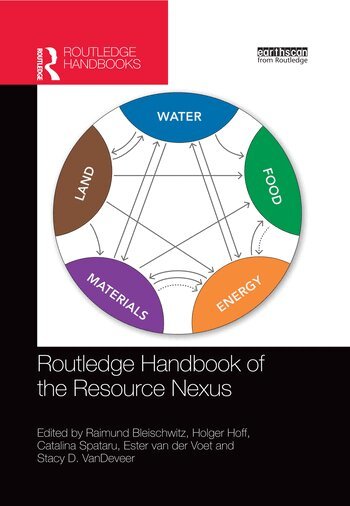
    In recent years the concept of the resource "nexus" has been both hotly debated and widely adopted in research and policy circles. It is a powerful new way to understand and better govern the myriad complex relationships between multiple resources, actors and their security concerns. Particular attention has been paid to water, energy and food interactions, but land and materials emerge as critical too. This comprehensive handbook presents a detailed review of current knowledge about resource nexus-related frameworks, methods and governance, including a broad set of inter-disciplinary perspectives. Written by an international group of scholars and practitioners, the volume focuses on rigorous research, including tools, methods and modelling approaches to analyse resource use patterns across societies and scales from a "nexus perspective". It also provides numerous examples from political economy to demonstrate how resource nexus frameworks can illuminate issues such as land grabs, mining, renewable energy and the growing importance of economies such as China, as well as to propose lessons and outlooks for sound governance. The volume seeks to serve as an essential reference text, source book and state-of-the-art, science-based assessment of this increasingly important topic – the resource nexus – and its utility in efforts to enhance sustainability of many kinds and implement the United Nations Sustainable Development Goals in an era of environmental and geopolitical change.

    Produktinformation

    • Utgivningsdatum:2020-02-25
    • Mått:174 x 246 x 36 mm
    • Vikt:980 g
    • Format:Häftad
    • Språk:Engelska
    • Serie:Routledge Environment and Sustainability Handbooks
    • Antal sidor:518
    • Förlag:Taylor & Francis Ltd
    • ISBN:9780367505288

    Utforska kategorier

    • Miljövetenskap och miljöpolitik inom Naturvetenskap och teknik
    • Geografi inom Naturvetenskap och teknik

    Mer om författaren

    Raimund Bleischwitz is Chair in Sustainable Global Resources and Deputy Director at the UCL Institute for Sustainable Resources, University College London, UK. Holger Hoff has a joint appointment as a Senior Researcher in the Resources and Development Group at the Stockholm Environment Institute, Sweden, and in the Research Domain "Earth System Analysis" at the Potsdam Institute for Climate Impact Research, Germany.Catalina Spataru is a Lecturer on Energy Systems and Networks and Director of the MRes course Energy Demand Studies at UCL Energy Institute, University College London, UK.Ester van der Voet is an Associate Professor of Industrial Ecology at the Institute of Environmental Sciences, Leiden University, The Netherlands. She is also a member of the UN International Resource Panel. Stacy D. VanDeveer is a Professor of Global Governance and Human Security at the McCormack School of Policy and Global Studies at the University of Massachusetts Boston, USA.

    Recensioner i media

    "The language of the nexus highlights the need for interconnected thinking between the natural and social sciences, and between the research community and decision makers. By bringing together such an outstanding range of thinkers and perspectives from across the world, Routledge Handbook of the Resource Nexus looks set to become an indispensable volume for all those engaged in these debates. It sets out with admirable clarity the theoretical, empirical and research underpinnings of this field, and will provide nexus brokers and boundary-spanners with the intellectual tools they need to achieve tangible progress." - James Wilsdon, Professor of Research Policy, University of Sheffield, UK and Director, ESRC Nexus Network"No energy myopia, no water myopia and no food cry of alarm, but a great handbook addressing the mutual relations." - Ernst von Weizsäcker, Past Co-Chair, International Resource Panel"This handbook provides a qualified response, given by key experts, to the recurring question of what the Resource Nexus actually means. That nexus is presented as a useful heuristic for addressing the new challenges of the Anthropocene and for evidence-based support of a sustainability transition. Integrative methods and tools for systemic resource management and governance are illustrated, adaptable to a wide range of thematic and geographic contexts and scales." - Prof. Hans Joachim Schellnhuber, Director of the Potsdam Institute for Climate Impact Research (PIK), Germany and Senior Research Fellow at the Stockholm Resilience Centre, Sweden "[the handbook is] a massive volume packed with 32 interesting and thought-provoking chapters researched and written by over 50 contributors" - Anton Löf, in Mineral Economics (March, 2019)

    Innehållsförteckning

    • Part I: Understanding the resource nexus: setting scenes 1. The resource nexus: Preface and Introduction to the Routledge Handbook 2. Appreciating wider environmental angles 3. Scale and the resource nexus 4. Security, climate change, and the resource nexus Part II: Analysing the resource nexus: tools and metrics 5. Life Cycle Assessment for resource nexus analysis 6. Linking society and nature: material flows and the resource nexus 7. Resource footprints 8. Input–output analysis and resource nexus assessment 9. Material criticality assessment and resource nexus analysis 10. Industrial ecology methods and the resource nexus Part III: Resource nexus modelling: practices and future transformations 11. Integrating environmental and social impacts with ecosystem services analysis 12. Modelling practices from local to global 13. Global change and K-waves: exploring nexus patterns 14. Foresight and scenarios: modelling practices and resource nexus assessment 15. Extending macro-economic modelling into the resource nexus 16. The five-node resouce nexus dynamics: an intergrated modelling approach Part IV: International political economy and the resource nexus 17. The resource nexus in an uncertain world: a non-equilibrium perspective 18. Mining and the resource nexus 19. Scarcities, supply, and new resource curses? 20. The international commodity trade: stylized facts 21. Rare earth elements and a resource nexus perspective 22. Governing land in the Global South Part V: Applying the resource nexus: regional and global scale 23. Elements of the water–energy–food nexus in China 24. The energy–materials nexus: the case of metals 25. Unconventional oil and gas production meets the resource nexus 26. Feeding Africa: nexus-related opportunities, challenges and policy options 27. The five-node resource nexus at sea Part VI: Governing the resource nexus: emerging responses 28. Urban metabolism and new urban governance 29. Eco-innovation and resource nexus challenges: ambitions and evidence 30. Green Chemistry: Opportunities, waste and food supply chains 31. California innovations @ WEN 32. The UN, Global Governance and the SDGs