• Fri frakt över 249 kr
  • •
  • Snabba leveranser
  • •
  • Billiga böcker
Kundservice

Du är på sajten för privatpersoner.

Företag, bibliotek eller offentlig verksamhet?

Du handlar på classic.bokus.com, där alla dina funktioner finns intakta.
Till classic.bokus.com
Bokus logotyp. Gå till startsidan.
  • Erbjudanden
  • Nyheter
  • Student
  • Topplistor
  • Barn & ungdom
  • Bokus Play
  • E-böcker
  • Pocketböcker
  • Spel & pussel

10% rabatt på allt med kod: NYSTART10 →

Sidfot

Mina sidor

    Hjälp

    • Kundservice
    • Vanliga frågor och svar
    • Frakt och leverans
    • Retur vid ångerrätt
    • Reklamera vara
    • Betalning
    • Köpvillkor
    • Allmänna villkor
    • Information om webbplatsens tillgänglighet

    Om Bokus

    • Om oss
    • Pressrum
    • För studenter
    • För företag
    • För bibliotek och offentlig verksamhet
    • För leverantörer
    • Hållbarhet

    Populärt

    • Aktuella erbjudanden
    • Presentkort
    • Studentlitteratur
    • Nya böcker
    • Topplistor
    • Signerade böcker
    • Engelska böcker

    Inspiration

    • Boktips
    • BookTok
    • Populära bokserier
    • Barnbokskaraktärer
    • Populära författare
    Logotyp för Bokus
    Följ oss på Facebook (extern länk)Följ oss på Instagram (extern länk)Följ oss på YouTube (extern länk)Följ oss på TikTok (extern länk)
    bokus @ CookiesAnpassa cookiesIntegritetspolicyKöpvillkor
    Till Citymail hemsida (extern länk)Till Budbee hemsida (extern länk)Till Postnord hemsida (extern länk)Till Schenker hemsida (extern länk)Till Early Bird hemsida (extern länk)Till Walleys hemsida (extern länk)
    1. Kultur
    2. Arkitektur

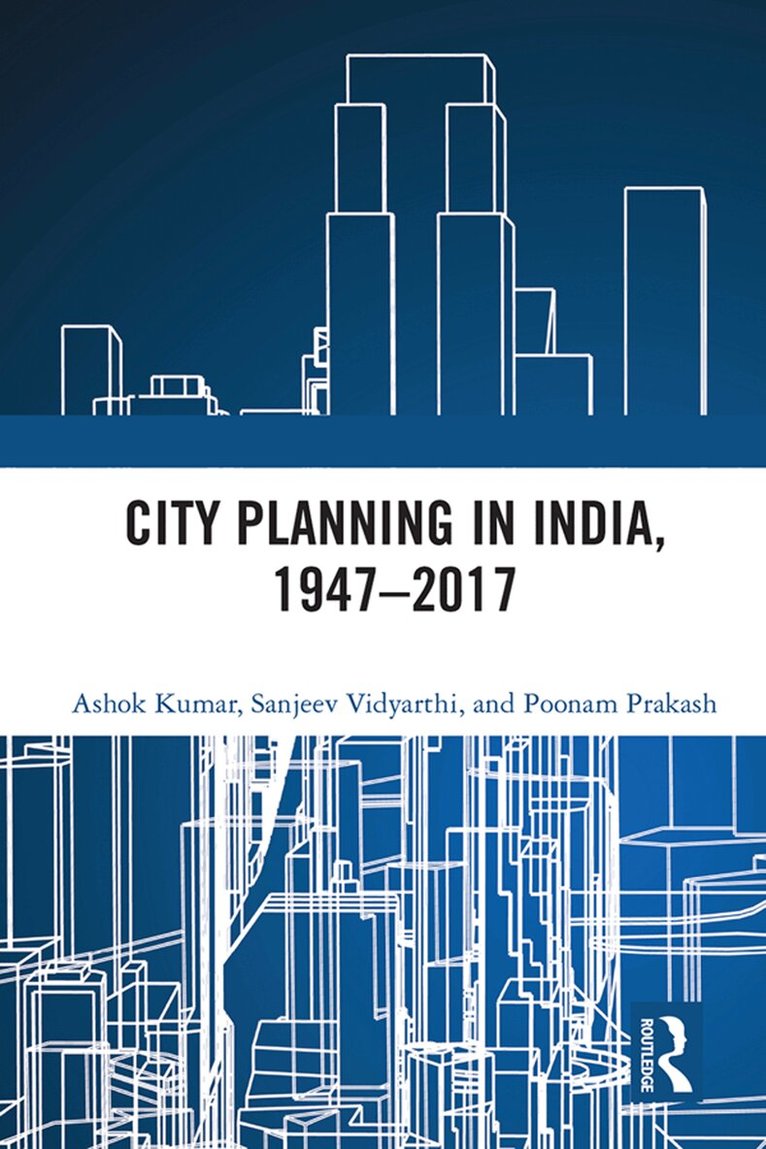
    City Planning in India, 1947–2017

    AvAshok Kumar,Sanjeev Vidyarthi

    Häftad, Engelska, 2023

    686 kr

    Beställningsvara. Skickas inom 10-15 vardagar. Fri frakt över 249 kr.

    Fler format och utgåvor

    E-bok

    812 kr

    E-bok

    812 kr

    Inbunden

    2 493 kr

    Beskrivning

    This book is a comprehensive history of city planning in post-independence India. It explores how the nature and orientation of city planning have evolved in India’s changing sociopolitical context over the past hundred or so years.The book situates India’s experience within a historical framework in order to illustrate continuities and disjunctions between the pre- and post-independent Indian laws, policies, and programs for city planning and development. It focuses on the development, scope, and significance of professional planning work in the midst of rapid economic transition, migration, social disparity, and environmental degradation. The volume also highlights the need for inclusive planning processes that can provide clean air, water, and community spaces to large, diverse, and fast growing communities.Detailed and insightful, this volume will be of interest to researchers and students of public administration, civil engineering, architecture, geography, economics, and sociology. It will also be useful for policy makers and professionals working in the areas of town and country planning.

    Produktinformation

    • Utgivningsdatum:2023-09-25
    • Mått:156 x 234 x 22 mm
    • Vikt:453 g
    • Format:Häftad
    • Språk:Engelska
    • Antal sidor:400
    • Förlag:Taylor & Francis Ltd
    • ISBN:9780367519872

    Utforska kategorier

    • Arkitektur inom Kultur
    • Sociala och etiska frågor inom Samhälle och politik
    • Regional planering inom Naturvetenskap och teknik

    Mer om författaren

    Ashok Kumar is a professor of physical planning at the School of Planning and Architecture, New Delhi, India. Trained as a human geographer and spatial planner, he believes in planning that aims at reducing spatial injustices, a task that is not well accomplished without comprehending and linking planning with broader political and economic processes. For him, collaborative planning remains at the core of planners' efforts, where plans are participatory and pragmatic. Ashok lives and works in Delhi. He has studied in India and the UK. His most recent edited books include (with D.S. Meshram and Krishne Gowda) Urban and Regional Planning Education – Learning for India (Springer, 2016) and (with Poonam Prakash) Public Participation in Planning in India (Cambridge Scholars Publishing, 2016).Sanjeev Vidyarthi is a professor of urban planning and policy and director of the Master of City Design program at the University of Illinois, Chicago. Trained as an architect, urban designer, and spatial planner, Sanjeev employs an integrative research approach to studying the meaning and purpose of planning for places. His recent work explores plan-making and city-designing efforts in a variety of urban settings like planned neighborhoods, historic settlements, and rapidly-growing urban regions. Sanjeev has lived, worked, and studied in the Middle East, Western Europe, and the United States while studying the case of independent India using a comparative lens and insider/outsider perspective. He works with progressive scholars and professional practitioners worldwide.Poonam Prakash is a professor of physical planning and head, Department of Physical Planning at the School of Planning and Architecture, New Delhi, an institute of National Importance. She has a doctoral degree in Housing from the School of Planning and Architecture, New Delhi. She has been teaching for the last 23 years. Her research interests relate to low-income housing, participatory planning, decision-making processes in planning, and planning pedagogy. Her approach toward teaching is to facilitate self-reflection through experiential learning. She was the nodal officer for Housing and Urban Development Corporation’s Chair for research and documentation in housing and urban development between 2012 and 2017. In 2016, she was nominated for the In-residence Programme for Inspired Teachers at Rashtrapati Bhawan.

    Recensioner i media

    ‘This book provides a clear and readable account of India’s multi-layered experience of the planning of urban development. It is infused with a wide knowledge of the planning field, while being deeply sensitive to India’s particular political economy and diverse urban realities. Kumar, Vidyarthi and Prakash show how present initiatives in developing urban planning legislation and practice are built on, and have to contend with, a complex history, in which India only emerged as a single nation in the colonial and post-colonial periods, and where ways of planning urban development have been inherited from past colonial and local regimes. Their account is richly illustrated and referenced, and draws on research and evaluation studies where available. The book is supplemented by an appendix which consists of very helpful mini-essays on key concepts and topics. It will surely become an essential text for planning students in India, while serving as a very valuable introduction for all those interested in the ‘planning story’ of this vast and populous sub-continent.’—Patsy Healey, Professor emeritus of planning, Newcastle University, UK‘This book ushers a new era of joint scholarship between scholars from India and the US to better understand the trajectory of urban development and planning in India. This is not a rehash of all the insurmountable problems facing Indian cities. On the contrary: this is a nuanced and ultimately hopeful view of how urban planning has evolved over the last 70 years in a decolonized and democratic nation where majority of the citizens still live in rural areas. The book blends historical understanding with new aspirations for economic growth and social mobility to argue for a stronger role of urban planning in India’s development.’—Bish Sanyal, Ford International Professor of Urban Development and Planning, Director, Spurs/Humphrey Program, Massachusetts Institute of Technology ‘The book provides a welcome and valuable overview of planning for cities in India since its independence in 1947, starting with the long-standing legacies of British colonial rule. The book will serve as a clear, easy to follow and extremely informative primer to students and practitioners of planning in India, especially as a jumping-off point for more detailed and critical analysis of recent government initiatives such as the Jawaharlal Nehru National Urban Renewal Mission, Special Economic Zones, and Smart Cities Mission. Ultimately, the book fulfils three roles simultaneously and admirably: an excellent overview of past trajectories, a clear and detailed taking account of current practices, and most significantly, for those planning the future of Indian cities, a launching pad for investigating the potentialities as well as pitfalls of future efforts.’—Aseem Inam, Professor and Chair in Urban Design, Cardiff University and Director, TRULAB: Laboratory for Designing Urban Transformation‘City Planning in India, 1947-2017, is an outstanding introduction to India’s post-independence urban planning challenges, possibilities, and institutions. It explains the complexities of spatial planning in modern India with nuance and optimism. In anticipation of India’s new urban age and expected massive rural to urban transition, it makes the case for and provides an important resource for the growth of the planning profession in the country. The book, however, is much more than a basic textbook. In addition to planning students and professionals, scholars, activists and citizens interested in urban development will find it a useful reference and resource.’—Vinit Mukhija, Professor and Chair, Department of Urban Planning UCLA Luskin School of Public Affairs, Los Angeles

    Innehållsförteckning

    • List of Figures. List of Tables. List of Boxes. Preface. 1. Introduction – City Planning in India 2. Shifts and Transitions: Legacies of Pre-Independence Planning 3. Efforts to Build a Modern Nation: Planning From 1947 to Late 1960s 4. Paper Plans Meet the Actual Ground: 1960s to 1980s 5. Post-Liberalization Planning: 1985-2005 6. Recent Planning Efforts: 2005 – 2017. Appendix. References. Index.