• Fri frakt över 249 kr
  • •
  • Snabba leveranser
  • •
  • Billiga böcker
Kundservice

Du är på sajten för privatpersoner.

Företag, bibliotek eller offentlig verksamhet?

Du handlar på classic.bokus.com, där alla dina funktioner finns intakta.
Till classic.bokus.com
Bokus logotyp. Gå till startsidan.
  • Erbjudanden
  • Nyheter
  • Student
  • Topplistor
  • Barn & ungdom
  • Bokus Play
  • E-böcker
  • Pocketböcker
  • Spel & pussel

10% rabatt på allt med kod: NYSTART10 →

Sidfot

Mina sidor

    Hjälp

    • Kundservice
    • Vanliga frågor och svar
    • Frakt och leverans
    • Retur vid ångerrätt
    • Reklamera vara
    • Betalning
    • Köpvillkor
    • Allmänna villkor
    • Information om webbplatsens tillgänglighet

    Om Bokus

    • Om oss
    • Pressrum
    • För studenter
    • För företag
    • För bibliotek och offentlig verksamhet
    • För leverantörer
    • Hållbarhet

    Populärt

    • Aktuella erbjudanden
    • Presentkort
    • Studentlitteratur
    • Nya böcker
    • Topplistor
    • Signerade böcker
    • Engelska böcker

    Inspiration

    • Boktips
    • BookTok
    • Populära bokserier
    • Barnbokskaraktärer
    • Populära författare
    Logotyp för Bokus
    Följ oss på Facebook (extern länk)Följ oss på Instagram (extern länk)Följ oss på YouTube (extern länk)Följ oss på TikTok (extern länk)
    bokus @ CookiesAnpassa cookiesIntegritetspolicyKöpvillkor
    Till Citymail hemsida (extern länk)Till Budbee hemsida (extern länk)Till Postnord hemsida (extern länk)Till Schenker hemsida (extern länk)Till Early Bird hemsida (extern länk)Till Walleys hemsida (extern länk)
    1. Kultur
    2. Musikböcker
    3. Musikvetenskap

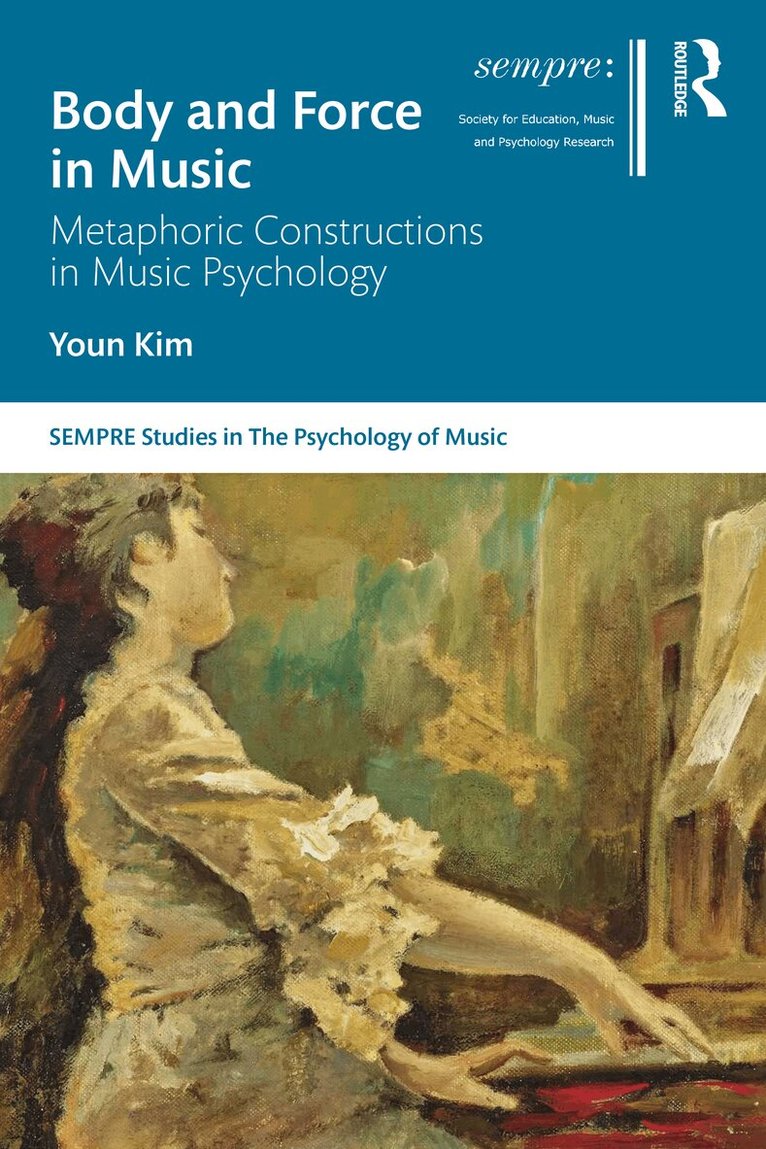
    Body and Force in Music

    Metaphoric Constructions in Music Psychology

    AvYoun Kim

    Häftad, Engelska, 2023

    Del i serien SEMPRE Studies in The Psychology of Music

    644 kr

    Beställningsvara. Skickas inom 10-15 vardagar. Fri frakt över 249 kr.

    Fler format och utgåvor

    Inbunden

    2 495 kr

    E-bok

    760 kr

    E-bok

    760 kr

    Beskrivning

    Our understanding of music is inherently metaphorical, and metaphoricity pervades all sorts of musical discourses, be they theoretical, analytical, philosophical, pedagogical, or even scientific. The notions of "body" and "force" are the two most pervasive and comprehensive scientific metaphors in musical discourse. Throughout various intertwined contexts in history, the body–force pair manifests multiple layers of ideological frameworks and permits the conceptualization of music in a variety of ways. Youn Kim investigates these concepts of body and force in the emerging field of music psychology in the late nineteenth and early twentieth centuries. The field’s discursive space spans diverse contexts, including psychological theories of auditory perception and cognition, pedagogical theories on the performer’s bodily mechanism, speculative and practical theories of musical rhythm, and aesthetical discussion of the power of music. This investigation of body and force aims to illuminate not just the past scene of music psychology but also the notions of music that are being constructed at present.

    Produktinformation

    • Utgivningsdatum:2023-09-25
    • Mått:156 x 234 x 10 mm
    • Vikt:453 g
    • Format:Häftad
    • Språk:Engelska
    • Serie:SEMPRE Studies in The Psychology of Music
    • Antal sidor:158
    • Förlag:Taylor & Francis Ltd
    • ISBN:9780367520601

    Utforska kategorier

    • Musikvetenskap inom Kultur

    Mer om författaren

    Youn Kim obtained her PhD in music theory from Columbia University and is currently Associate Professor of Music at The University of Hong Kong. Kim’s previous publications include a monograph History of Western Music Theory (2006) and articles in Journal of Musicology, Psychology of Music, and Journal of Musicological Research, among others. She also co-edited The Oxford Handbook of Music and the Body (2019) and co-authored several articles published in Scientific Reports and PLOS One.

    Recensioner i media

    What Kim presents in her "meta-psychology" of music is a story, circa 1900, in which music theorists and physiologists, economists and educators, physicists and philosophers create a whole new way of thinking about music – a musical thought that starts from the body and takes metaphors such as motion and force seriously. In this wide-ranging book, Kim shows how these discussions have not lost any of their relevance but strongly resonate with current musical concerns. Alexander Rehding, Fanny Peabody Professor of Music, Department of Music, Harvard UniversityYoun Kim is one of the very few contemporary musicologists whose work is of true value to both historians of music as well as historians and philosophers of science. Her new book, Body and Force in Music: Metaphoric Constructions in Music Psychology captures the emergence of a complex new way of imagining music in the course of the rise of the new sciences of biology and human nature by psychologists and philosophers (Darwin, Spencer, William James) in the course of the late 19th century. Concepts such as "soul," "force," and "body" become at this time simultaneously scientific "facts" and powerful metaphors that shape an understanding of music as phenomenon and relocate the question of its social and cultural meanings. Youn Kim’s book offers a rethinking not only of what music means today but how it came to have such meanings. Any one engaged with discussions about music as a "scientific" or "social" phenomenon, ethnomusicologists and those engaged in post-colonial studies of music; any one captured by the idea that our musical minds both pre-determined by genetics and yet shaped by our environment, will benefit from reading Youn Kim’s seminal work. Sander L. Gilman, Distinguished professor of the liberal arts and sciences and professor of psychiatry (emeritus), Emory University;Author of "I Know Who Caused COVID-19": Pandemics and Xenophobia. (2021)What exactly is music? Scientists have long wrestled with this question, often resorting to metaphors about movement, force, and the human body. In this well researched volume Professor Kim surveys the historical landscape that eventually becomes the modern field of music psychology. Along the way we are introduced to a singing sloth, a mechanical voice, and all manner of graphical representations as writers from previous centuries wrestle with the fleeting experience of music. The author brings together a chorus of fascinating voices––performers, critics, scientists, historians, dancers, neurologists—all grappling, as we still do today, with the mysteries of music.Robert O. Gjerdingen, Professor Emeritus of Music Theory and Cognition, Northwestern University

    Innehållsförteckning

    • Introduction The human body and musical instrumentsConceptual dimension of metaphoric construction Force and agency "Body and force" and "body versus force" The discursive space and disciplinary identity of music psychology Metaphors as shorthand for music psychologyRoadmapHistoricizing music psychology Chapter 1. The Musicking Body-machine Music, machine, and the body The emergence of the "human motor" model Rhythm: "an inevitable corollary from the persistence of forces" Psychological studies in the era of rhythm Musical rhythm and laborRhythm in the "body culture" The "irrational," continuous rhythm Rhythm and the piano-playing body Concluding remarksChapter 2. "A Force of Nature": Tracing Voice Animal, machine, and voice Speech theory of music Voice, the body machine, and the issue of agency Voice as both object and subject Voice of the "primitive" soul Recorded Voice "Dragging movement" "How the voice looks" Concluding remarksChapter 3. Motion, Force, and "Rhythm Form"The "‘co-working of motion’ with one’s own will" Piano theories Motion in piano playing Force and the will The will, physiology, and piano-playing Force and posture Action–perception coupling at the turn of the twentieth century "Rhythmic massing" Concluding remarks Chapter 4. Minding Gaps and Musical Energy The ball analogy The human motor capable of locomotion Capturing the musicking body Music as streams of energy Gliding between tones The agency of motion Revisiting the ball analogy Music as motion across disciplines and times Concluding remarks Chapter 5. Force at a Distance Force acting at a distance In the words of amateur pianists and psychologists Force affecting the audience The metaphor of vibratory waves in psychology Force at a distance and The power of sound"Brain waves" in communication Inhibition and waves in music psychology The vibratory energy of music "Sympathetic oscillation" Concluding remarks Epilogue Bibliography Index